Why Businesses Must Adopt IPv6 Today
Discover the critical advantages of IPv6 migration for scalability, security, and future-proofing your business network in a connected world.
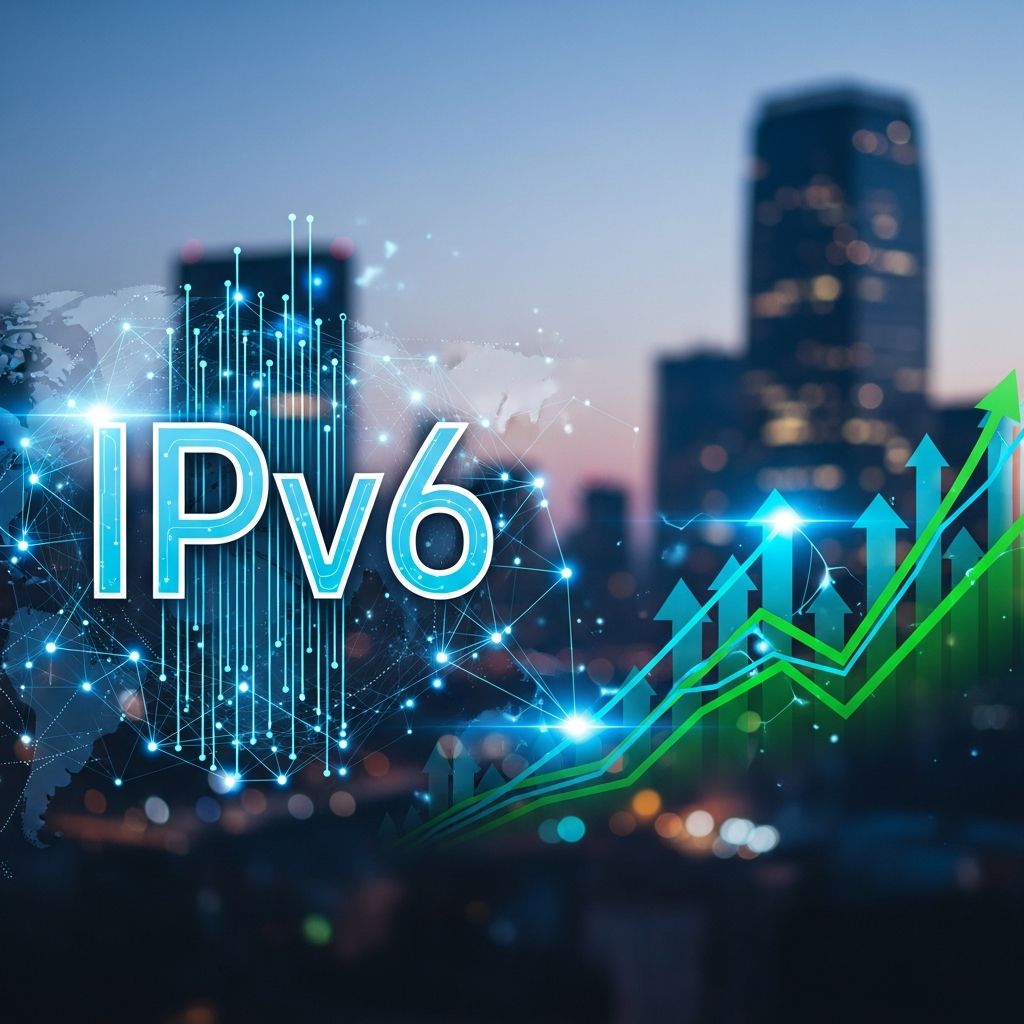
In an era where digital connectivity defines success, businesses cannot afford to cling to outdated infrastructure. The Internet Protocol version 4 (IPv4), with its mere 4.3 billion addresses, is running dry amid explosive growth in devices, cloud services, and IoT ecosystems. Enter IPv6, the next-generation protocol offering 340 undecillion unique addresses. This shift isn’t optional—it’s a strategic imperative for ensuring uninterrupted operations, bolstering defenses, and unlocking new opportunities. This comprehensive guide delves into the compelling reasons why companies should prioritize IPv6 deployment right now.
The Impending IPv4 Crisis and IPv6’s Solution
IPv4 address exhaustion has been a looming threat for years, accelerated by the proliferation of smartphones, smart homes, and enterprise cloud expansions. Regional Internet Registries have depleted their free pools, forcing reliance on costly secondary markets. Businesses still dependent on IPv4 face escalating expenses and deployment hurdles, such as Network Address Translation (NAT), which complicates direct connectivity.
IPv6 eliminates these bottlenecks with its 128-bit addressing scheme, providing an inexhaustible supply. No more NAT workarounds mean simpler network designs, reduced latency, and true end-to-end communication. For enterprises, this translates to scalable growth without the fear of running out of addresses during peak expansions or mergers.
- IPv4 usable addresses: ~3.7 billion
- IPv6 addresses: 3.4 × 1038 (practically unlimited)
- Global IPv6 adoption rate: Over 40% as of 2026 (per official metrics)
Fortifying Security in a Threat-Laden Landscape
Cyber threats evolve daily, and legacy IPv4 networks expose vulnerabilities through NAT dependencies and fragmented security models. IPv6 fundamentally enhances protection by mandating IPsec support—an integrated suite for authentication, encryption, and integrity. Unlike IPv4’s optional IPsec, IPv6 embeds these capabilities natively, though configuration is required.
The vast address space thwarts reconnaissance attacks; hackers can’t easily scan or identify hosts amid trillions of possibilities. End-to-end encryption becomes seamless, shielding data flows from interception. Businesses gain from streamlined packet processing, reducing attack surfaces and enabling efficient deployment of firewalls and intrusion detection systems optimized for IPv6.
| Feature | IPv4 | IPv6 |
|---|---|---|
| IPsec | Optional | Mandatory (configurable) |
| Address Scanning | Easy (small space) | Extremely difficult |
| Encryption | Add-on layers | Built-in end-to-end |
Powering the IoT Revolution with Seamless Connectivity
The Internet of Things (IoT) is reshaping industries, from manufacturing sensors to smart retail. Billions of devices demand unique IPs, far beyond IPv4’s capacity. IPv6’s auto-configuration (Stateless Address Autoconfiguration, SLAAC) allows devices to self-assign addresses effortlessly, minimizing management overhead.
Imagine factories with thousands of sensors communicating directly, or fleets of vehicles tracking in real-time without NAT-induced delays. IPv6 supports mobile IP natively, ensuring uninterrupted roaming across networks. This fosters innovation in machine-to-machine (M2M) communications, predictive maintenance, and data analytics at scale.
Boosting Network Performance and Efficiency
IPv6 streamlines headers—40 bytes fixed plus optional extensions—enabling faster routing and reduced overhead compared to IPv4’s variable 20-60 bytes. Routers process packets more efficiently, slashing latency for VoIP, video streaming, and real-time apps. Studies show IPv6-only connections often outperform IPv4, especially on mobile networks.
Eliminating NAT restores the Internet’s original end-to-end principle, improving application performance and simplifying troubleshooting. For cloud-heavy businesses, IPv6 enables direct peering with providers like Google Cloud and AWS, who offer native dual-stack support. Bandwidth costs drop as extensibility allows optimized traffic flows without wasteful translations.
Driving Innovation and Competitive Edge
Stagnation is the enemy of progress. IPv4’s limitations stifle new apps like immersive VR, peer-to-peer collaboration, and edge computing. IPv6 unleashes potential with features like multicast efficiency for video conferencing and simplified Quality of Service (QoS) for multimedia.
Early adopters gain market advantages: faster global reach to IPv6-enabled users (over 50% in some regions), compliance with emerging standards, and appeal to tech-savvy partners. As governments and ISPs mandate IPv6 (e.g., U.S. federal networks since 2025), businesses risk isolation without it. Dual-stack transitions ease migration, running IPv4 and IPv6 concurrently.
Cost Savings and Simplified Management
Long-term economics favor IPv6. No NAT means fewer gateways, less hardware, and lower operational costs. Auto-configuration cuts deployment time for new devices by up to 80%. Extensible headers future-proof networks, avoiding frequent upgrades.
In mergers, non-overlapping IPv6 addresses prevent address conflicts, streamlining integrations. Cloud scalability soars without address pooling hacks, aligning with projections of a $500+ billion market by 2026.
Overcoming Migration Challenges: A Practical Roadmap
Transition fears are valid but surmountable. Start with dual-stack: enable IPv6 alongside IPv4 on routers and hosts. Test with tools like Hurricane Electric’s tunnel broker. Prioritize public-facing services, then internal networks.
- Step 1: Audit current infrastructure for IPv6 readiness.
- Step 2: Train IT teams via free resources from standards bodies.
- Step 3: Pilot in non-critical segments.
- Step 4: Monitor with tools like RIPE Atlas.
Vendors like Cisco and Juniper offer plug-and-play IPv6 support. Incentives include tax credits in regions pushing digital transformation.
Real-World Success Stories
Major players like Comcast and China Mobile have dual-stacked billions of users, reporting 20-30% performance uplifts. Enterprises in finance and healthcare cite seamless IoT rollouts post-migration. These cases prove IPv6 delivers ROI within 12-18 months.
FAQs: IPv6 Migration Essentials
What is the current state of IPv4 exhaustion?
IPv4 pools are fully depleted in most registries; secondary markets charge $50+ per address.
Does IPv6 break existing applications?
No—dual-stack ensures compatibility; most modern software supports it natively.
How long does migration take?
3-12 months for enterprises, depending on size, with minimal downtime.
Is IPv6 more secure than IPv4?
Yes, via built-in IPsec and vast address space reducing attack vectors.
What about costs?
Initial setup is low; long-term savings from efficiency outweigh expenses.
IPv6 isn’t a distant future—it’s the present reality powering tomorrow’s Internet. Businesses delaying adoption risk obsolescence amid IoT booms and 5G/6G rollouts. Act now to secure scalability, resilience, and innovation.
References
- IPv6 Address Space — Internet Assigned Numbers Authority (IANA). 2024-01-15. https://www.iana.org/assignments/ipv6-parameters/ipv6-parameters.xhtml
- IPv6 Security Considerations — Internet Engineering Task Force (IETF). 2023-06-20. https://datatracker.ietf.org/doc/html/rfc4940
- World IPv6 Launch Statistics — Internet Society. 2025-03-10. https://www.internetsociety.org/deploy360/ipv6/statistics/
- IPv6 for IoT Devices — National Institute of Standards and Technology (NIST). 2024-11-05. https://nvlpubs.nist.gov/nistpubs/SpecialPublications/NIST.SP.800-213.pdf
- Cloud Computing Market Forecast — Gartner. 2023-10-18. https://www.gartner.com/en/information-technology/insights/cloud-strategy
Similar Articles







Read full bio of medha deb