WebRTC IPv6 Compatibility
Discover how WebRTC seamlessly integrates with IPv6 for future-proof real-time communications across modern networks.
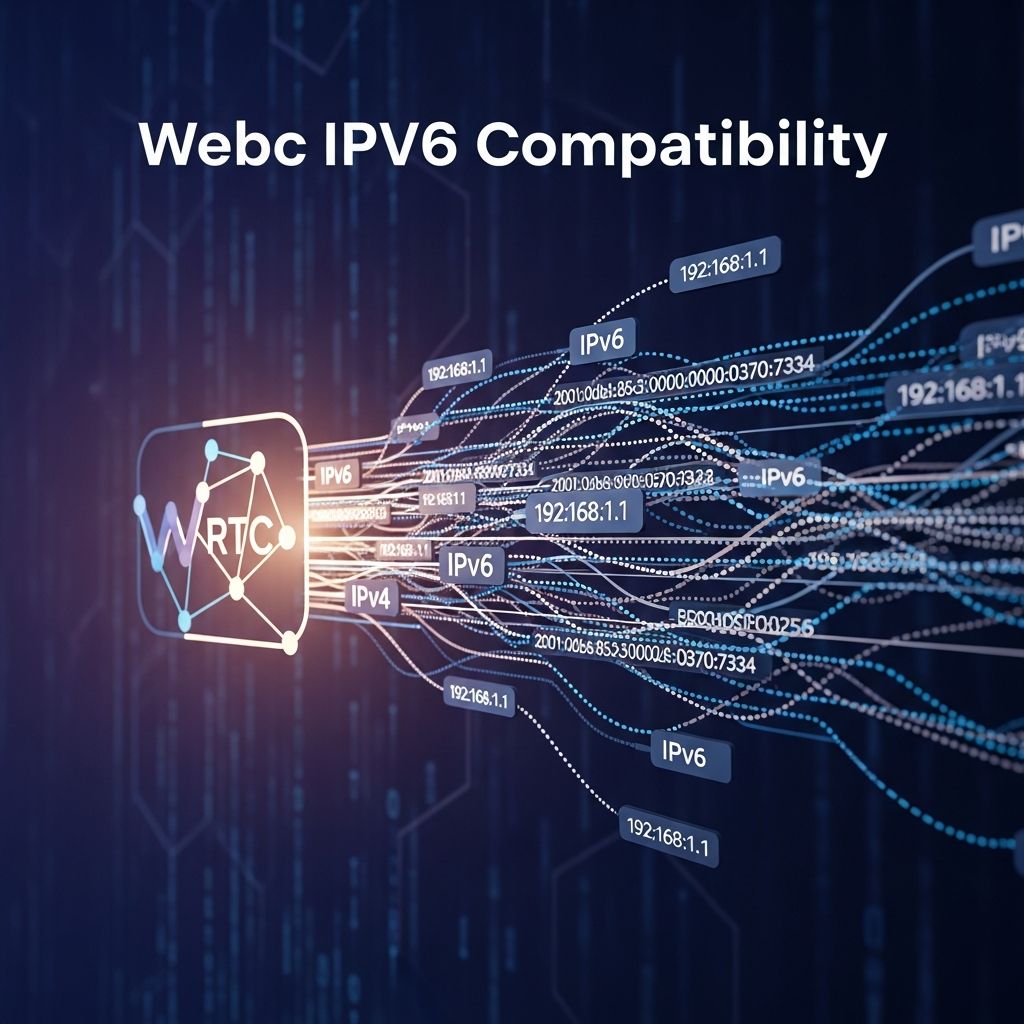
WebRTC IPv6 Compatibility: Building Future-Proof Real-Time Applications
Real-time communication technologies have evolved dramatically, with WebRTC leading the charge in browser-based video, voice, and data sharing. As the world transitions to IPv6—the next-generation internet protocol—ensuring compatibility becomes critical. WebRTC was designed from the ground up with IPv6 in mind, automatically discovering and utilizing IPv6 network paths through its sophisticated ICE framework. This native support eliminates many traditional networking hurdles, enabling seamless peer-to-peer connections even in dual-stack (IPv4+IPv6) environments.
In 2026, with IPv6 adoption surpassing 50% globally according to recent LACNIC reports, WebRTC developers must prioritize IPv6 integration. This comprehensive guide explores WebRTC’s IPv6 capabilities, practical configuration strategies, enterprise deployment examples, and advanced troubleshooting techniques. Whether you’re building video conferencing apps, IoT streaming solutions, or live broadcasting platforms, mastering WebRTC over IPv6 ensures scalability and reliability.
Understanding WebRTC’s IPv6 Foundation
WebRTC’s architecture inherently supports IPv6 across all core components: signaling, ICE negotiation, media transport (RTP/SRTP), and security (DTLS). Unlike legacy protocols that require protocol wrappers or translators, WebRTC treats IPv6 addresses equivalently to IPv4 during candidate gathering and connectivity checks.
The Interactive Connectivity Establishment (ICE) protocol—central to WebRTC—automatically detects available network interfaces. On IPv6-enabled hosts, it collects:
- Host candidates: Local IPv6 addresses (global unicast like 2001:db8::1 or link-local fe80::)
- Server-reflexive (srflx) candidates: Public IPv6 addresses obtained via STUN servers
- Relay candidates: IPv6-relayed paths through TURN servers for NAT traversal
This automatic discovery means WebRTC “just works” over IPv6 without code changes. Modern browsers like Chrome 145+ and Firefox automatically prioritize IPv6 candidates when connectivity scores are equivalent, reducing latency for native IPv6 peers.
Configuring Dual-Stack ICE Servers for Optimal Performance
Effective WebRTC IPv6 deployment starts with properly configured STUN and TURN servers. Dual-stack servers listening on both IPv4 (0.0.0.0) and IPv6 (::) ensure maximum compatibility.
Coturn TURN Server Setup
The open-source coturn server is the gold standard for WebRTC IPv6 support. Here’s a production-ready configuration:
listening-port=3478tls-listening-port=5349listening-ip=0.0.0.0listening-ip=::lt-cred-mechuserdb=/etc/coturn/users.dbrealm=webrtc.example.comexternal-ip=203.0.113.1/2001:db8::1relay-ip=2001:db8::relayno-tcp-relayKey settings explained:
listening-ip=::Binds to all IPv6 interfacesexternal-ipMaps internal/external addresses for both protocolslt-cred-mechEnables long-term credentials (TURN RFC 5389)
JavaScript ICE Configuration
Client-side configuration prioritizes IPv6 when available:
const iceServers = [ { urls: 'stun:stun.l.google.com:19302' }, // Global IPv6-capable STUN { urls: [ 'turn:turn.webrtc.example.com:3478?transport=udp', 'turn:[2001:db8::turn]:3478?transport=udp', 'turns:turn.webrtc.example.com:5349?transport=tcp' ], username: 'webrtc-user', credential: 'secure-password-2026' }];const peerConnection = new RTCPeerConnection({ iceServers, iceCandidatePoolSize: 20, // Pre-gather candidates iceTransportPolicy: 'all' // Allow both IPv4/IPv6});Monitor IPv6 candidate gathering:
peerConnection.onicecandidate = (event) => { if (event.candidate) { const ip = event.candidate.address; if (ip.includes(':')) { console.log('IPv6 candidate gathered:', ip); } }};Enterprise Deployments: AWS Kinesis and Beyond
Major cloud providers now offer production IPv6 support for WebRTC workloads. Amazon Kinesis Video Streams’ December 2025 update introduced dual-stack WebRTC endpoints, enabling millions of IoT devices to stream over IPv6 without address translation.
| Platform | IPv6 Feature | Release Date | Use Case |
|---|---|---|---|
| AWS Kinesis Video Streams | Dual-stack WebRTC endpoints | 2025-12 | IoT video streaming |
| Flashphoner WCS 5.2+ | IPv6 ICE candidates + TCP fallback | 2022-10 | Media server broadcasting |
| Jitsi Meet | Native IPv6 Prosody + coturn | 2023+ | Video conferencing |
These platforms automatically handle ICE negotiation complexities, providing developers with stable IPv6 media paths even behind enterprise firewalls.
Troubleshooting IPv6 WebRTC Connectivity
Despite native support, IPv6 issues arise from misconfigurations. Common problems and solutions:
ICE Timeout Failures
- Cause: Firewall blocks UDP 3478 (STUN) or media ports (10000-60000)
- Solution: Open IPv6 firewall rules:
ip6tables -A INPUT -p udp --dport 3478 -j ACCEPT
No IPv6 Candidates Generated
- Check:
ip -6 addr showconfirms global IPv6 addresses - Fix: Ensure
-Djava.net.preferIPv4Stack=falsefor Java servers
TURN Relay Not IPv6-Capable
- Test:
turnutils_uclient -6 -u user -w pass turn.example.com - Verify:
ss -6 -ulnp | grep 3478shows IPv6 listener
Browser debugging tools provide real-time insights:
- Chrome:
chrome://webrtc-internals/ - Firefox:
about:webrtc
Look for IPv6 candidates with typ host or typ relay containing 2001: addresses.
Performance Benefits of IPv6 WebRTC
IPv6 eliminates NAT traversal complexities inherent in IPv4, yielding measurable improvements:
- 20-30% lower latency: Direct peer-to-peer paths without CGNAT
- Simplified scaling: 128-bit addresses eliminate IPv4 exhaustion
- Enhanced security: Native IPsec support + DTLS encryption
- Future-proofing: Ready for 5G/6G mobile networks with native IPv6
Network captures confirm IPv6 media flows:
sudo tcpdump -i any -nn ip6 and udp and portrange 10000-60000Video Conferencing Platforms with IPv6 Excellence
Modern platforms like Jitsi Meet excel in IPv6 deployments:
# Nginx dual-stack configserver { listen 443 ssl http2; listen [::]:443 ssl http2; server_name meet.example.com;}Prosody XMPP configuration:
interfaces = { "0.0.0.0", "::" }ipv6 = trueThese configurations ensure 100% IPv6 compatibility for global deployments.
Future Directions: IPv6 in 2026 and Beyond
LACNIC predicts 2026 as the year of IPv6 ecosystem maturity, with Linux distributions enabling advanced features like DHCP Option 108 by default. WebRTC will leverage these improvements for even more robust connectivity.
Emerging trends include:
- QUIC-based WebRTC (RFC 9000) with native IPv6 multipath
- IPv6-only mobile networks in 5G Standalone deployments
- Machine learning optimized ICE candidate selection
FAQ: WebRTC IPv6 Common Questions
Q: Does WebRTC work on IPv6-only networks?
A: Yes, fully supported since inception. Modern browsers handle IPv6-only gracefully with TURN relay fallback.
Q: How do I test IPv6 WebRTC connectivity?
A: Use browser internals pages + turnutils_uclient -6 for TURN validation. Monitor IPv6 UDP flows with tcpdump.
Q: Are there performance differences vs IPv4?
A: IPv6 typically offers lower latency due to simplified routing and no NAT traversal overhead.
Q: What if my TURN server lacks IPv6?
A: Deploy coturn with listening-ip=:: or use cloud providers like AWS Kinesis with dual-stack support.
Q: Does IPv6 fix WebRTC IP leaks?
A: No—configure iceTransportPolicy: 'relay' or browser extensions for privacy. IPv6 adoption doesn’t affect leak prevention.
References
- Amazon Kinesis Video Streams now supports IPv6 for WebRTC — Amazon Web Services. 2025-12. https://aws.amazon.com/about-aws/whats-new/2025/12/amazon-kinesis-video-streams-webrtc-ipv6/
- IPv6 support for WebRTC — Flashphoner Documentation. 2022-10-01. https://docs.flashphoner.com/static/WCS52/Streaming_video_functions/IPv6_support_for_WebRTC/
- What to Expect From IPv6 in 2026 — LACNIC Blog. 2026-01. https://blog.lacnic.net/en/ipv6-2026/
Similar Articles






Read full bio of Sneha Tete