Verizon Wireless Hits 25% IPv6 Traffic Milestone
Explore how Verizon Wireless pioneered IPv6 adoption in mobile networks, reaching over 25% traffic and paving the way for modern internet evolution.
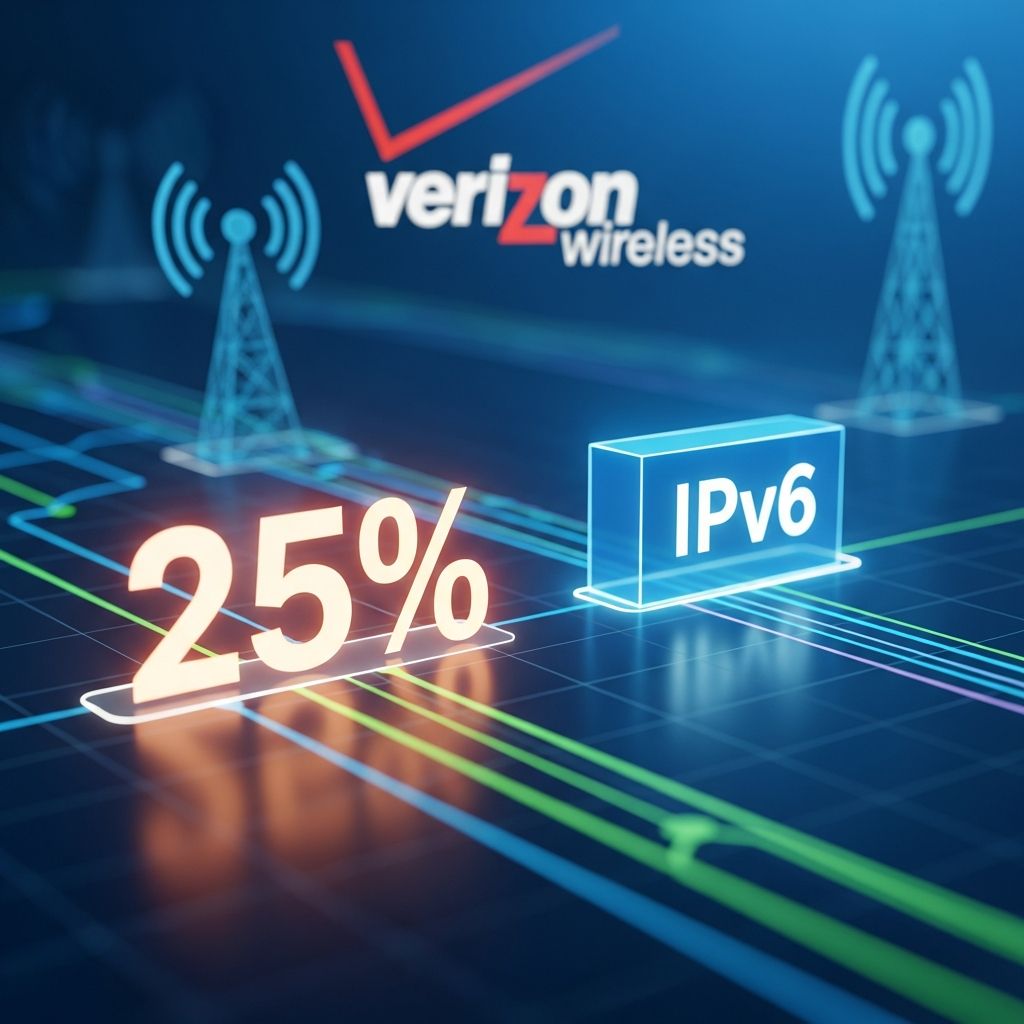
In the early 2010s, the telecommunications industry stood at a crossroads with the impending exhaustion of IPv4 addresses. Verizon Wireless emerged as a trailblazer, announcing that more than a quarter of its wireless traffic—precisely 26.25%—had transitioned to IPv6. This achievement, highlighted in industry measurements, marked a significant step toward the inevitable shift to the next-generation Internet Protocol. Tied intrinsically to their LTE network deployment, this milestone underscored the practical benefits of embracing IPv6 in mobile environments.
The Imperative for IPv6 in Mobile Networks
IPv4, with its 32-bit address space, provided roughly 4.3 billion unique addresses—a number insufficient for the exploding number of connected devices. IPv6, offering 128-bit addresses, resolves this scarcity while introducing enhancements like simplified packet headers, better multicast support, and built-in security features. For mobile operators like Verizon, the pressure was acute: smartphones, tablets, and IoT devices demanded seamless connectivity without NAT workarounds that complicated networks.
Verizon’s proactive stance was documented in technical presentations, such as their APNIC 34 talk in 2012, where they detailed integrating IPv6 into LTE architecture from the outset. This ‘IPv6-native’ approach meant new LTE devices and base stations supported the protocol natively, fostering organic growth in adoption rates.
Breaking Down the 2013 Achievement
The World IPv6 Launch initiative, a collaborative effort by ISPs and content providers, tracked voluntary participants’ IPv6 traffic shares. Verizon Wireless led mobile operators, surging from around 7-10% in mid-2012 to over 26% by early 2013. This rapid ascent—50% growth in months—was fueled by:
- Increasing LTE subscriber penetration, as IPv6 was mandatory in their 4G rollout.
- Partnerships with content giants like Google and Akamai, whose IPv6-enabled services drew traffic over the new protocol.
- Network optimizations that minimized dual-stack overhead, encouraging IPv6 preference.
Independent stats corroborated this: Akamai noted 38% of global IPv6 traffic originated from Verizon, dwarfing competitors. Google measurements showed 16.6% of Verizon queries over IPv6 by August 2012, climbing steadily.
Technical Foundations: Dual-Stack and LTE Synergy
Verizon employed a dual-stack model, running IPv4 and IPv6 concurrently. Devices received both address types, with DNS resolution dictating protocol use. In LTE, this was seamless: the Packet Data Network (PDN) Gateway assigned IPv6 prefixes dynamically, enabling end-to-end connectivity without translation layers that plagued IPv4-only networks.
| Period | IPv6 Traffic Share | Source |
|---|---|---|
| June 2012 | 7.36% | World IPv6 Launch |
| August 2012 | 10.64% | World IPv6 Launch |
| Early 2013 | 26.25% | World IPv6 Launch |
| 2018 | ~84% | Internet Society |
| 2022 | 82-90% | Industry Reports |
This table illustrates the exponential trajectory, from nascent deployment to dominance.
Overcoming Deployment Challenges
Transitioning wasn’t without hurdles. Verizon managed over 70 internal IPv4 private address overlaps, causing routing complexities and costs. IPv6’s global addressing eliminated these, simplifying operations. Device compatibility was another: early Android and iOS updates enabled IPv6, but legacy gear required dual-stack fallbacks.
Content availability was key. By 2013, major sites like Google (IPv6 since 2012) and Facebook pulled traffic natively. Verizon’s advocacy accelerated ecosystem readiness, proving mobile networks could lead the charge.
Global Context and Competitor Landscape
Verizon’s milestone inspired others. In the US, T-Mobile and Sprint followed, achieving 90%+ IPv6 by 2020s via IPv6-only cores. Globally, Reliance Jio in India hit 87-90%, while Japan’s KDDI and Softbank exceeded 30-40%. By 2018, 49 countries surpassed 5% IPv6 traffic, 24 over 15%, per Google stats.1
Mobile led due to greenfield LTE/5G deployments, unburdened by IPv4 legacy. Fixed broadband lagged, with Comcast and AT&T at 70% by 2022.4
Long-Term Impacts on Network Efficiency
IPv6 slashed operational expenses for Verizon. No more NAT traversal issues for peer-to-peer apps, VoIP, or gaming. Simplified routing reduced latency, vital for real-time services. Security improved with IPsec mandates and stateless autoconfiguration, easing device onboarding.
By 2026, Verizon’s Fios and wireless networks fully embrace dual-stack, with IPv6 preferred.5 This positions them for 5G standalone, where IPv6 is foundational.
Current State: IPv6 Dominance in 2026
Today, Verizon Wireless reports 80-90% IPv6 traffic to key providers, outpacing many fixed networks.3 T-Mobile’s IPv6-only model exemplifies the endgame, turning off IPv4 internally. This shift enables massive IoT scaling—billions of 5G devices—and edge computing without address exhaustion fears.
Future Prospects: 5G and Beyond
5G amplifies IPv6’s role. Network slicing, URLLC, and mMTC demand vast addresses; IPv6 delivers. Verizon’s early bet yields competitive edges in low-latency services. Globally, full IPv6 parity looms by 2030, driven by mobile.
FAQ
- What is IPv6 and why does it matter for Verizon Wireless?
- IPv6 is the successor to IPv4, providing vastly more addresses. For Verizon, it simplified LTE networks and supports massive device growth.
- How did Verizon achieve 25% IPv6 traffic in 2013?
- Through native IPv6 in LTE rollout, device updates, and content provider support, hitting 26.25% per World IPv6 Launch metrics.
- Is IPv6 fully deployed on Verizon today?
- Nearly: Over 80% wireless traffic uses IPv6, with dual-stack ensuring compatibility.
- What are the benefits of IPv6 for users?
- Faster connections, better security, and future-proofing for IoT and 5G.
- Will IPv4 be phased out?
- Gradually in mobile; operators like T-Mobile are going IPv6-only internally.
References
- State of IPv6 Deployment 2018 — Internet Society. 2018-07-05. https://www.internetsociety.org/resources/2018/state-of-ipv6-deployment-2018/
- IPv6 at Verizon Wireless – APNIC 34 Presentation — Verizon Wireless / APNIC. 2012-08-01. https://www.apnic.net/wp-content/uploads/2017/01/vzw_apnic_13462152832-2.pdf
- World IPv6 Launch Measurements — Internet Society. 2013-04 (archived data). http://www.worldipv6launch.org/measurements/
- What is IPv6 and why aren’t we there yet? — Network World. 2022-03-15. https://www.networkworld.com/article/965192/what-is-ipv6-and-why-aren_t-we-there-yet.html
- Learn About IPv6 — Verizon. 2023-06-10. https://www.verizon.com/support/residential/internet/getting-started/learn-about-ipv6.html
Similar Articles








Read full bio of medha deb