Understanding LoRA in AI
Discover how Low-Rank Adaptation revolutionizes fine-tuning of large AI models with efficiency and minimal resources.
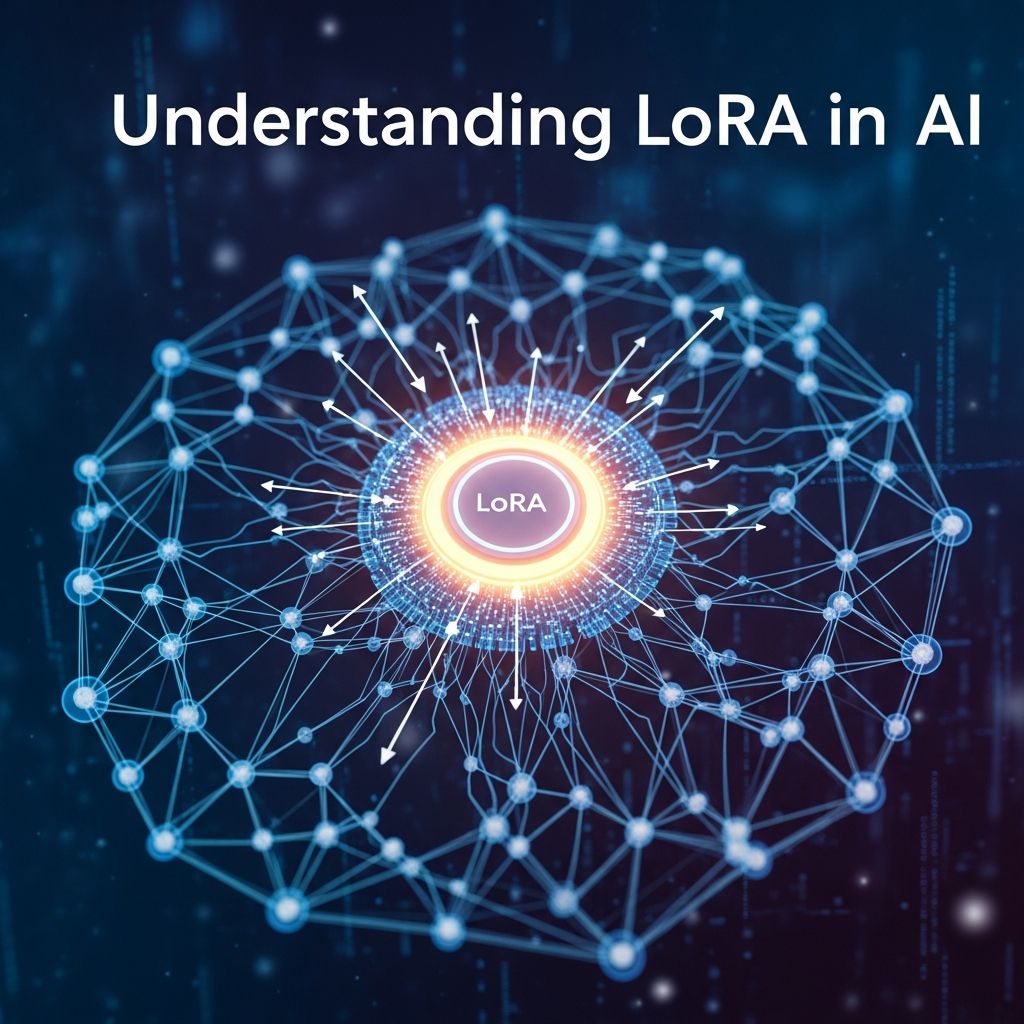
Low-Rank Adaptation, commonly known as LoRA, has emerged as a game-changer in the field of artificial intelligence, particularly for handling the challenges posed by ever-growing models. As AI systems scale to billions of parameters, traditional methods of customization become impractical due to their immense resource demands. LoRA addresses this by introducing a smart, lightweight approach to model adaptation that maintains high performance while drastically cutting down on computational needs. This technique allows developers and researchers to tailor pre-trained models for niche applications without overhauling the entire architecture.
The Evolution of Model Fine-Tuning
Before LoRA, fine-tuning large language models (LLMs) or other deep neural networks involved updating every parameter in the model. This process, while effective, required vast amounts of GPU memory, processing power, and time—often making it accessible only to well-resourced organizations. For instance, adapting a model like GPT-3, with its 175 billion parameters, could demand terabytes of memory and weeks of training.
LoRA flips this paradigm by hypothesizing that the changes needed for task-specific adaptation occupy a much smaller subspace within the full parameter space. This insight draws from linear algebra principles, where high-dimensional matrices can often be approximated by products of lower-dimensional ones. Introduced by Microsoft researchers in 2021, LoRA has since proliferated across applications, from natural language processing to computer vision.
Core Mechanics of LoRA
At its heart, LoRA operates on Transformer layers, the building blocks of most modern LLMs. During adaptation, the original weight matrices—typically denoted as W—are frozen. Instead of modifying W directly, LoRA injects two smaller matrices, A and B, such that the forward pass computes h = (W + ΔW)x, where ΔW = BA. Here, B is initialized as zero to ensure initial outputs match the pre-trained model, and A is randomly initialized.
- Rank Selection (r): The ‘low-rank’ aspect comes from choosing a small rank r (e.g., 8 or 16), making A (d x r) and B (r x k) far smaller than W (d x k).
- Trainable Parameters: Only A and B are updated via gradient descent, reducing trainable parameters by orders of magnitude.
- Integration: Post-training, ΔW can be merged into W for inference, or kept separate for modularity.
This decomposition leverages the observation that fine-tuning updates have low intrinsic rank, meaning most of the ‘important’ changes can be captured with minimal parameters. For a typical Transformer attention layer, this can shrink trainable parameters from millions to thousands per layer.
Mathematical Foundation Explained
Consider a weight matrix W ∈ ℝ^{d×k}. A full fine-tuning update ΔW would also be ∈ ℝ^{d×k}, with up to d*k parameters. LoRA approximates ΔW ≈ B A, where B ∈ ℝ^{d×r} and A ∈ ℝ^{r×k}, with r ≪ min(d, k). The number of parameters drops to r*(d + k), a tiny fraction for small r.
Empirical validation from the original research shows that for models like RoBERTa, LoRA matches full fine-tuning accuracy on GLUE benchmarks while using 10,000x fewer parameters. This efficiency stems from the low-rank structure of natural language updates, a property validated across domains.
| Aspect | Full Fine-Tuning | LoRA (r=8) |
|---|---|---|
| Trainable Params (GPT-3 example) | 175 Billion | ~18 Million |
| GPU Memory | ~700 GB | ~200 GB |
| Training Time | Weeks | Hours |
Advantages Driving Adoption
LoRA’s appeal lies in its multifaceted benefits. First, resource efficiency democratizes AI development; individuals with consumer GPUs can now fine-tune models previously reserved for data centers. Second, it enables modular adaptation—multiple LoRA adapters can be swapped or combined for different tasks without retraining the base model. Third, preserved performance ensures no quality loss; studies show parity or superiority in many cases.
Moreover, LoRA adapters are compact files (often MBs), facilitating easy sharing via platforms like Hugging Face. This has fueled ecosystems around ‘LoRA marketplaces’ for specialized styles in image generation or dialects in text.
Beyond Language Models: Diverse Applications
Though born for LLMs, LoRA’s versatility extends to diffusion models like Stable Diffusion. In text-to-image generation, LoRA fine-tunes on user datasets to produce consistent characters, art styles, or objects. For example, training a LoRA on 10-20 images of a specific face yields photorealistic generations without overfitting.
In vision transformers and even audio models, LoRA adapts backbones for tasks like object detection or speech recognition. Its plug-and-play nature suits continual learning, where models accumulate adapters over time without catastrophic forgetting.
Practical Steps to Implement LoRA
Getting started is straightforward with libraries like PEFT from Hugging Face. Here’s a high-level workflow:
- Load Pre-trained Model: Use a base like Llama-2 or Stable Diffusion.
- Configure LoRA: Set target modules (e.g., q_proj, v_proj), rank r=16, alpha=32.
- Prepare Dataset: Curate task-specific data, e.g., instruction-response pairs.
- Train Adapter: Run for epochs on modest hardware; monitor loss.
- Infer and Merge: Apply adapter or merge weights for deployment.
Code snippets in Python with transformers library make this accessible, often completing in under an hour for 7B-parameter models.
Challenges and Future Directions
Despite strengths, LoRA isn’t flawless. Optimal rank r requires tuning, and very low r may underfit complex tasks. Multi-adapter fusion can introduce interference, needing advanced merging techniques like rank-stabilized optimization.
Looking ahead, extensions like QLoRA (quantized LoRA) combine 4-bit quantization for even lower memory, enabling fine-tuning on single GPUs. Research into infinite adapters and lifelong learning promises sustained model evolution.
Real-World Impact and Case Studies
Organizations leverage LoRA for rapid prototyping. A healthcare firm might adapt a medical LLM on proprietary records; an e-commerce platform customizes recommendation models per category. In creative industries, LoRA powers personalized avatars in games or films.
Quantitative wins include 3x speedups in deployment pipelines and 99% parameter reduction, per IBM benchmarks.
Frequently Asked Questions
What exactly does LoRA stand for?
LoRA stands for Low-Rank Adaptation, a method to fine-tune AI models efficiently.
Can LoRA be used with any model?
Primarily for Transformers, but adaptable to convolutional and diffusion architectures.
How small can LoRA adapters be?
Typically 1-100 MB, versus gigabytes for full checkpoints.
Does LoRA degrade model quality?
No, it often matches or exceeds full fine-tuning on standard benchmarks.
Is LoRA open-source?
Yes, implementations are freely available on Hugging Face and GitHub.
References
- LoRA: Low-Rank Adaptation of Large Language Models — Hu, E. J. et al., Microsoft Research. 2021-09-22. https://arxiv.org/abs/2106.09685
- IBM Think: What is LoRA (Low-Rank Adaptation)? — IBM. 2024-05-01. https://www.ibm.com/think/topics/lora
- LoRA Documentation — Hugging Face Diffusers. 2025-03-15. https://huggingface.co/docs/diffusers/training/lora
- PEFT: Parameter-Efficient Fine-Tuning — Hugging Face. 2024-11-10. https://huggingface.co/docs/peft/en/conceptual_guides/lora
- LoRA for Stable Diffusion — Hugging Face Blog. 2023-08-20. https://huggingface.co/blog/lora
Similar Articles








Read full bio of medha deb