Transceiver Essentials
Discover how transceivers power modern networks by enabling seamless signal transmission and reception across diverse technologies.
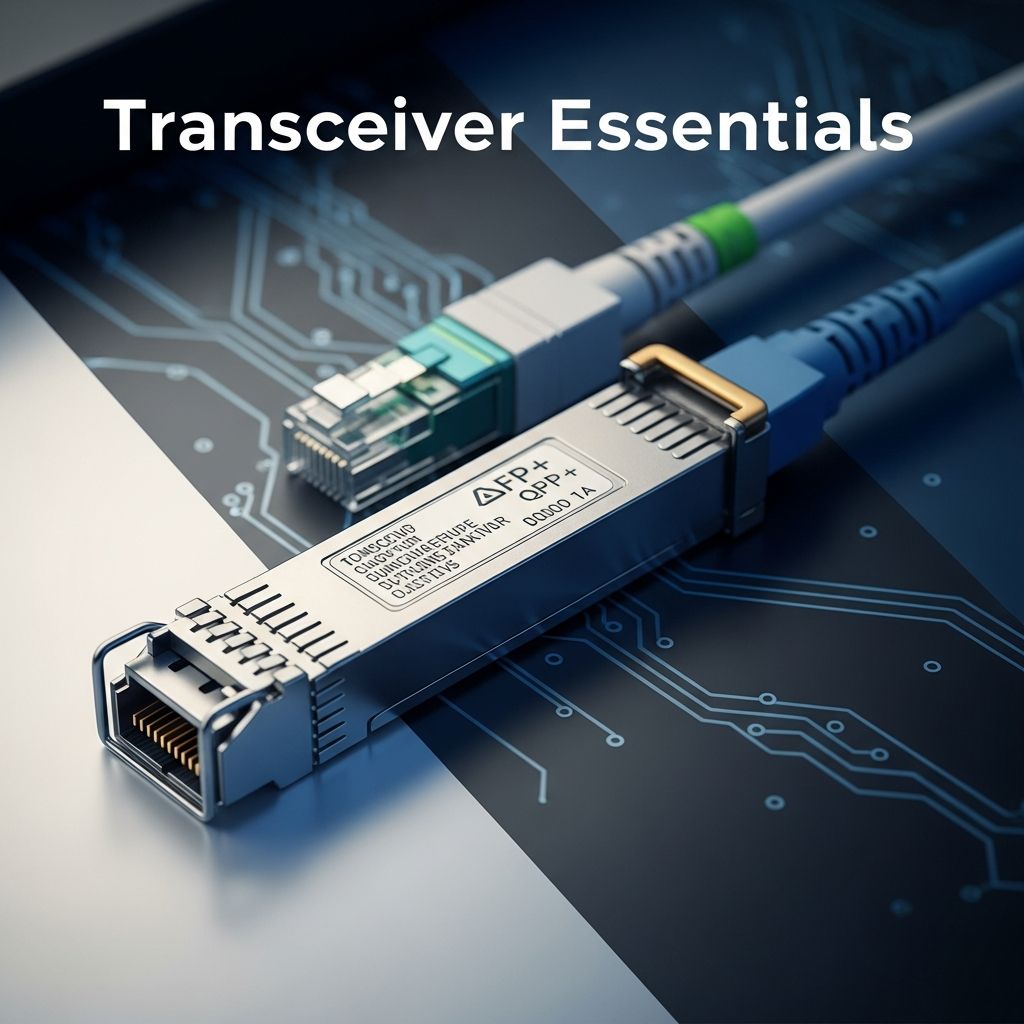
Transceiver Essentials: Powering the Backbone of Digital Connectivity
In the intricate world of modern communication systems, transceivers stand as foundational components that bridge the gap between electrical and optical domains. These compact devices integrate the capabilities of both sending and receiving signals, making them indispensable for everything from local area networks to global telecommunications infrastructures. By converting data into transmittable forms and decoding incoming streams, transceivers ensure reliable, high-speed information flow across vast distances.
Defining the Core Role of Transceivers in Communication
A transceiver, at its essence, is a multifunctional hardware unit that handles bidirectional data transfer. Unlike standalone transmitters that only broadcast or receivers that solely capture, transceivers perform both tasks within a single module. This duality is crucial in environments where real-time interaction is paramount, such as internet routing, wireless hotspots, and data center interconnects.
Historically, the concept evolved from early radio technologies where separate units were cumbersome. Today, miniaturization and advanced semiconductors have made transceivers ubiquitous, fitting into pluggable form factors like SFP or QSFP. Their ability to adapt to various media—copper wires, fiber optics, or radio waves—positions them as versatile enablers of network scalability.
Fundamental Mechanisms: How Transceivers Operate
The operation of a transceiver begins with signal modulation. Incoming electrical data from a host device, such as a switch or router, is encoded onto a carrier wave. For optical variants, a laser diode generates light pulses modulated by the data pattern. These pulses propagate through fiber cables at near-light speeds, minimizing latency.
Upon reaching the destination, a photodiode detects the light variations, converting them back to electrical impulses. Error correction and amplification stages ensure integrity. In wireless setups, antennas replace fibers, with RF modulation handling the air interface. Full-duplex modes allow simultaneous send-receive, doubling throughput compared to half-duplex alternatives.
- Modulation Techniques: Amplitude, frequency, or phase shifts encode bits efficiently.
- Signal Amplification: Boosts weak incoming signals to usable levels.
- Clock Recovery: Synchronizes data timing to prevent bit errors.
Diverse Categories of Transceivers for Specialized Needs
Transceivers are categorized by transmission medium and protocol support, each optimized for specific scenarios.
Fiber Optic Transceivers: Champions of High-Bandwidth Links
Fiber optic transceivers dominate long-haul and data center applications due to their immunity to electromagnetic interference and capacity for terabit speeds. Devices like 100GBASE-SR4 use multimode fiber for short reaches up to 100 meters, while single-mode variants like 400GBASE-DR4 extend to 10 kilometers or more.
These modules feature digital diagnostics monitoring (DDM) for real-time performance tracking, including temperature, voltage, and optical power. Standards from the IEEE 802.3 series dictate interoperability, ensuring vendor-agnostic deployments.
Ethernet Transceivers: The Heart of LAN Connectivity
In local networks, Ethernet transceivers, often called media access units, interface twisted-pair cables with network interfaces. Supporting speeds from 10/100 Mbps to 10 Gbps and beyond, they employ encoding schemes like 4B/5B or PAM4 to maximize bandwidth over Cat5e to Cat8 cabling.
Power over Ethernet (PoE) variants deliver up to 90W alongside data, powering IP cameras and VoIP phones without extra wiring.
Wireless and RF Transceivers: Bridging Air Gaps
RF transceivers excel in untethered environments, converting baseband signals to radio frequencies for Wi-Fi, Bluetooth, or cellular use. In 5G base stations, they manage massive MIMO arrays, supporting hundreds of simultaneous users with beamforming for precision targeting.
These devices navigate spectrum regulations, using techniques like OFDM to pack more data into licensed bands.
Form Factors and Compatibility Standards
Physical design influences deployment flexibility. Common form factors include:
| Form Factor | Data Rate | Typical Reach | Use Case |
|---|---|---|---|
| SFP/SFP+ | Up to 10G | 550m MMF / 40km SMF | Enterprise switches |
| QSFP28 | 100G+ | 100m MMF / 10km SMF | Data centers |
| OSFP | 400G/800G | 2km SMF | Hyperscale clouds |
| CFP2 | 400G | 10km SMF | Metro networks |
MSA (Multi-Source Agreements) ensure plug-and-play compatibility across vendors, with hot-swappability minimizing downtime.
Critical Applications Across Industries
Transceivers underpin diverse sectors:
- Data Centers: Interconnect servers at 800G speeds for AI workloads.
- Telecom: Form DWDM systems for 80+ Tbps trunk lines.
- Enterprise: Enable 10G/40G campus backbones.
- 5G/Edge: Support fronthaul with low-latency eCPRI.
In automotive Ethernet for ADAS, single-pair variants reduce cabling weight in EVs.
Performance Metrics and Selection Criteria
Choosing transceivers involves evaluating:
- Bit Error Rate (BER): Target <10^-12 for reliability.
- Optical Budget: Power margin for link loss.
- Latency: Sub-microsecond for real-time apps.
- Power Consumption: Critical for dense deployments.
Tools like OTDR test insertion loss, while Eye diagrams verify signal quality.
Emerging Innovations and Future Directions
Coherent optics push 1.6T boundaries with DSP for dispersion compensation. Silicon photonics integrates lasers on chips, slashing costs. CPO (Co-Packaged Optics) embeds transceivers in ASICs, halving power for exascale computing.
Quantum-safe encryption in transceivers counters future threats, per NIST standards.
Frequently Asked Questions
What distinguishes a transceiver from a modem?
Modems focus on signal conversion for specific media like DSL, while transceivers are broader, handling various protocols bidirectionally.
Are all transceivers hot-swappable?
Most pluggable types like SFP are, but fixed modules may require shutdowns.
How do transceivers support 400G speeds?
Via PAM4 modulation and parallel lanes, e.g., 4x100G in QSFP-DD.
Can transceivers mix fiber types?
No; multimode with multimode, single-mode with single-mode to avoid mismatch losses.
What is DDM in transceivers?
Digital Diagnostic Monitoring provides SNMP-accessible metrics for proactive maintenance.
References
- IEEE 802.3 Ethernet Standards — IEEE Standards Association. 2023-12-06. https://standards.ieee.org/ieee/802.3/7318/
- Multi-Source Agreement for QSFP-DD — QSFP-DD MSA. 2024-01-15. https://www.qsfp-dd.com/
- Fiber Optic Test Procedure Standard — TIA-455-B. 2022-05-10. https://www.tiaonline.org/
- 5G NR Physical Layer Specifications — 3GPP TS 38.211. 2025-03-20. https://www.3gpp.org/ftp/Specs/archive/38_series/38.211/
- Optical Internetworking Forum Guidelines — OIF. 2024-06-12. https://www.oiforum.com/
Similar Articles








Read full bio of medha deb