The Mobile Internet Divide
Unpacking the persistent gaps in global mobile connectivity that leave billions offline despite widespread coverage.
The Mobile Internet Divide: Bridging Gaps in a Connected World
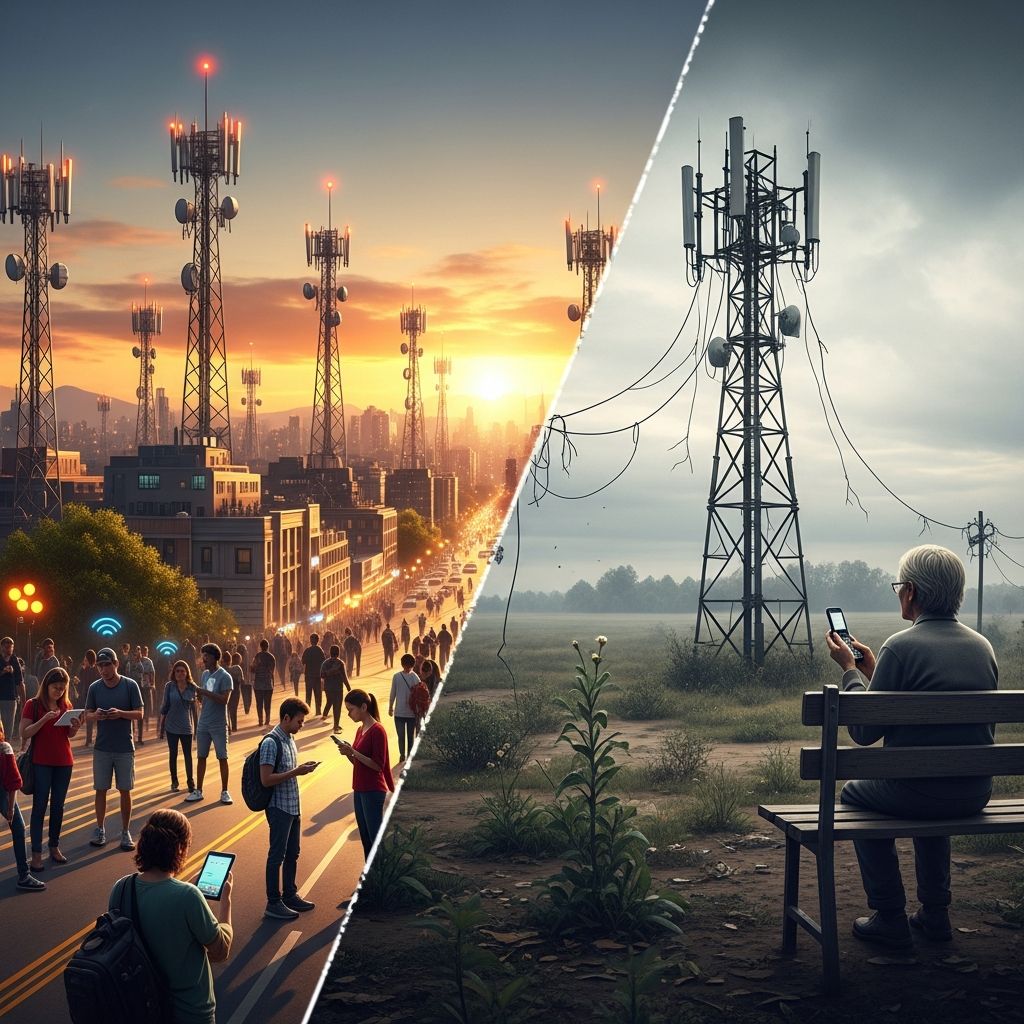
In an era where smartphones are ubiquitous in daily life, the promise of universal mobile internet access remains unfulfilled for billions. Recent data reveals that while 4.7 billion people—58% of the global population—now access the internet via their own mobile devices, a staggering 3.4 billion individuals are still offline. This divide is not merely a technological shortfall but a multifaceted barrier encompassing economics, geography, skills, and infrastructure. As mobile networks expand, the focus shifts from coverage to usage, highlighting why coverage alone fails to connect everyone.
Global Connectivity Landscape: Progress and Persistent Challenges
The expansion of mobile infrastructure has been remarkable. In 2024, 96% of the world’s population lived in areas with mobile internet coverage, up from previous years with an additional 40 million people gaining access, primarily in Sub-Saharan Africa. Yet, this leaves a 4% coverage gap affecting 300 million people, mostly in remote regions. More critically, the usage gap dominates, with 3.1 billion people—38% of the global population—living in covered areas but not using mobile internet services.
Mobile internet now drives 84% of global connections, serving as the primary entry point in low- and middle-income countries (LMICs). However, disparities deepen when examining demographics. In LMICs, 93% of the unconnected reside there, facing compounded challenges like rural isolation and gender inequities.
- Rural-Urban Split: Adults in rural LMICs are 25% less likely to use mobile internet than urban counterparts.
- Gender Disparity: Women in these regions are 14% less likely to go online via mobile compared to men.
- Income Levels: Fixed broadband in low-income countries costs nearly a third of average monthly income, pushing reliance on mobile—yet even that proves unaffordable for many.
These figures, drawn from authoritative reports, underscore that while networks reach far, adoption lags due to non-coverage factors.
Unraveling the Barriers to Mobile Internet Adoption
Beyond physical reach, several entrenched obstacles prevent people from embracing mobile internet. Affordability tops the list, particularly for devices. An entry-level internet-enabled handset equates to 16% of average monthly income in LMICs, ballooning to 48% for the poorest 20%. This device cost stagnation since 2021 exacerbates exclusion.
| Barrier | Impact in LMICs | Example Statistic |
|---|---|---|
| Affordability (Devices) | High cost relative to income | 48% of poorest 20%’s monthly income |
| Digital Skills | Lack of literacy hinders use | Key reason for 38% usage gap |
| Awareness | Unknown benefits or how-to | Primary barrier in rural areas |
| Content Relevance | Limited local language options | Reduces daily engagement |
| Infrastructure Enablers | No reliable electricity | Affects consistent access |
Other hurdles include security fears, irrelevant content, and basic enablers like electricity. Even among the connected 4.7 billion, meaningful use is limited—many stick to basic tasks like social media or news, missing deeper benefits.
Historical Context: From Fixed Lines to Mobile Leapfrogging
The digital divide’s evolution traces back to uneven fixed broadband adoption. From 2000-2010, mobile cellular subscriptions surged globally, outpacing fixed broadband, especially in developing regions. This “leapfrogging” occurred because mobiles demand less infrastructure, finance, and ICT literacy than computers with wired connections. Africa, for instance, saw fixed wireless broadband lag at under 1 per 100 people, while mobile data boomed.
Today, this trend continues with 5G covering 55% of the population in 2025, but unevenly: 84% in high-income countries versus 4% in low-income ones. Mobile broadband subscriptions nearly match cellular ones, yet data usage reveals quality gaps—high-income users generate 16.2 GB monthly versus 2 GB in low-income economies.
Economic Stakes: The Trillion-Dollar Opportunity
Closing the usage gap could add $3.5 trillion to global GDP by 2030. In LMICs, where mobile is often the sole internet avenue, unlocking this potential demands targeted interventions. Enhanced connectivity fosters education, healthcare, commerce, and innovation, amplifying economic multipliers.
Strategies for Overcoming the Divide
Addressing the mobile divide requires multifaceted approaches:
- Affordable Devices and Data: Subsidies, financing, and low-cost models to drop handset prices below 10% of income.
- Digital Literacy Programs: Community training on skills, safety, and relevant apps, tailored for women and rural users.
- Localized Content: Developing apps and services in local languages to boost engagement.
- Infrastructure Boost: Solar-powered stations and satellite tech for coverage gaps.
- Policy Reforms: Governments incentivizing competition to lower costs and expand 5G equitably.
Organizations like GSMA emphasize breaking barriers through public-private partnerships, while ITU advocates for urban-rural parity.
FAQs: Understanding the Mobile Internet Divide
What is the main cause of the mobile internet usage gap?
The usage gap stems from affordability, lack of digital skills, awareness, and enablers like electricity, not just coverage—impacting 3.1 billion people.
How does the divide affect women and rural areas?
Women in LMICs are 14% less likely to use mobile internet; rural adults 25% less, due to compounded socio-economic factors.
Can closing the gap boost economies?
Yes, it could generate $3.5 trillion in GDP by 2030 through increased productivity and access to services.
What role does 5G play?
5G covers 55% globally but only 4% in low-income countries, widening quality disparities in data usage.
Looking Ahead: Toward Universal Meaningful Connectivity
By 2025, global internet users hit 5.5 billion (68%), with ITU noting rising connectivity but enduring divides—83% urban vs. 48% rural usage. Mobile’s dominance offers hope, but true inclusion demands tackling usage barriers head-on. Stakeholders must collaborate to ensure the next billion aren’t just covered, but empowered with safe, enriching online experiences. The mobile internet divide is surmountable, promising a more equitable digital future.
References
- Report: 58% of global population use mobile internet services — Advanced Television (GSMA Intelligence). 2025-09-10. https://www.advanced-television.com/2025/09/10/report-58-of-global-population-use-mobile-internet-services/
- Global Internet use continues to rise but disparities remain — International Telecommunication Union (ITU). 2024-11-27. https://www.itu.int/en/mediacentre/Pages/PR-2024-11-27-facts-and-figures.aspx
- Global number of Internet users increases, but disparities deepen — TechXplore (ITU Facts and Figures 2025). 2025-11. https://techxplore.com/news/2025-11-global-internet-users-disparities-deepen.html
- The digital divide: Trends in global mobile and broadband Internet capacity since 2001 — PMC/NCBI (Peer-reviewed). 2013-10-22. https://pmc.ncbi.nlm.nih.gov/articles/PMC3799113/
- Breaking Barriers – Closing the Digital Divide — GSMA. 2025 (ongoing). https://www.gsma.com/breaking-barriers-closing-the-digital-divide/
Similar Articles








Read full bio of medha deb