SIP and IPv6: Seamless Integration Guide
Explore how Session Initiation Protocol adapts to IPv6 networks for future-proof VoIP communications and telecom evolution.
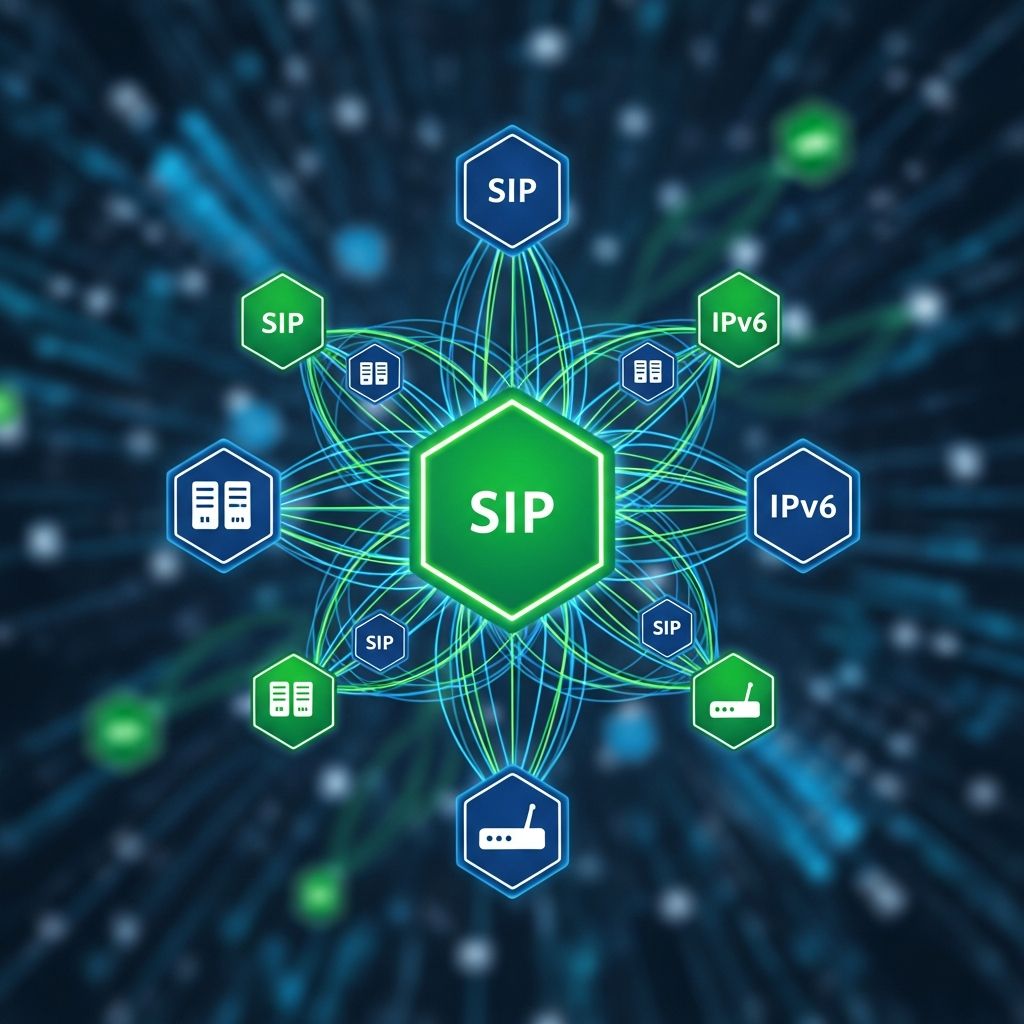
Session Initiation Protocol (SIP) has long been the cornerstone of Voice over IP (VoIP) and multimedia communications. As the world shifts from IPv4 to IPv6 to accommodate the explosion of connected devices, ensuring SIP’s smooth operation over the new protocol stack becomes critical. This article delves into the intricacies of making SIP and IPv6 work together effectively, drawing on standardized practices and practical deployment insights. We’ll explore technical nuances, configuration best practices, and the collaborative efforts shaping this transition.
Understanding the IPv6 Imperative for SIP
IPv6 addresses the IPv4 address exhaustion problem with its 128-bit addressing scheme, enabling direct end-to-end connectivity without the pervasive NAT complications of IPv4. For SIP, which orchestrates call setup, this means rethinking how IP addresses appear in signaling messages and media descriptions. Unlike IPv4’s dotted-decimal format, IPv6 uses hexadecimal notation, necessitating precise handling to avoid parsing errors in SIP elements like proxies, registrars, and user agents.
SIP messages embed IP addresses in headers such as Via, Contact, and Record-Route, as well as in the Session Description Protocol (SDP) bodies for media negotiation. Mismanaging these can lead to failed registrations, dropped calls, or media blackholing. The good news is that standards like RFC 3261 and RFC 5118 provide clear guidelines, ensuring interoperability when implemented correctly.
Mastering Address Representation in SIP
One of the first hurdles is correctly formatting IPv6 addresses within SIP URIs and headers. According to RFC 3261, IPv6 literals must be enclosed in square brackets to distinguish them from port numbers. For instance, a SIP URI becomes sip:user@[2001:db8::1]:5060, and a Via header’s sent-by parameter follows suit: Via: SIP/2.0/UDP [2001:db8::20]:5060.
- URI Syntax: Host portions with IPv6 addresses require brackets for unambiguous parsing.
- Header Fields: Via, Contact, and similar fields mirror this notation to prevent syntactic ambiguities.
- Common Pitfall: Omitting brackets often causes SIP stacks to misinterpret the address, leading to routing failures.
This bracketed convention is mandatory for SIP over IPv6, as outlined in official IETF documentation, promoting consistent behavior across diverse implementations.
Configuring SIP Servers for Dual-Stack Environments
Modern SIP servers like OpenSIPS or Kamailio support dual-stack operation, listening on both IPv4 and IPv6 interfaces. Configuration files specify sockets explicitly:
socket=udp:0.0.0.0:5060 # IPv4socket=udp:[::]:5060 # IPv6socket=tcp:0.0.0.0:5060 # IPv4 TCPsocket=tcp:[::]:5060 # IPv6 TCPRouting logic can detect client address families and respond accordingly. For registrations, servers store location bindings with both address types if applicable. NAT traversal simplifies in pure IPv6 setups since global addresses eliminate the need for port rewriting in many cases.
| Protocol | IPv4 Socket | IPv6 Socket |
|---|---|---|
| UDP | 0.0.0.0:5060 | [::]:5060 |
| TCP | 0.0.0.0:5060 | [::]:5060 |
| TLS | 0.0.0.0:5061 | [::]:5061 |
This table illustrates standard socket bindings, ensuring comprehensive coverage for signaling traffic.
Adapting SDP for IPv6 Media Streams
SDP, carried in SIP bodies, describes media endpoints and must reflect IPv6 realities. Key lines switch from IP4 to IP6, with addresses presented without brackets:
v=0o=- 123456789 123456789 IN IP6 2001:db8::20c=IN IP6 2001:db8::20t=0 0m=audio 10000 RTP/AVP 0 8- Origin (o=) Line: Specifies the session originator’s IPv6 address and network type.
- Connection (c=) Line: Defines the media IP, crucial for RTP packet routing.
- Distinction from Headers: No brackets here, unlike SIP URIs, to align with SDP grammar in RFC 4566.
Offer-answer exchanges must negotiate compatible address families, with SIP proxies potentially rewriting SDP if stack mismatches occur.
Firewall and Security Considerations
IPv6 firewalls demand explicit rules for SIP ports and dynamic RTP ranges. Using ip6tables:
ip6tables -A INPUT -p udp --dport 5060 -j ACCEPTip6tables -A INPUT -p tcp --dport 5060 -j ACCEPTip6tables -A INPUT -p udp --dport 10000:20000 -j ACCEPTSecure SIP with TLS on port 5061, and consider IPv6-aware Intrusion Prevention Systems. IPv6’s larger address space reduces scanning risks but introduces neighbor discovery vulnerabilities, mitigated by RA Guard and SEND protocols.
Deployment Strategies: Dual-Stack to Full IPv6
Organizations often start with dual-stack, running parallel IPv4 and IPv6 services. Transitional mechanisms like 464XLAT handle hybrid environments, while DNS SRV records prioritize IPv6 (AAAA over A records). Testing interoperability via tools like SIPp ensures robustness.
- Assessment: Audit existing SIP infrastructure for IPv6 readiness.
- Enable Dual-Stack: Update servers and endpoints incrementally.
- Test Thoroughly: Simulate calls across stack combinations.
- Monitor and Optimize: Use metrics on call success rates and media quality.
Industry Initiatives Driving SIP IPv6 Adoption
The SIP Forum’s IPv6 Task Group, launched around 2012, evaluates IETF standards and promotes best practices through public mailing lists and calls. This effort fosters collaboration among vendors, operators, and developers, accelerating VoIP’s IPv6 maturity. Resources from the Internet Society further emphasize telecom’s role in IPv6 deployment.
Challenges and Proven Solutions
Despite progress, challenges persist: legacy IPv4-only endpoints, DNS resolution quirks, and SDP interworking. Solutions include protocol-aware gateways and happy eyeballs algorithms for rapid connection attempts. Real-world deployments, such as those by major carriers, demonstrate high success rates post-upgrade.
Future Outlook: SIP in an IPv6-Dominant World
With IPv6 adoption surpassing 40% globally, SIP’s evolution ensures VoIP remains viable. Emerging standards like SIP Connect 2.0 mandate IPv6 support, paving the way for seamless multimedia services in smart cities and IoT ecosystems.
Frequently Asked Questions (FAQs)
Do SIP servers need special IPv6 configurations?
Yes, servers must bind to IPv6 sockets and handle bracketed addresses per RFC 3261.
What’s the difference in SDP for IPv6?
Use IP6 instead of IP4, with raw IPv6 addresses (no brackets).
Is NAT still needed with SIP over IPv6?
Often not, as global IPv6 addresses enable direct connectivity.
How do I test SIP IPv6 compatibility?
Employ tools like SIPp or sippit for end-to-end call simulations.
Are there public resources for SIP IPv6?
Yes, SIP Forum mailing lists and IETF RFCs provide extensive guidance.
References
- Hypertext Transfer Protocol (HTTP)/1.1 — IETF. 2022-06-27. https://datatracker.ietf.org/doc/html/rfc9110
- SIP: Session Initiation Protocol — IETF. 2002-06. https://datatracker.ietf.org/doc/html/rfc3261
- IPv6 Addressing of IPv4/IPv6 Translators — IETF. 2008-01. https://datatracker.ietf.org/doc/html/rfc5118
- SDP: Session Description Protocol — IETF. 2006-07. https://datatracker.ietf.org/doc/html/rfc4566
- SIP Forum IPv6 Task Group Announcement — Internet Society. 2012-08. https://www.internetsociety.org/blog/2012/08/sip-forum-formally-launches-sip-over-ipv6-task-group/
Similar Articles





Read full bio of Sneha Tete