SIP and IPv6: Seamless Integration Guide
Explore how Session Initiation Protocol adapts to IPv6 for future-proof VoIP, tackling address formats, NAT challenges, and deployment strategies.
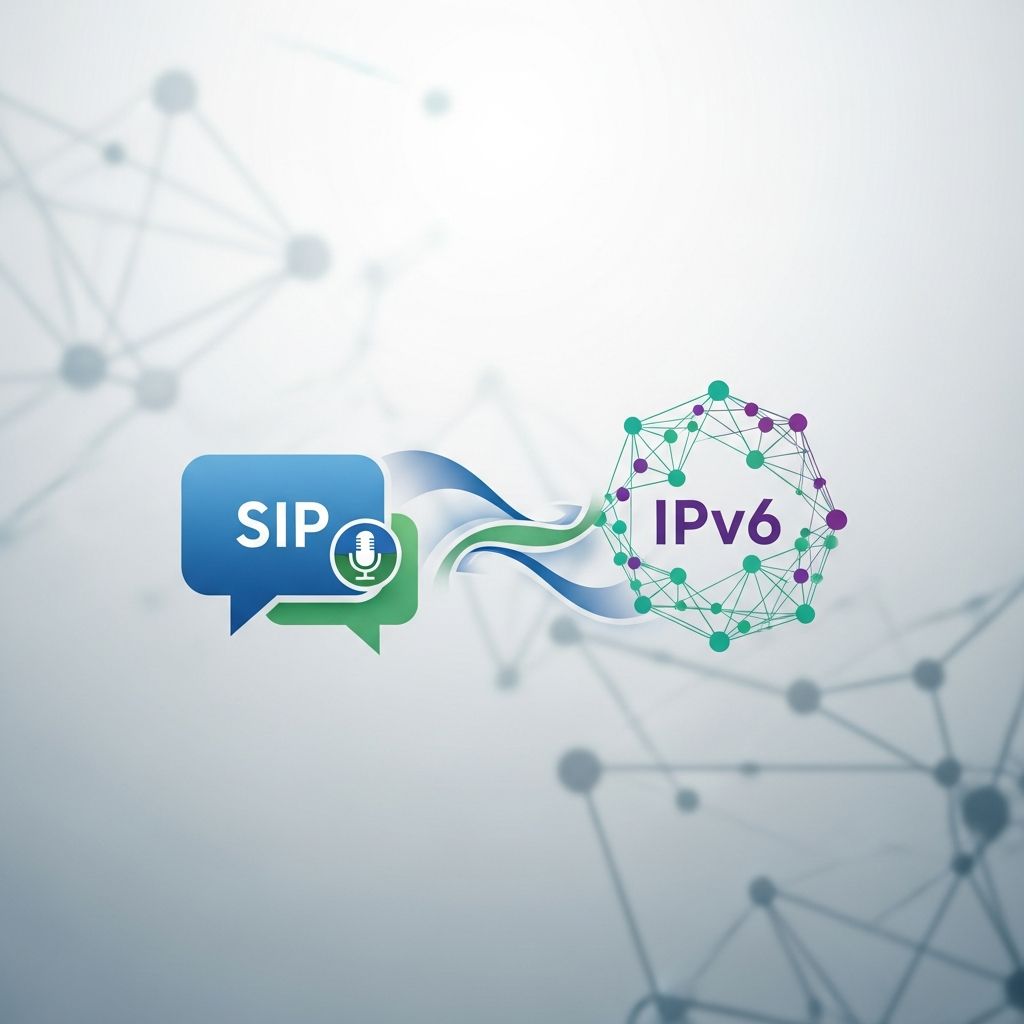
Session Initiation Protocol (SIP) has long been the cornerstone of Voice over IP (VoIP) communications, enabling calls, video sessions, and multimedia exchanges across global networks. As the internet evolves toward IPv6 to address the exhaustion of IPv4 addresses, ensuring SIP’s compatibility becomes critical. This article delves into the technical nuances of running SIP over IPv6, highlighting address representation, protocol adaptations, deployment models, and best practices drawn from standards and real-world implementations.
Understanding SIP’s Role in Modern Communications
SIP operates as a signaling protocol that establishes, modifies, and terminates multimedia sessions. It carries essential metadata in headers like Via, Contact, and To/From fields, while Session Description Protocol (SDP) bodies define media streams, including IP addresses for RTP transport. In IPv4 environments, these elements use dotted-decimal notation seamlessly. IPv6, with its 128-bit addresses and hexadecimal format, introduces complexities that demand precise handling to avoid interoperability failures.
Transitioning to IPv6 isn’t merely about enabling dual-stack support on SIP servers. It requires updates across the entire stack: from URI parsing in clients to SDP negotiation in proxies. Early adopters faced issues like malformed URIs or rejected INVITEs due to unrecognized address formats, underscoring the need for standardized behaviors.
Mastering IPv6 Address Representation in SIP
One of the primary hurdles is embedding IPv6 addresses within SIP messages. Unlike IPv4’s simple numeric strings, IPv6 addresses must follow strict notation rules to prevent parsing errors.
- Bracket Enclosure in URIs: IPv6 literals in SIP URIs and Via ‘sent-by’ parameters require square brackets. For instance, a valid URI appears as
sip:user@[2001:db8::1]:5060. This convention, rooted in RFC 3261, distinguishes the address from port numbers and parameters. - Via Header Specifics: The Via field mirrors this:
Via: SIP/2.0/UDP [2001:db8::20]:5060;branch=z9hG4bK.... Omitting brackets leads to syntactic invalidation. - Contact and To/From Fields: These follow the same URI rules, ensuring end-to-end address fidelity.
Table 1 compares IPv4 and IPv6 notations:
| Component | IPv4 Example | IPv6 Example |
|---|---|---|
| SIP URI | sip:user@192.0.2.1:5060 | sip:user@[2001:db8::1]:5060 |
| Via sent-by | 192.0.2.1:5060 | [2001:db8::20]:5060 |
| REGISTER To | sip:user@example.com | sip:user@[2001:db8::1] |
Adhering to these prevents common pitfalls like 400 Bad Request responses during registration or invitation phases.
Adapting SDP for IPv6 Media Streams
SDP, embedded in SIP bodies, describes media endpoints. IPv6 demands changes in the origin (o=) and connection (c=) lines.
- IP Version Declaration: Replace
IN IP4withIN IP6. Example:o=- 123456789 123456789 IN IP6 2001:db8::20. - No Brackets in SDP: Unlike SIP headers, SDP uses raw IPv6 addresses without brackets:
c=IN IP6 2001:db8::20. - Media Port Consistency: RTP ports remain unchanged, but ensure firewalls permit UDP ranges like 10000-20000.
A sample IPv6 SDP snippet:
v=0 o=- 123456789 123456789 IN IP6 2001:db8::20 s=IPv6 Call c=IN IP6 2001:db8::20 t=0 0 m=audio 10000 RTP/AVP 0 8 101This distinction—brackets in headers, none in SDP—stems from protocol specifications and trips up many initial deployments.
Dual-Stack and Transition Strategies
Most networks adopt dual-stack (IPv4+IPv6) during migration, allowing SIP elements to prefer IPv6 where available.
- Listen Directives: Configure servers like OpenSIPS with sockets for both:
socket=udp:0.0.0.0:5060andsocket=udp:[::]:5060. - Preference Mechanisms: SIP uses DNS SRV records to select IPv6 (AAAA) over IPv4 (A) records when clients support it.
- NAT Simplification: Pure IPv6 eliminates NAT, reducing SIP ALG dependencies and contact rewriting needs.
Hybrid scenarios may involve 6to4 tunneling or NAT64, but direct dual-stack minimizes complexity.
Configuring SIP Servers for IPv6
OpenSIPS exemplifies robust IPv6 support. Key config elements include:
# Dual-stack listeningsocket=udp:0.0.0.0:5060socket=udp:[::]:5060socket=tcp:[::]:5060# Basic routingroute { if (is_method("REGISTER")) { save("location"); exit; } if (nat_uac_test("diff-ip-src-contact")) { fix_nated_contact(); }}For TLS, add socket=tls:[::]:5061. Test with tools like sipvicious or sipp to validate REGISTER and INVITE flows.
Firewall and Security Considerations
IPv6 firewalls demand explicit rules:
ip6tables -A INPUT -p udp --dport 5060 -j ACCEPTip6tables -A INPUT -p udp --dport 10000:20000 -j ACCEPTfor RTP.- Persist with
ip6tables-save.
Secure with ip6tables zones and monitor for ICMPv6 Neighbor Discovery, vital for link-local operations.
Real-World Challenges and Solutions
Interop testing reveals issues like iPhone SIP clients faltering on IPv6 UDP due to stack quirks, resolvable via TCP fallback. Community efforts, including SIP Forum task groups, drive fixes through public mailing lists and conferences.
IPv6’s vast address space eases peer-to-peer RTP, bypassing traversal aids in greenfield deployments.
Future-Proofing VoIP with IPv6
As IPv6 adoption surpasses 40% globally, SIP must evolve. Standards bodies emphasize full-stack awareness, from parsers to SDP generators. Operators benefit from simplified architectures, reduced NAT overhead, and scalable multimedia services.
Frequently Asked Questions (FAQs)
Do SIP servers need special IPv6 builds?
Modern versions like OpenSIPS 3.x natively support IPv6; ensure kernel and libraries are IPv6-enabled.
Why brackets in SIP URIs but not SDP?
RFC 3261 mandates brackets for URI parsing; SDP uses a distinct grammar without them per RFC 4566.
Is NAT required in IPv6 SIP?
No, end-to-end connectivity prevails, though NAT64 aids IPv4-IPv6 hybrids.
How to test SIP IPv6 setups?
Use sipp for scenarios, Wireshark for packet inspection, and dual-stack endpoints.
What about RTP over IPv6?
Direct UDP with IN IP6 in SDP; STUN/TURN optional for firewalls.
References
- Hypertext Transfer Protocol (HTTP/1.1): Message Syntax and Routing — IETF. 2022-06-27. https://datatracker.ietf.org/doc/html/rfc9112
- SIP: Session Initiation Protocol — IETF. 2002-06 (updated). https://datatracker.ietf.org/doc/html/rfc3261
- SDP: Session Description Protocol — IETF. 2006-07. https://datatracker.ietf.org/doc/html/rfc4566
- IPv6 Support in SIP — IETF Draft. 2006. https://datatracker.ietf.org/doc/html/draft-gurbani-sipping-ipv6-sip-00
- SIP Forum IPv6 Task Group Announcement — Internet Society. 2012-08. https://www.internetsociety.org/blog/2012/08/sip-forum-formally-launches-sip-over-ipv6-task-group/
Similar Articles






Read full bio of medha deb