Securing Africa’s Internet Backbone
Building resilient digital networks across Africa through collaboration, policy, and technical innovation to counter rising cyber threats.
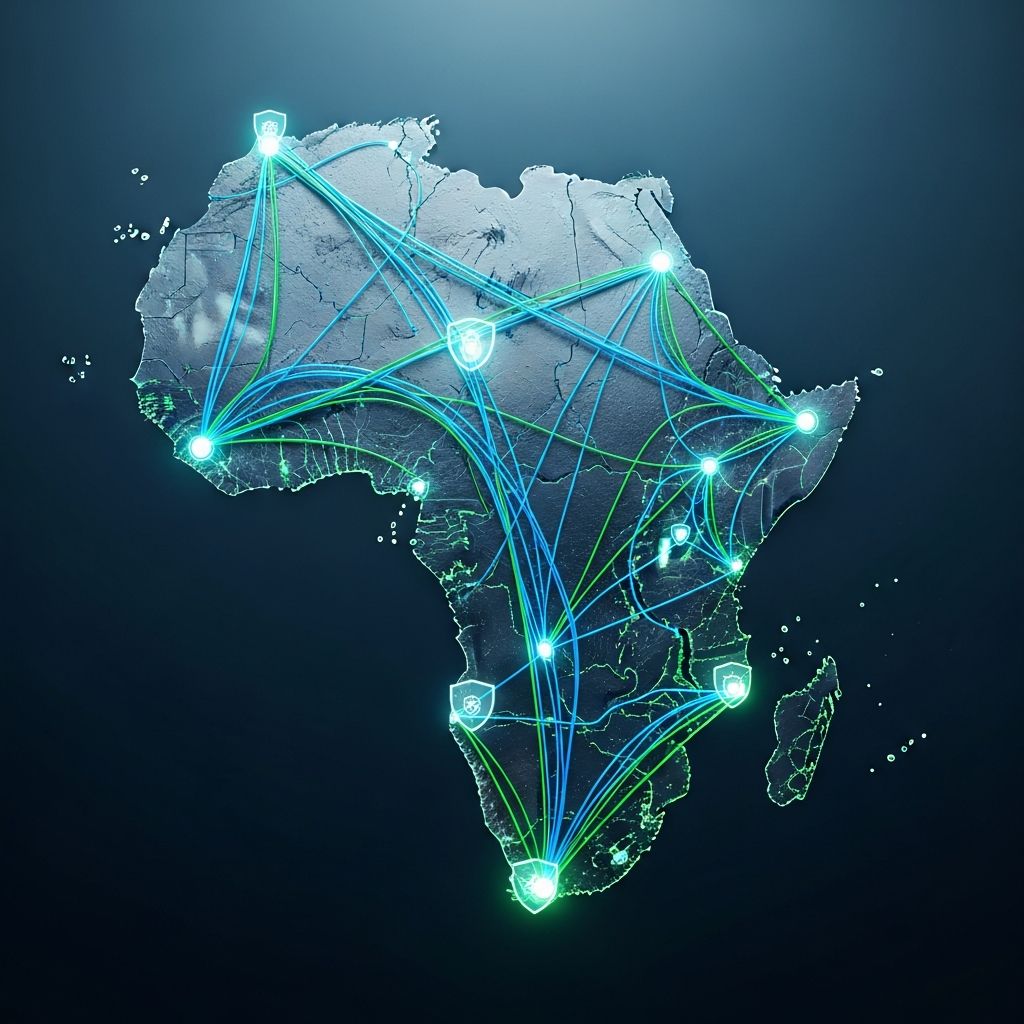
Africa’s digital landscape is expanding rapidly, with Internet penetration rising from 26% in 2019 to 36% in 2022, thanks to initiatives like the World Bank’s Digital Economy for Africa (DE4A).1 Yet, this growth exposes critical vulnerabilities in the continent’s Internet infrastructure, including undersea cables, routing systems, and domain services. Cyberattacks, such as DDoS assaults and routing hijacks, threaten economic stability and public services. Addressing these requires a unified approach involving governments, operators, and communities to foster resilience and trust in digital networks.
The Growing Imperative for Robust Digital Defenses
As African nations digitize economies and services, the stakes for Internet security have never been higher. Sub-Saharan Africa’s interconnectivity boom amplifies risks to critical sectors like finance, healthcare, and governance. Recent cable disruptions highlight the fragility of reliance on international links, underscoring the need for local redundancy.2
Key challenges include limited monitoring tools, skill shortages, and fragmented responses to incidents. Without proactive measures, breaches could erode user confidence and hinder growth. A multi-layered strategy—spanning policy, technology, and collaboration—is essential to safeguard this backbone.
Foundational Principles for Infrastructure Protection
Effective security rests on core tenets: heightened awareness of threats, clear accountability among players, seamless cooperation, and commitment to best practices. These principles guide stakeholders from national leaders to network engineers.
- Awareness: Educating all parties on evolving risks like BGP hijacks and DNS spoofing.
- Responsibility: Operators owning their network hygiene, from patching to monitoring.
- Cooperation: Sharing threat intelligence across borders and sectors.
- Best Practices: Adopting global standards tailored to African contexts.
Implementing these creates a resilient ecosystem where incidents are detected early and mitigated swiftly.
Government Leadership in National Security Frameworks
Governments play a pivotal role in setting the stage for secure infrastructure. Establishing national Computer Security Incident Response Teams (CSIRTs) is a priority. These teams coordinate responses, analyze threats, and build local expertise. Countries like Kenya and South Africa have advanced models, but broader adoption is needed.5
Policies promoting Internet Exchange Points (IXPs) enhance resilience by localizing traffic, reducing DDoS impacts, and easing international bandwidth strain. For instance, projects like Djoliba’s West African fiber network exemplify redundancy efforts.2 Public institutions must lead by securing their own systems, demonstrating standards for others.
| Action | Benefits | Examples |
|---|---|---|
| Form CSIRTs | Unified incident response | Rwanda, Mauritius |
| Promote IXPs | Local traffic routing | Djoliba project |
| Adopt standards | Baseline security | ISA/IEC 62443 |
| Capacity programs | Skill development | AU-led training |
Operator Responsibilities: Building Secure Networks
Internet Service Providers (ISPs) and operators form the frontline. They must deploy baseline protections like Resource Public Key Infrastructure (RPKI) for routing security and DNSSEC for domain integrity. Regular risk assessments and vulnerability scans are non-negotiable.
Collaboration is key—joining forums like the Network Operators’ Group for Africa (NOG) enables threat sharing. U.S. Trade and Development Agency (USTDA) efforts in Côte d’Ivoire and Senegal support such upgrades, positioning U.S. tech as partners in fortification.3
- Implement RPKI to prevent route leaks.
- Enable DNSSEC on ccTLDs.
- Monitor for anomalies using open-source tools.
- Participate in regional peering via IXPs.
Regional Collaboration: A Pan-African Approach
No nation stands alone. An Africa-wide Cyber Security Collaboration Committee, modeled on expert recommendations, could advise the African Union Commission (AUC) on strategies.0 This multistakeholder body would prioritize capacity gaps, foster knowledge exchange, and align policies.
Harmonized data governance and cybersecurity standards, as suggested by the World Economic Forum, would enable cross-border flows while protecting sovereignty.6 Initiatives like shared digital infrastructure lower costs and boost collective resilience.
Capacity Building: Empowering the Next Generation
Skills shortages hinder progress. AUC-led programs, partnering with academia, private sector, and technical communities, should target training in incident response, secure coding, and infrastructure management. International standards like ISA/IEC 62443 offer cost-effective baselines, accelerating adoption without reinventing wheels.5
Workshops, certifications, and simulations build expertise. Engaging youth through hackathons ensures a pipeline of talent.
Technical Innovations Driving Resilience
Beyond policy, technologies matter. IXPs localize traffic, mitigating cable cuts—countries with multiples fared better in recent outages.2 Content Delivery Networks (CDNs) and edge caching reduce latency and attack surfaces.
Adopting standards from bodies like the Internet Society ensures interoperability. Carnegie Endowment notes digital infrastructure now includes trust layers like identity systems.4
Measuring Success and Overcoming Hurdles
Track progress via metrics: CSIRT coverage, IXP traffic share, RPKI deployment rates. Challenges like funding and political will persist, but incentives like tax credits can attract investment.6
Legal frameworks must balance security with innovation, drawing from global models while addressing local needs.
FAQs
What role do IXPs play in African Internet security?
IXPs enable local peering, reducing reliance on vulnerable international links and limiting DDoS spread.
How can governments start building CSIRTs?
Partner with regional experts, adopt international frameworks, and invest in training for rapid deployment.
Why is collaboration essential for Africa’s digital security?
Cyber threats cross borders; shared intelligence and resources amplify defenses continent-wide.
What standards should operators prioritize?
RPKI, DNSSEC, and ISA/IEC 62443 provide foundational protections tailored for critical infrastructure.
How has broadband access evolved in Africa?
World Bank efforts lifted penetration to 36% by 2022, fueling demand for secure infrastructure.7
Conclusion
Securing Africa’s Internet demands collective action. By embracing awareness, responsibility, and innovation, stakeholders can transform vulnerabilities into strengths, unlocking a prosperous digital era. The path forward is clear: collaborate, build capacity, and invest in resilience.
References
- From Connectivity to Services: Digital Transformation in Africa — World Bank. 2023-06-27. https://www.worldbank.org/en/results/2023/06/27/from-connectivity-to-services-digital-transformation-in-africa
- Challenges and Opportunities in Internet Access in Africa — DataCup. Accessed 2026. https://datacup.io/en/defis-et-les-opportunites-de-l-acces-a-internet-en-afrique
- USTDA Supports Cybersecurity for Critical Infrastructure in Africa — USTDA (.gov). Accessed 2026. https://www.ustda.gov/ustda-supports-cybersecurity-for-critical-infrastructure-in-africa/
- Africa’s Digital Infrastructure Imperative — Carnegie Endowment. 2026-04. https://carnegieendowment.org/research/2026/04/africa-digital-infrastructure-aftech-technology-policy
- Adopting International Standards in Africa to Protect Critical Infrastructure — ISACA. 2021. https://www.isaca.org/resources/isaca-journal/issues/2021/volume-6/adopting-international-standards-in-africa-to-protect-critical-infrastructure
- How Shared Digital Infrastructure Can Bridge the Gap in Africa — World Economic Forum. 2025-04. https://www.weforum.org/stories/2025/04/how-shared-digital-infrastructure-can-bridge-the-gap-in-africa/
- Internet Infrastructure Security Guidelines for Africa — Internet Society. 2017. https://www.internetsociety.org/resources/doc/2017/internet-infrastructure-security-guidelines-for-africa/
Word count: 1678
Similar Articles








Read full bio of Sneha Tete