Rebuilding Nepal: Resilient Recovery After Quakes
Exploring Nepal's path to resilient reconstruction post-2015 earthquake, from housing grants to innovative tech and community empowerment.
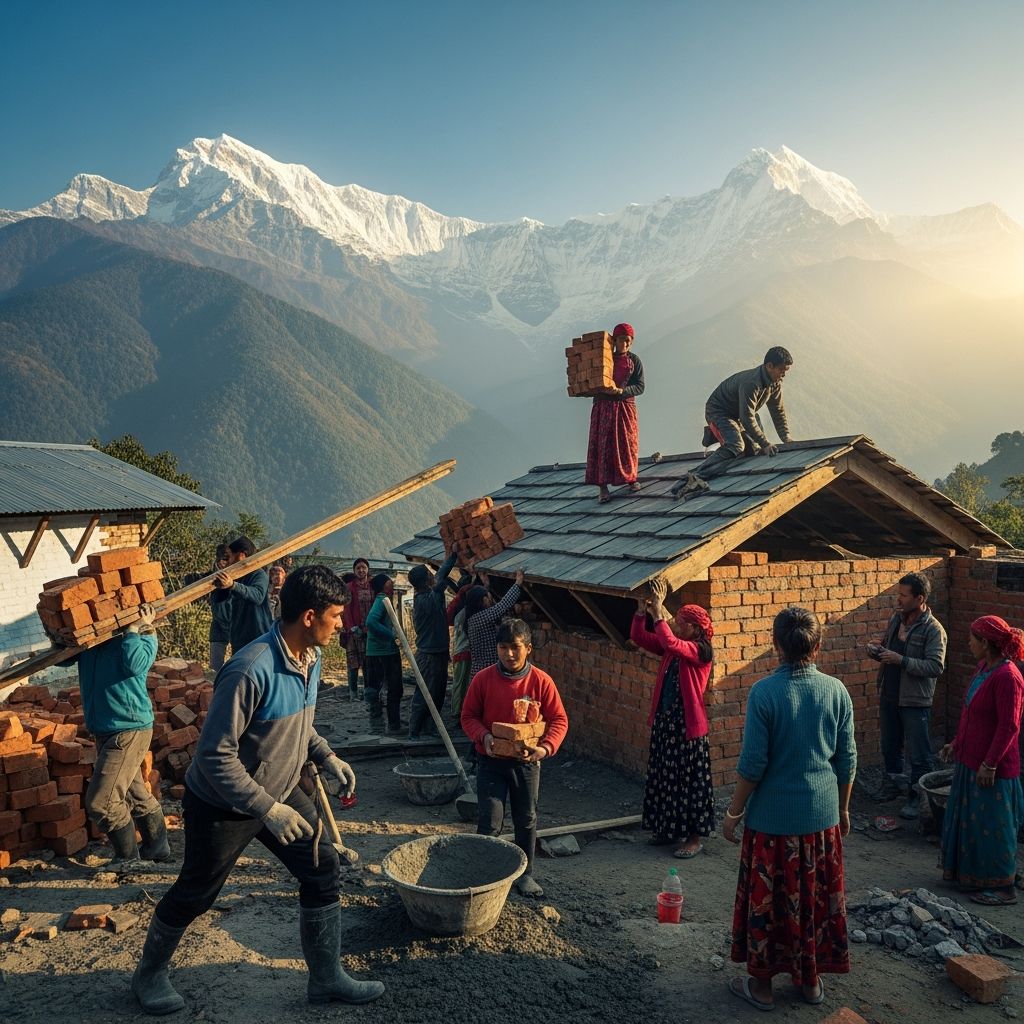
Nepal’s 2015 earthquakes devastated communities, destroying hundreds of thousands of homes and infrastructure. Yet, over the past decade, the nation has mounted one of the world’s largest owner-driven reconstruction efforts, rebuilding over 300,000 homes with a focus on resilience. This journey combines government leadership, international financing, and grassroots innovation to create safer, sustainable futures.
The Scale of Destruction and Initial Response
The April 25, 2015, Gorkha earthquake (magnitude 7.8) and subsequent May aftershock claimed nearly 9,000 lives and displaced millions. Housing needs alone totaled $3.27 billion, per post-disaster assessments.4 The government swiftly established the Nepal Reconstruction Authority (NRA) to coordinate efforts, securing $4.1 billion in international pledges.
Early responses prioritized emergency aid, but long-term rebuilding demanded strategic planning. Conditional cash grants became the cornerstone, empowering homeowners to reconstruct using earthquake-resistant designs while local governments facilitated implementation post-2017 elections.2
Government-Led Housing Reconstruction Programs
Nepal’s approach emphasized owner-driven reconstruction, providing eligible households with grants disbursed in tranches upon meeting building milestones. Around 850,000 households qualified for $3,000 grants, with additional $1,500 retrofitting support for 63,000 others.2
- Grant Distribution: Funds transferred directly to bank accounts, promoting transparency and reducing corruption risks.
- Technical Assistance: Training for masons and communities on resilient techniques, including retrofitting for partially damaged structures.
- Vulnerable Groups: Top-up grants and special provisions for landless families, those on unstable land, and marginalized communities.
Local governments post-2017 played pivotal roles, streamlining grievances, outreach, and data collection to ensure no one was left behind.2
International Partnerships Driving Recovery
The World Bank led financing with a $700 million IDA credit and $34.45 million Multi-Donor Trust Fund from Canada, the US, Switzerland, and the UK.1 This funded the Earthquake Housing Reconstruction Project (EHRP), disbursing $500 million initially, followed by $300 million in 2017 and $200 million in 2020.4
| Funding Source | Amount | Focus Areas |
|---|---|---|
| World Bank IDA Credit | $700 million | Housing reconstruction, technical support |
| Multi-Donor Trust Fund | $34.45 million | Community resilience, local governance |
| Additional Financing (2017/2020) | $500 million | Expanded housing, infrastructure |
These resources built over 300,000 homes, emphasizing durability against future seismic events.1
Innovative and Sustainable Building Techniques
Beyond grants, Nepal embraced eco-friendly methods. Organizations like Build Up Nepal promoted Compressed Stabilized Earth Blocks (CSEB), or eco-bricks, made from local soil, sand, stone dust, and minimal cement. These unfired bricks cut costs by 40% for walls and 25% overall per house, while reducing environmental impact.3
- Cost Savings: CSEB production machinery costs ~$5,000, enabling micro-enterprises.
- Training Impact: 220 enterprises across 59 districts; 12,000+ homes built; 300+ masons trained via partnerships like Detroit2Nepal.3
- Scalability: Workshops for communities and governments demonstrate viability.
In Karnali Province, after the 2023 magnitude 6.4 quake, Helvetas trained 240 masons (19% women, 64% disadvantaged) in resilient construction.5
Challenges Overcome in the Reconstruction Process
Recovery faced hurdles: delayed top-up grants for vulnerables, incomplete data on at-risk households, and centralized coordination pre-2017.2 Research from the Asia Foundation informed NRA adjustments, like expanded eligibility for unstable land dwellers and better communication.
Equity issues persisted; some groups missed grants due to poor mapping. Devolution to local governments mitigated this, accelerating procedures and support.2
Building Resilience Beyond Housing
Reconstruction extended to infrastructure, education, and urban planning. The Post Disaster Recovery Framework advocates safe settlements, open evacuation spaces, and resilient public facilities.7 Initiatives like Rebuild Nepal Education Foundation rebuilt schools, ensuring continuity for orphaned children.6
Recent efforts in western Nepal integrate climate-resilient designs, fostering skilled workforces for ongoing needs.5
Lessons for Global Post-Disaster Recovery
Nepal’s model offers blueprints: owner-driven grants ensure buy-in; international funds amplify scale; local empowerment via training sustains gains. Within five years, most rebuilt, showcasing robust response.2
Key takeaways include prioritizing data for vulnerables, decentralizing post-elections, and blending aid with innovation for sustainability.
Future Directions: Toward Disaster-Resistant Nepal
A decade on, focus shifts to maintenance, climate integration, and policy evolution. With frameworks like the NRA’s, Nepal exemplifies turning tragedy into resilience, inspiring quake-prone regions worldwide.
Frequently Asked Questions (FAQs)
What was the main funding for Nepal’s housing reconstruction?
The World Bank provided $700 million IDA credit plus additional financing, supporting over 300,000 homes.1
How many households received grants after the 2015 quakes?
About 850,000 households got $3,000 grants; 63,000 received $1,500 retrofitting aid.2
What are eco-bricks and their benefits?
Compressed Stabilized Earth Blocks from local materials; 25-40% cheaper, eco-friendly, and earthquake-resistant.3
Did local governments contribute to recovery?
Post-2017, they facilitated grants, training, and outreach, devolving power effectively.2
Has Nepal faced recent earthquakes?
Yes, a 6.4 magnitude hit Karnali in 2023; reconstruction emphasizes skilled local masons.5
References
- Nepal’s Journey from Post-Earthquake Reconstruction to Resilience — World Bank. 2023. https://www.worldbank.org/en/country/nepal/brief/post-earthquake-reconstruction-in-nepal
- A Decade Later: Lessons from Nepal’s Earthquake Response — The Asia Foundation. 2025-04-25. https://asiafoundation.org/a-decade-later-lessons-from-nepals-earthquake-response/
- A new approach to post-earthquake rebuilding in Western Nepal — The Himalayan Times. 2024. https://thehimalayantimes.com/nepal/a-new-approach-to-post-earthquake-rebuilding-in-western-nepal
- Post-Earthquake Reconstruction in Nepal: Rebuilding Lives, One Home at a Time — World Bank. 2020-09-29. https://www.worldbank.org/en/results/2020/09/29/post-earthquake-reconstruction-in-nepal-rebuilding-lives-one-home-at-a-time
- Post-Earthquake Reconstruction that Leaves No One Behind — Helvetas. 2023. https://www.helvetas.org/en/switzerland/what-we-do/how-we-work/our-projects/asia/nepal/nepal-earthquake-reconstruction
- Rebuild Nepal Education Foundation — Rebuild Nepal Education Foundation. 2024. https://rebuildnepaleducation.org
- Post Disaster Recovery Framework — GFDRR. 2019. https://www.gfdrr.org/sites/default/files/publication/Nepal%20PDRF%20Report.pdf
Similar Articles







Read full bio of Sneha Tete