IPv6 vs IPv4 Performance Analyzer
Explore APNIC Labs' breakthrough tool revealing where IPv6 outperforms IPv4 worldwide through real-time global measurements.
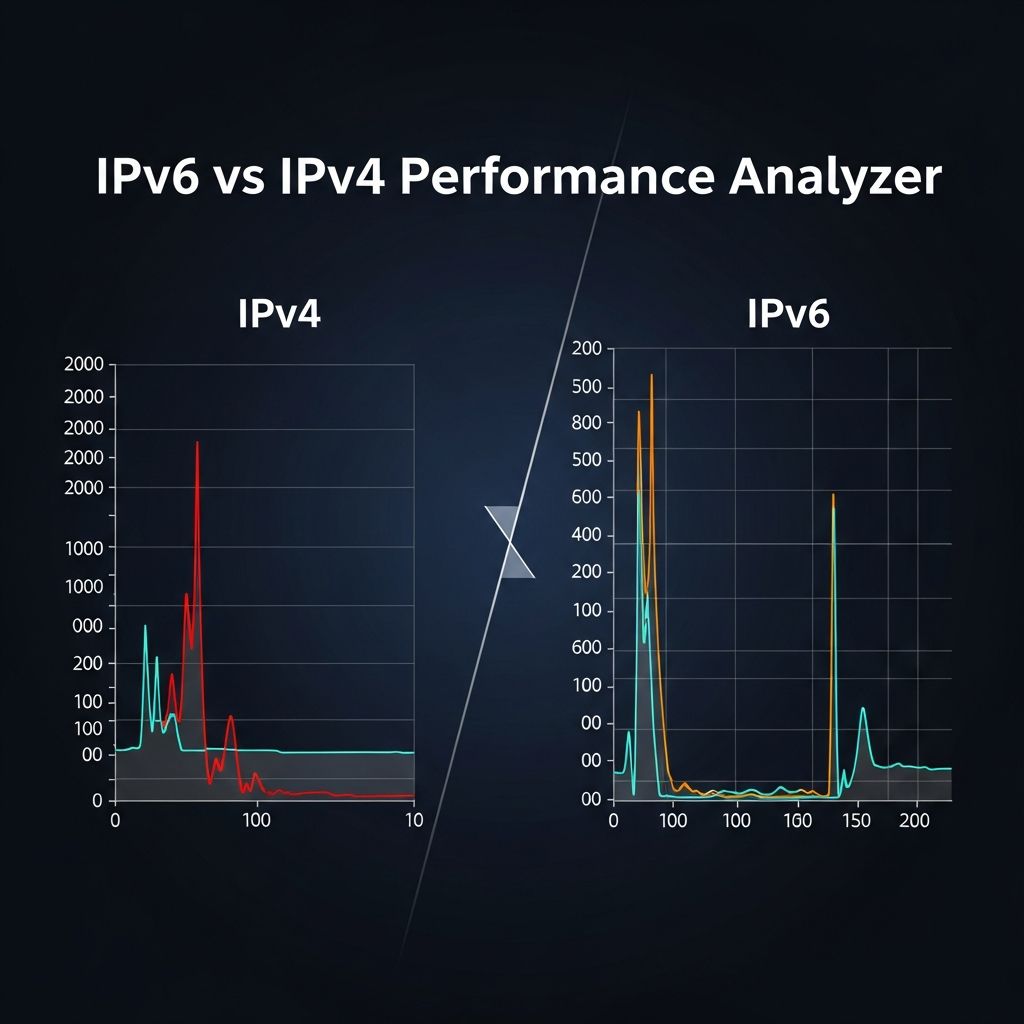
IPv6 vs IPv4 Performance Analyzer: Global Insights from APNIC Labs
The ongoing transition from IPv4 to IPv6 represents one of the most significant evolutions in internet infrastructure. As IPv4 address exhaustion continues to pressure networks worldwide, organizations are increasingly adopting dual-stack configurations that support both protocols. However, a critical question persists: does IPv6 deliver comparable—or superior—performance to its predecessor? APNIC Labs has addressed this with a groundbreaking visualization tool that provides granular, real-time comparisons of IPv6 and IPv4 performance across the globe.
Understanding the Need for Protocol Performance Comparison
Network operators, ISPs, and enterprises face mounting pressure to deploy IPv6 without compromising user experience. Historical concerns about IPv6 latency, throughput, and reliability have slowed adoption in some sectors. Traditional benchmarks often fail to capture real-world dual-stack behavior, where devices dynamically select between IPv4 and IPv6 based on Happy Eyeballs algorithms.
APNIC Labs’ tool fills this gap by analyzing actual TCP SYN connection times from dual-stack endpoints worldwide. By measuring round-trip times (RTT) for both protocols on the same devices and paths, it eliminates variables like hardware differences or geographic inconsistencies. The result is a clear, data-driven picture of protocol performance in production environments.
How the IPv6 Performance Measurement Works
The methodology is elegantly simple yet powerful. For each dual-stack client connecting to APNIC’s measurement infrastructure:
- TCP SYN packets are sent over both IPv4 and IPv6 paths simultaneously
- The lowest RTT observed for each protocol is recorded
- A relative performance score is calculated: IPv6 RTT minus IPv4 RTT
- Negative values (green on maps) indicate IPv6 is faster; positive values (red) favor IPv4
Aggregated over 30-day windows, these measurements create heatmaps and country-level statistics. The tool updates continuously, providing the most current view of global IPv6 performance trends.
Global Performance Heatmap: Where IPv6 Excels
The tool’s flagship feature is an interactive world map displaying average relative performance. Recent data (14/09/2025 – 13/10/2025) reveals striking patterns:
| Region/Country | Avg IPv6 Advantage (ms) | Samples | Performance Color |
|---|---|---|---|
| Vietnam | -36.07 | 4,479 | Dark Green |
| Greece | -3.85 | 136,299 | Light Green |
| United States (select ISPs) | -10 to -25 | Millions | Green |
| Western Europe average | +2 to +8 | High volume | Light Red |
These findings challenge the notion that IPv6 inherently underperforms. In optimized networks, IPv6 often delivers measurably faster connections, particularly in Asia-Pacific regions with mature deployments.
Happy Eyeballs and Protocol Selection Accuracy
Modern operating systems use Happy Eyeballs (RFC 8305) to select the fastest available protocol. APNIC’s data validates this approach: in Greece, dual-stack clients chose IPv6 correctly 63% of the time when it was faster. When accounting for the 300ms head-start IPv6 receives in the algorithm, accuracy jumps to 98%.
This demonstrates that current implementations effectively minimize performance penalties, even when IPv6 paths vary slightly from IPv4 routes.
Technical Factors Driving IPv6 Performance
- Elimination of NAT Overhead: IPv6’s end-to-end addressing removes Network Address Translation, reducing processing overhead and enabling direct peer-to-peer connections.
- Optimized Routing: Modern IPv6 deployments often use shorter paths and avoid legacy IPv4 tunneling overhead.
- Hardware Acceleration: Recent NICs and routers include dedicated IPv6 processing, eliminating software bottlenecks.
- CDN Integration: Major content delivery networks prioritize IPv6 anycast routing for global load balancing.
These advantages compound in high-traffic scenarios, explaining IPv6’s edge in densely populated regions.
Benchmarking IPv6 vs IPv4: Practical Testing Methods
Network engineers can replicate APNIC-style measurements using standard tools. Here’s a practical workflow:
# Dual-stack RTT comparisonping -c 100 -i 0.1 192.0.2.1 # IPv4 baselineping -6 -c 100 -i 0.1 2001:db8::1 # IPv6 comparison# Throughput testing with iperf3iperf3 -c ipv4-server -t 30 -P 4 # IPv4 TCPiperf3 -6 -c ipv6-server -t 30 -P 4 # IPv6 TCPAutomated scripts can generate ongoing comparisons, alerting when IPv6 performance degrades below IPv4 thresholds.
Implications for Network Operators and Enterprises
The data has profound implications for deployment strategies:
- Prioritize IPv6 in Green regions—users already experience better performance
- Investigate Red areas—routing optimization or peering improvements needed
- Validate dual-stack implementations using Happy Eyeballs v2
- Monitor CDN performance across protocol stacks
Comcast’s IPv6 deployment provides a real-world example: removing NAT simplified architecture, reduced latency, and improved overall network efficiency.
Future Directions in Protocol Performance Monitoring
APNIC Labs continues evolving the platform with planned enhancements:
- Per-ISP breakdowns within countries
- Connection success rate metrics
- Throughput comparisons alongside RTT
- Mobile vs fixed network segmentation
These additions will provide even richer insights as IPv6 adoption approaches critical mass.
FAQ: IPv6 Performance Common Questions
- Is IPv6 always slower than IPv4?
- No. APNIC data shows IPv6 faster in many regions, with averages favoring IPv6 in optimized networks.
- How accurate are these measurements?
- Extremely accurate, based on millions of real dual-stack connections using TCP SYN methodology.
- Should I disable IPv4 for better performance?
- Not recommended. Dual-stack with proper Happy Eyeballs ensures best protocol selection.
- Why does IPv6 performance vary by country?
- Differences stem from ISP maturity, routing optimization, peering arrangements, and hardware acceleration adoption.
- Can I access the raw data?
- Yes, APNIC provides downloadable datasets and API access for advanced analysis.
Conclusion: IPv6 Performance Maturity Achieved
APNIC Labs’ tool dispels lingering IPv6 performance myths. Far from being a compromised alternative, IPv6 delivers equivalent or superior performance in production networks worldwide. As evidenced by green-shaded regions across Asia, Europe, and North America, the protocol transition has reached technical maturity.
Network professionals should leverage these insights for targeted optimization, confident that IPv6 enables the scalable, future-proof infrastructure essential for tomorrow’s internet.
References
- V6/V4 Relative Performance Maps — APNIC Labs. 2025-10-13. https://stats.labs.apnic.net/v6perf
- IPv6 Performance – Revisited — APNIC Blog. 2016-08-22. https://blog.apnic.net/2016/08/22/ipv6-performance-revisited/
- IPv4 vs IPv6 Compared — UptimeRobot Knowledge Hub. 2025. https://uptimerobot.com/knowledge-hub/devops/ipv4-ipv6/
- How to Benchmark IPv6 vs IPv4 Network Performance — OneUptime. 2026-03-20. https://oneuptime.com/blog/post/2026-03-20-benchmark-ipv6-vs-ipv4-performance/view
- IPv6 for Your Boss — LACNIC. 2018-05. https://www.lacnic.net/innovaportal/file/2549/1/ipv6-for-your-boss-lacnic-may-2018-v3.pdf
Similar Articles








Read full bio of Sneha Tete