IPv6 Security Myth: More Bits Don’t Mean Magic
Unraveling the misconception that IPv6's vast address space magically boosts security—discover the real protections that matter.
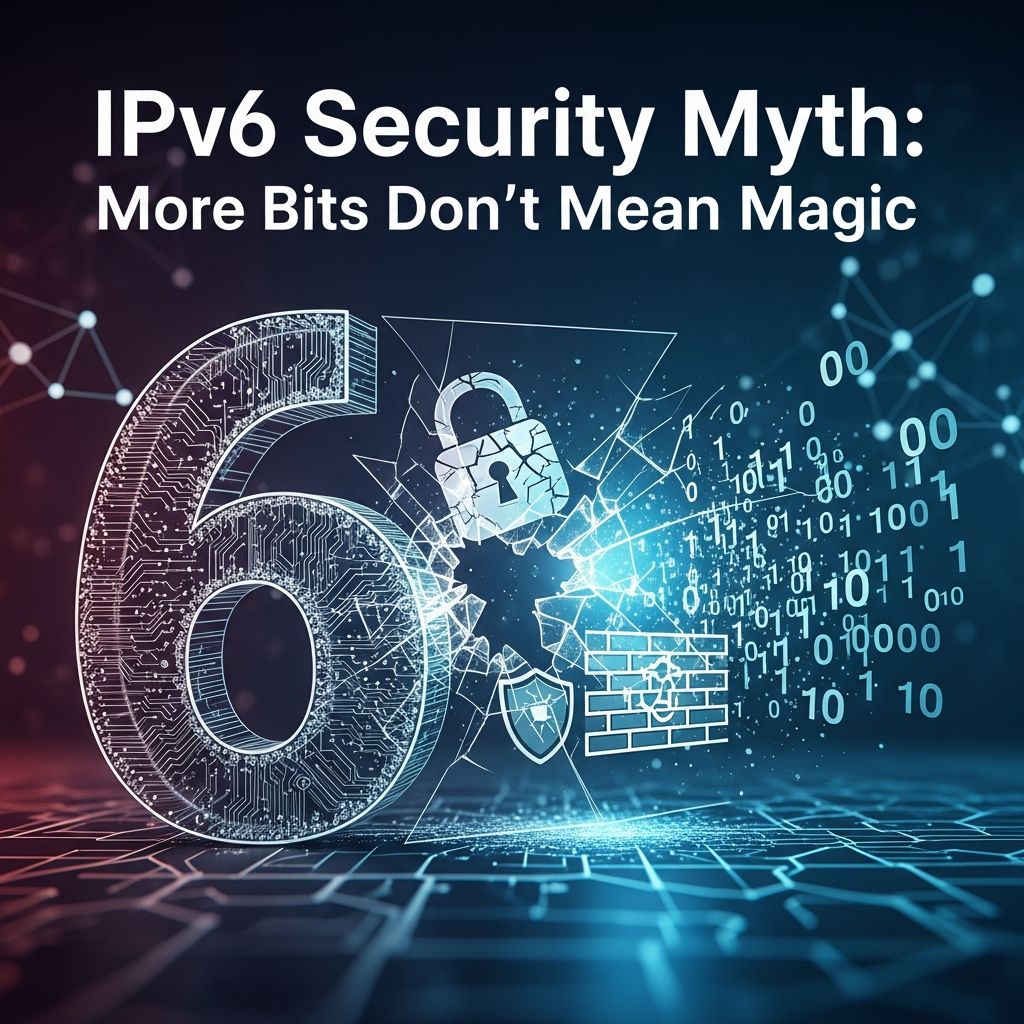
In the evolving landscape of internet protocols, IPv6 has emerged as the long-awaited successor to IPv4, promising an enormous expansion in address availability. With 128 bits compared to IPv4’s 32, it offers approximately 3.4 × 10^38 unique addresses—a number so vast it’s often described as practically unlimited. This abundance has fueled excitement but also misconceptions, particularly around security. A common belief persists that this sheer scale of addresses alone fortifies networks against threats. This article dissects that notion, explaining why more bits in IPv6 addresses do not equate to inherent security improvements and outlining genuine strategies for safeguarding IPv6 environments.
Understanding the IPv6 Address Revolution
IPv4’s address exhaustion forced the development of IPv6, where each address spans 128 bits, typically written in hexadecimal format like 2001:db8::1. This design eliminates the need for Network Address Translation (NAT), which was a workaround in IPv4 to share scarce public addresses. NAT masked internal devices, creating an illusion of security through obscurity. In IPv6, every device can have a globally routable address, restoring the end-to-end connectivity principle of the early internet.
However, the myth arises from assuming that the colossal address pool—96 more bits than IPv4—makes scanning or targeting impossible. In theory, an attacker scanning for vulnerabilities would face an astronomically large search space. Yet, this overlooks practical realities of network operations and threat models.
Why Address Size Alone Fails as a Security Barrier
The idea that IPv6’s address expanse provides ‘magic’ protection stems from a misunderstanding of attack vectors. While random guessing of addresses is infeasible, real-world threats don’t rely on blind probes.
- Targeted Attacks Dominate: Most intrusions target known services, using protocols like DNS or DHCPv6 to discover active hosts, bypassing brute-force scanning.
- Neighbor Discovery Exploits: IPv6’s Neighbor Discovery Protocol (NDP) replaces ARP, enabling devices to find neighbors efficiently—but also opens doors to spoofing if unsecured.
- Link-Local Realities: Devices often use predictable link-local addresses (fe80::/10), which attackers on the same segment can easily identify.
Moreover, privacy extensions in operating systems randomize interface IDs periodically, mitigating some tracking but not eliminating discoverability. A study by the Internet Assigned Numbers Authority (IANA) highlights that address autoconfiguration follows predictable patterns, making enumeration feasible within subnets.
Core Security Mechanisms in IPv6 Deployments
IPv6 embeds several features designed for security, independent of address length. Understanding these is crucial for myth-busting.
IPsec: Built-In but Optional Protection
IPsec, mandatory to implement in IPv6 stacks per RFC 4301, offers authentication, integrity, and encryption at the IP layer. Unlike IPv4, where IPsec is optional, IPv6 ensures compatibility, though activation remains deployment-dependent. This header provides end-to-end security without NAT interference.
| Feature | IPv4 IPsec | IPv6 IPsec |
|---|---|---|
| Implementation | Optional | Mandatory |
| NAT Traversal | Often required | NAT-free, simpler |
| Deployment Rate | Low (~5% per surveys) | Low but growing |
Source: RFC 4301 and recent World IPv6 Launch data.
Stateful Firewalls: The True Gatekeepers
Regardless of protocol, stateful inspection firewalls track connection states, allowing outbound-initiated traffic while blocking unsolicited inbound packets. In IPv6, these must filter both global and link-local traffic. Tools like ip6tables in Linux or Windows Firewall configurations enforce this effectively.
Common Pitfalls in IPv6 Security Configurations
Moving to IPv6 exposes misconfigurations if admins assume address abundance handles security.
- Disabled ICMPv6: ICMPv6 is vital for path MTU discovery and neighbor discovery; blocking it breaks connectivity, per RFC 4890.
- Unsecured RA Guards: Router Advertisements can be spoofed without Secure Neighbor Discovery (SEND).
- Dual-Stack Oversights: Many networks run IPv4 and IPv6 simultaneously, risking bypasses if one stack is neglected.
A 2023 report from the North American Network Operators Group (NANOG) notes that 40% of IPv6 deployments suffer from default firewall rules allowing excessive inbound access.
Best Practices for Robust IPv6 Network Defense
To secure IPv6 properly:
- Enable Stateful IPv6 Firewalls: Default-deny inbound; allow only established connections.
- Deploy IPsec Where Feasible: Use for site-to-site VPNs and sensitive traffic.
- Implement RA Guard and DHCPv6 Snooping: Prevent rogue router announcements.
- Monitor NDP Traffic: Use tools like ndpmon or SeND for anomaly detection.
- Regular Audits: Conduct IPv6-specific penetration testing.
These steps align with NIST guidelines in SP 800-119 for IPv6 security.
Comparing IPv4 and IPv6 Threat Landscapes
IPv4 relied on NAT for pseudo-security, complicating legitimate protocols like IPsec. IPv6 removes this crutch, demanding proactive defenses. Yet, surveys from APNIC show IPv6 adoption reaching 40% globally by 2025, with security incidents comparable to IPv4 when properly configured.
Key Differences:
- IPv4: NAT hides hosts but breaks end-to-end apps.
- IPv6: Direct addressing enables better IPsec but requires vigilant filtering.
Future-Proofing with IPv6 Security Innovations
Emerging standards like RFC 8981 (DHC) enhance DHCPv6 security, while Cryptographically Generated Addresses (CGA) tie addresses to public keys, thwarting spoofing. Adoption of these will further solidify IPv6’s posture.
FAQ: IPv6 Security Essentials
Q: Does IPv6 make scanning attacks impossible?
A: No, active hosts are discoverable via protocols like NDP, not just brute force.
Q: Is IPsec automatically enabled in IPv6?
A: Supported yes, but enabled no—configure it explicitly.
Q: Should I disable IPv6 if unused?
A: Avoid it; dual-stack is default. Secure it instead.
Q: How does address privacy impact security?
A: It reduces tracking but doesn’t prevent local network attacks.
Q: What’s the biggest IPv6 security risk today?
A: Misconfiguration, especially in firewalls and dual-stack setups.
Conclusion: Security Lies in Implementation, Not Bits
The allure of IPv6’s vast address space is real, but it doesn’t confer magical security. True protection comes from layered defenses: firewalls, IPsec, and vigilant configuration. By debunking this myth, network professionals can embrace IPv6 confidently, leveraging its strengths without false assurances. As adoption accelerates, prioritizing these practices will ensure resilient infrastructures.
References
- Internet Protocol, Version 6 (IPv6) Specification — IETF. 1998-12-10 (updated). https://datatracker.ietf.org/doc/html/rfc8200
- Security Architecture for the Internet Protocol — IETF. 2005-12-11. https://datatracker.ietf.org/doc/html/rfc4301
- IPv6 Node Requirements — IETF. 2017-05-22. https://datatracker.ietf.org/doc/html/rfc6437
- Guidelines for the Secure Deployment of IPv6 — NIST. 2011-10 (authoritative standard). https://nvlpubs.nist.gov/nistpubs/SpecialPublications/NIST.SP.800-119.pdf
- IPv6 Security Myths & Legends — NANOG. 2013-10. https://archive.nanog.org/sites/default/files/ebersman2_notr-boston-ipv6-sec.pdf
Similar Articles







Read full bio of Sneha Tete