IPv6 Milestone: Comcast Hits 30%, AT&T Tops 20%
Exploring the rapid rise of IPv6 adoption as major ISPs like Comcast and AT&T lead the charge toward a future-proof internet.
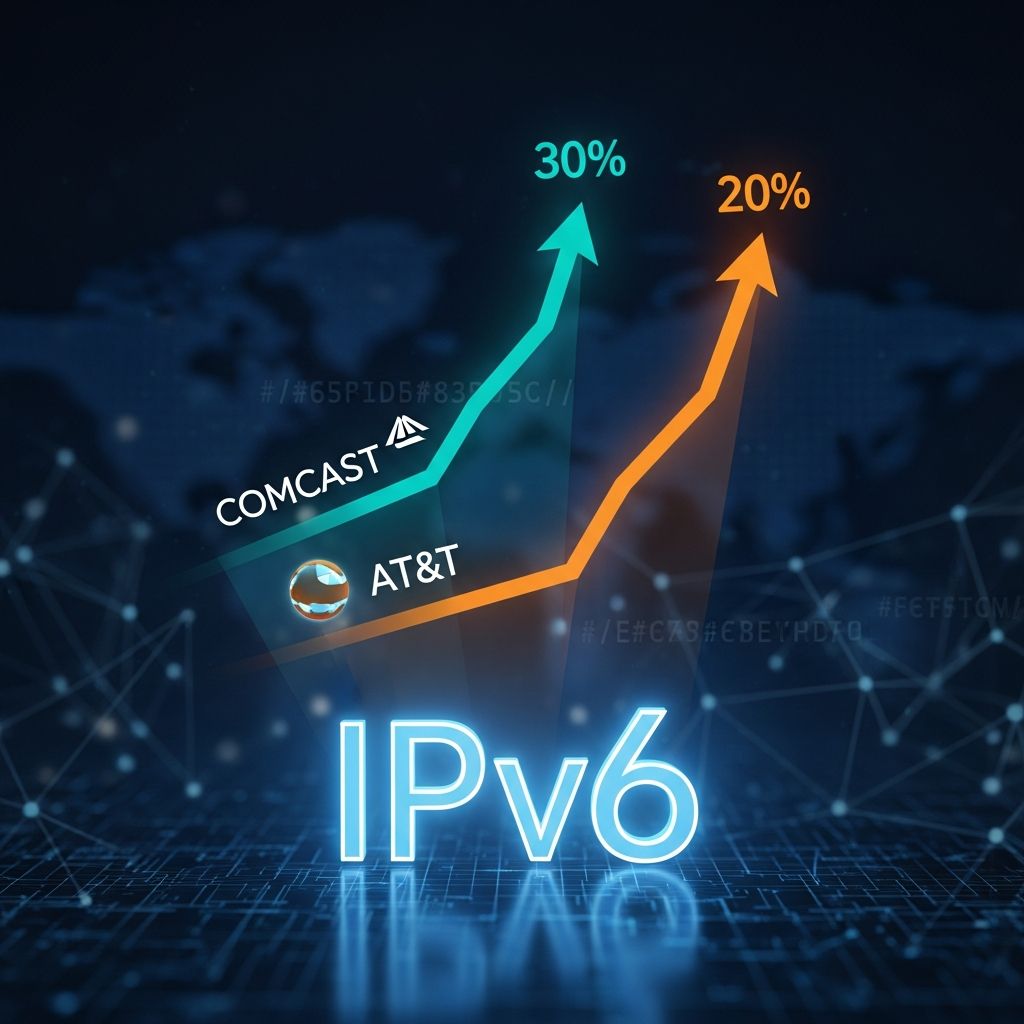
The transition from IPv4 to IPv6 represents one of the most critical evolutions in internet history. By mid-2014, major U.S. internet service providers (ISPs) like Comcast and AT&T achieved remarkable milestones in IPv6 deployment. Comcast’s network carried over 30% IPv6 traffic, while AT&T crossed the 20% threshold. These figures, highlighted in World IPv6 Launch measurements, underscored a accelerating shift driven by the exhaustion of IPv4 addresses and the need for expansive connectivity.
The Imperative for IPv6 Adoption
IPv4, with its 32-bit addressing scheme, supports roughly 4.3 billion unique addresses—a number dwarfed by today’s connected devices. The Internet Assigned Numbers Authority (IANA) depleted its IPv4 pool in 2011, forcing reliance on techniques like Network Address Translation (NAT). While NAT delayed crisis, it introduced complexities in peer-to-peer applications, gaming, and IoT.
IPv6, featuring 128-bit addresses, offers approximately 3.4 × 10^38 possibilities—enough for every device on Earth and beyond. Beyond capacity, IPv6 simplifies routing, enhances security via IPsec integration, and eliminates NAT overhead. The World IPv6 Launch initiative, coordinated by the Internet Society, catalyzed permanent IPv6 activation by leading networks starting June 6, 2012.
Breaking Down 2014’s Top Performers
July 2014 measurements revealed top networks by traffic volume:
- Comcast: Exceeded 30% IPv6 traffic, pioneering dual-stack deployment across its entire U.S. footprint.
- AT&T: Surpassed 20%, reflecting aggressive mobile and fixed-line rollouts.
- Other leaders included T-Mobile (high 80s in some metrics) and international players like Reliance Jio precursors.
These gains stemmed from strategic investments. Comcast, for instance, enabled IPv6 on 98% of customer modems by 2014, paving the way for 50%+ adoption projections.
| Network | IPv6 Traffic % | Deployment Notes |
|---|---|---|
| Comcast | >30% | Dual-stack nationwide |
| AT&T | >20% | Mobile-led adoption |
| T-Mobile | ~80% | Wireless dominance |
| Global Average | ~5-7% | Steady upward trend |
Technical Strategies Driving Success
ISPs employed dual-stack lite approaches, running IPv4 and IPv6 concurrently. Comcast’s full dual-stack rollout by 2014 meant new customers received both protocols seamlessly. AT&T focused on wireless, where IPv6 aligns perfectly with 4G/LTE architectures.
Key enablers included:
- Prefix Delegation: Allocating /56 or /60 blocks to customer routers for subnet flexibility.
- DHCPv6 and SLAAC: Stateless autoconfiguration for rapid device provisioning.
- Transition Mechanisms: 6rd and DS-Lite for hybrid environments.
Content providers like Google (50%+ IPv6 by 2014) and Facebook amplified adoption, as dual-stack sites prefer IPv6 when available (Happy Eyeballs algorithm).
Global Perspectives and Regional Variations
While U.S. giants led, adoption varied globally. Asia saw explosive growth via mobile networks; India’s Reliance Jio would later hit 93%. Europe lagged due to regulatory fragmentation, but providers like Free in France reached 40%+.
APNIC data from 2018 (reflecting 2014 trends) showed ISP leadership: 13 of 20 largest IPv6-enabled networks exceeded 35% penetration. Factors included new customer defaults to IPv6 and device ecosystem maturity.
Challenges Encountered During Rollout
Despite progress, hurdles persisted:
- Legacy Equipment: Older CPE and servers lacked IPv6 stacks, necessitating upgrades.
- Operational Complexity: Monitoring dual-stack traffic doubled troubleshooting efforts.
- Application Compatibility: Some software ignored IPv6, causing fallback issues.
- Cost: Backbone and edge router firmware updates strained budgets.
Comcast mitigated via managed IPv6-only modems (87% provisioned by 2014), while AT&T prioritized low-hanging mobile fruit.
Progress Since 2014: A Decade of Acceleration
From 2014’s 5-7% global baseline, IPv6 reached 30-40% by 2024. Comcast hit 73%, AT&T 70%+, per recent World IPv6 Launch archives. T-Mobile USA topped 90%, driven by 5G.
ARIN notes Android’s IPv6 preference and IoT proliferation (50 billion devices by 2020) as catalysts. Yet, Alexa Top 1000 sites hover at ~30% IPv6-reachability, indicating content-side inertia.
Future Implications for Networks and Users
Universal IPv6 promises simplified architectures, native end-to-end connectivity, and IoT scalability. Benefits include:
- Reduced NAT traversal for VoIP, gaming.
- Built-in security and mobility support.
- Addressing for 340 undecillion devices.
Full transition may extend to 2030, but 2014 milestones proved feasibility. ISPs now default new deployments to IPv6, with IPv4 as legacy.
FAQ: IPv6 Adoption Essentials
- Why did IPv4 run out?
- Only 4.3B addresses vs. billions of devices; IANA exhausted in 2011.IANA Registry Exhaustion
- Is IPv6 slower than IPv4?
- No—dual-stack ensures performance parity; IPv6 often routes more efficiently.
- Do I need to upgrade my router?
- Modern routers (post-2014) support IPv6; check ISP provisioning.
- When will IPv6 be everywhere?
- Projections: 50%+ global by 2025, full by 2030+.
- How to test my IPv6 connectivity?
- Use test-ipv6.com for comprehensive diagnostics.
Conclusion: Toward an IPv6-Dominant Internet
Comcast’s 30% and AT&T’s 20% in 2014 marked a turning point. Fueled by World IPv6 Launch, these benchmarks inspired global momentum. Today, with 70%+ in leading networks, the internet sheds IPv4 constraints, embracing a boundless future. Stakeholders must sustain efforts to bridge remaining gaps, ensuring seamless connectivity for generations.
References
- World IPv6 Launch Measurements — World IPv6 Launch (Internet Society). 2014-07 (archived). https://www.worldipv6launch.org/measurements/
- World IPv6 Launch Four Years Later: Taking Stock and Looking Forward — Comcast Corporate. 2016-06-06. https://corporate.comcast.com/comcast-voices/world-ipv6-launch-four-years-later-taking-stock-and-looking-forward
- What Drives IPv6 Deployment? — ARIN Vault (American Registry for Internet Numbers). 2018-06-06. https://www.arin.net/vault/blog/2018/06/06/what-drives-ipv6-deployment/
- What is IPv6 and Why Aren’t We There Yet? — Network World. 2022-03 (updated). https://www.networkworld.com/article/965192/what-is-ipv6-and-why-aren-t-we-there-yet.html
- IPv4 Address Exhaustion — IANA (ICANN). 2011-02-03. https://www.icann.org/news/announcement-2011-02-03-en
Similar Articles







Read full bio of Sneha Tete