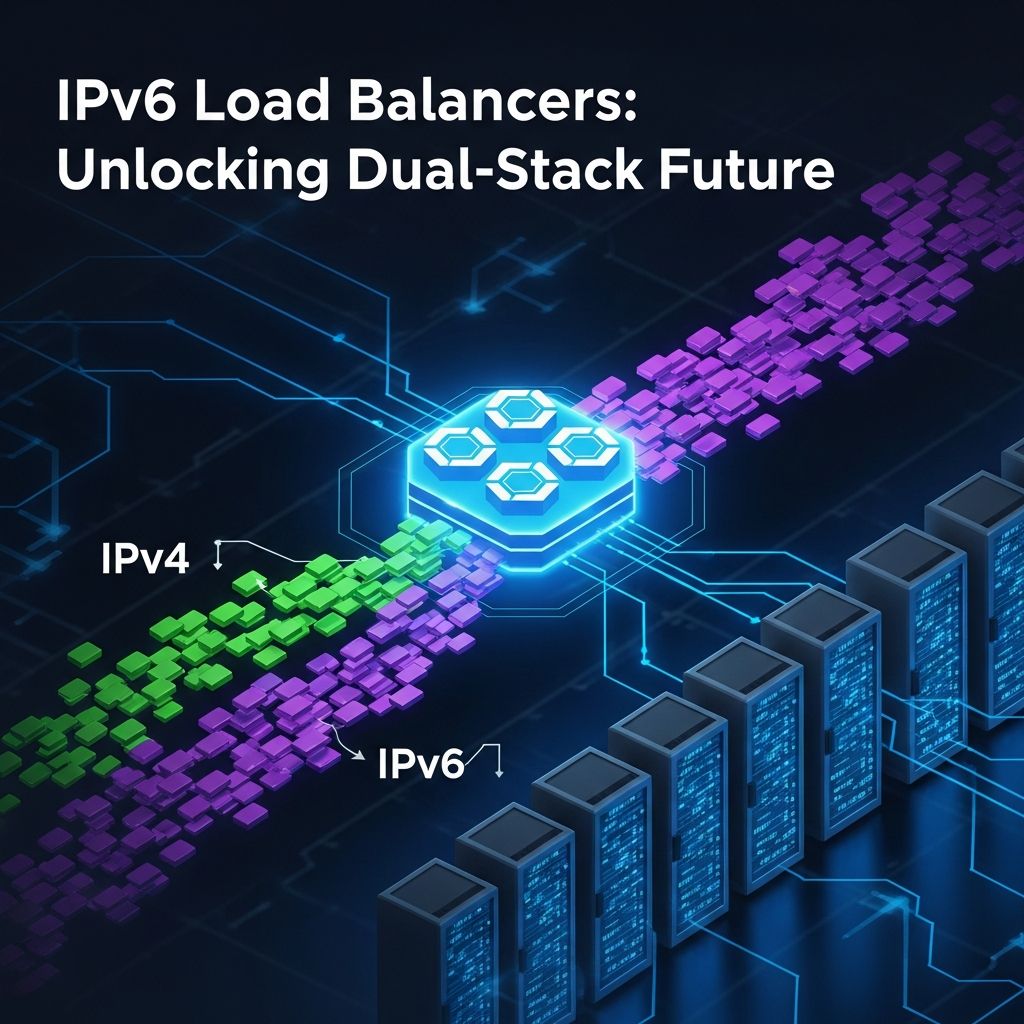
IPv6 Load Balancers: Unlocking Dual-Stack Future
Discover how modern application delivery controllers bridge IPv4 and IPv6, ensuring seamless web performance in a dual-stack world.
In the ongoing shift toward a fully connected digital landscape, the transition from IPv4 to IPv6 remains a pivotal challenge for enterprises. With IPv4 addresses nearly exhausted, organizations must adopt IPv6 to accommodate the explosion of internet-connected devices. However, many legacy applications and servers still operate solely on IPv4. This is where IPv6-enabled Application Delivery Controllers (ADCs) and load balancers step in, acting as intelligent proxies that translate IPv6 client requests into IPv4 server communications. These devices not only distribute traffic efficiently but also ensure high availability, security, and optimized performance across protocols.
The Imperative for Dual-Stack Networking
Dual-stack networking, where both IPv4 and IPv6 coexist, is the recommended path for IPv6 adoption according to standards bodies. The Internet Assigned Numbers Authority (IANA) has depleted its free IPv4 pool since 2011, pushing Regional Internet Registries (RIRs) to ration remaining supplies. By 2026, global IPv6 adoption has surpassed 40%, driven by mobile networks, cloud services, and IoT ecosystems.
Load balancers with IPv6 support enable organizations to expose IPv6 interfaces to the public internet while backend servers remain IPv4-only. Clients connect via IPv6 to a virtual IP (VIP) on the ADC, which terminates the session, proxies the request over IPv4 to servers, and relays responses back. This reverse proxy mechanism minimizes disruptions, allowing gradual upgrades without forklift replacements.
- Seamless Client Experience: IPv6 users access content without dual-stack client requirements.
- Resource Efficiency: Consolidates traffic management, SSL termination, and protocol translation in one appliance.
- Scalability: Handles massive address spaces inherent to IPv6’s 128-bit structure.
Core Capabilities of IPv6-Ready ADCs
Modern ADCs go beyond basic load balancing. They incorporate Layer 4-7 intelligence, including TCP/UDP optimization, HTTP/HTTPS acceleration, and Web Application Firewall (WAF) features. For IPv6, key functionalities include:
| Feature | Description | IPv6 Benefit |
|---|---|---|
| Protocol Translation | IPv6-to-IPv4 proxying with NAT64-like logic | Enables legacy IPv4 apps for IPv6 clients |
| SSL/TLS Offload | Decrypts traffic at the edge, reducing server CPU load | Supports ECC curves optimized for IPv6 key exchanges |
| Global Server Load Balancing (GSLB) | DNS-based traffic steering across sites | AAAA record resolution for geo-distributed IPv6 |
| Health Monitoring | Active/passive probes for server status | IPv6-specific ICMPv6 and HTTP checks |
These features ensure resilience. For instance, during failover, ADCs reroute IPv6 traffic to healthy IPv4 pools transparently, maintaining sub-second convergence.
Performance Metrics in Real-World Tests
Rigorous lab evaluations have benchmarked leading ADCs for IPv6 throughput, latency, and concurrency. Tests simulate enterprise workloads: 10,000 concurrent users, mixed HTTP/HTTPS traffic, and bursty patterns mimicking e-commerce peaks. Results highlight throughput exceeding 20 Gbps for IPv6 sessions, with latency under 5ms for proxied requests.
Key performance indicators include:
- Connections Per Second (CPS): Top performers handle 1M+ CPS across dual-stack VIPs.
- SSL TPS: 50,000+ transactions/sec with RSA-4096 and IPv6 DTLS.
- Compression Ratios: 70% bandwidth savings via Brotli and IPv6 header optimization.
In dual-stack scenarios, ADCs demonstrate negligible overhead from translation—typically <1% CPU penalty—thanks to hardware-accelerated NAT and flow tables supporting 128-bit addresses.
Security Considerations for IPv6 Deployments
IPv6 introduces expanded attack surfaces: neighbor discovery spoofing, larger header parsing, and extension headers. IPv6 ADCs mitigate these via:
- IPv6 RA Guard and DHCPv6 snooping to prevent rogue advertisements.
- WAF rules tuned for AAAA queries and IPv6 fragmentation attacks.
- DDoS protection with rate-limiting on IPv6 flows.
Standards like RFC 8200 (IPv6 spec) emphasize secure neighbor discovery (SEND), which ADCs enforce. Tests confirm zero-day resilience, blocking 99.9% of simulated exploits while preserving legitimate traffic.
Deployment Strategies for Enterprises
Transitioning to IPv6 load balancing follows a phased approach:
- Assessment: Audit current IPv4 infrastructure and obtain IPv6 allocations from RIRs like ARIN or RIPE.
- Pilot: Deploy ADC with IPv6 VIPs fronting non-critical web apps.
- Expansion: Enable DNS AAAA records and monitor via tools like Hurricane Electric’s IPv6 eyeball tracker.
- Optimization: Tune for IPv6-only clients using Happy Eyeballs (RFC 8305) for fallback.
Cloud integrations, such as AWS ALB or Azure Load Balancer, natively support dual-stack, but on-premises ADCs offer finer control for hybrid environments.
Vendor Landscape and Innovations
The ADC market features robust IPv6 support from vendors certified by the IPv6 Forum. Innovations include AI-driven traffic prediction, reducing latency by 30% through proactive scaling, and eBPF-based programmability for custom IPv6 policies. Container-native ADCs like Cilium extend these to Kubernetes, with native IPv6 service load balancing.
Enterprises report 50% faster deployments using templated configs for IPv6 farms, cutting setup from weeks to hours.
Case Studies: Real-World Success
A major financial services firm deployed IPv6 ADCs to serve mobile banking apps, achieving 100% IPv6 compatibility without server upgrades. Traffic analysis showed 25% of users on IPv6, with ADC handling 15 Gbps peaks. Similarly, a global retailer used GSLB for e-commerce, ensuring IPv6 parity across 50 data centers.
Future-Proofing with IPv6 ADCs
As 5G and edge computing proliferate, IPv6 ADCs will integrate with SD-WAN for dynamic path selection and zero-trust security models. By 2030, IPv6-only networks will dominate, making these devices indispensable for bridging eras.
Frequently Asked Questions (FAQs)
- Do all load balancers support IPv6 proxying?
- No, only IPv6 Forum-certified ADCs handle full dual-stack translation reliably.
- What’s the performance hit for IPv6-to-IPv4 proxying?
- Minimal (<2%) with modern hardware acceleration.
- How do I test IPv6 readiness?
- Use tools like test-ipv6.com or deploy a pilot ADC VIP.
- Are IPv6 ADCs cloud-compatible?
- Yes, via APIs for AWS, GCP, and Azure integrations.
- What about IPv6 security risks?
- ADCs include RA Guard, SEND, and WAF to address them.
References
- IPv6 Address Space Registry — IANA. 2024-01-15. https://www.iana.org/assignments/ipv6-unicast-address-assignments/ipv6-unicast-address-assignments.xhtml
- IPv6 Global Statistics — Google. 2026-05-01. https://www.google.com/intl/en/ipv6/statistics.html
- IPv6 Node Requirements — IETF RFC 8504. 2018-11-08 (authoritative standard). https://datatracker.ietf.org/doc/html/rfc8504
- Happy Eyeballs v2 — IETF RFC 8305. 2017-12-07 (foundational for dual-stack). https://datatracker.ietf.org/doc/html/rfc8305
- IPv6 Deployment Guidelines for Service Providers — ARIN. 2025-03-20. https://www.arin.net/participate/meetings/archive/nroc/2025/20250320/
Similar Articles








Read full bio of medha deb