IPv6 Hits 50%: The New Internet Standard
After decades of anticipation, IPv6 adoption surpasses 50% globally, marking a pivotal shift in internet infrastructure and future connectivity.
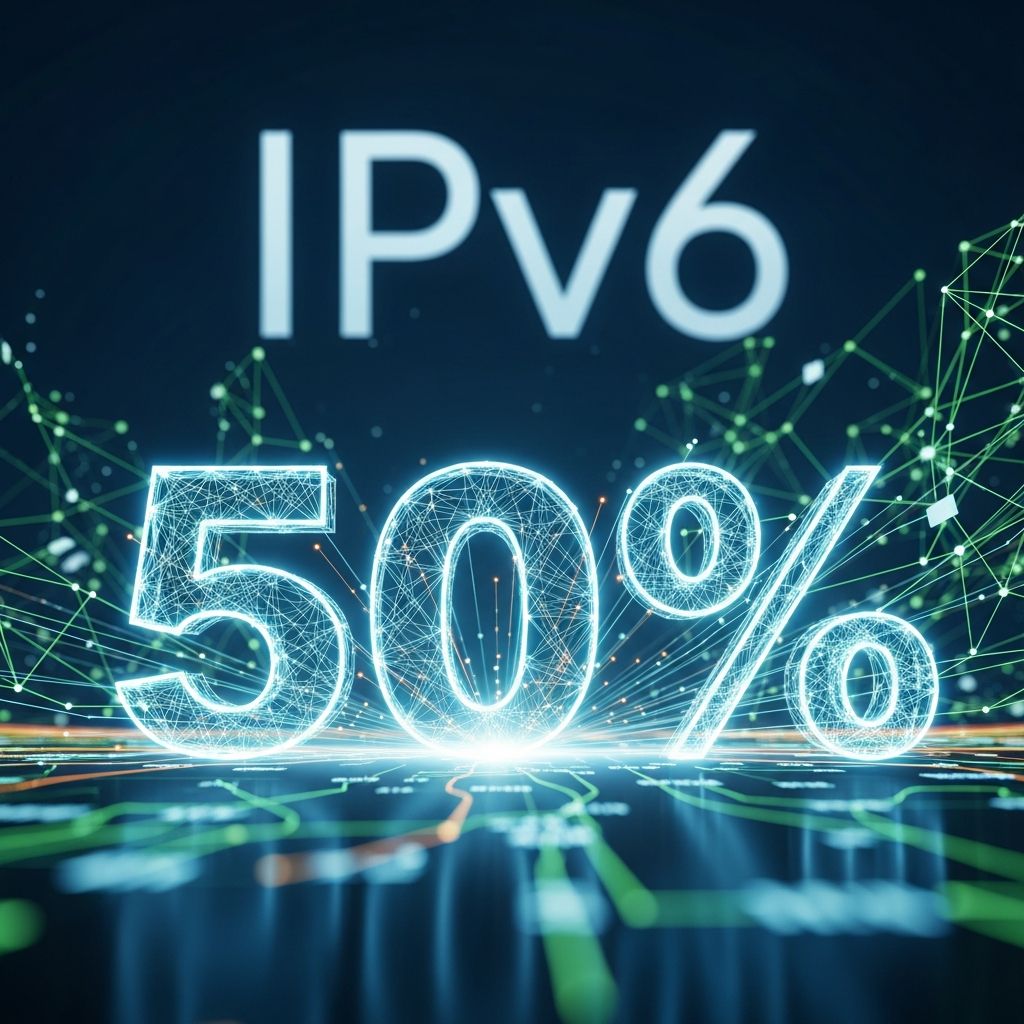
In a landmark achievement for global networking, IPv6—the long-awaited successor to IPv4—has crossed the 50% adoption threshold. This milestone, confirmed by leading metrics from Google on March 28, 2026, signals the end of an era dominated by address scarcity and the dawn of a more scalable internet. For years, the internet relied on IPv4’s limited 4.3 billion addresses, but explosive growth in devices demanded change. Now, with native IPv6 traffic at 50.10%, the protocol is no longer experimental; it’s the backbone of modern connectivity.
Understanding the IPv6 Revolution
At its core, IPv6 addresses the fundamental flaw in IPv4: a finite pool of addresses exhausted by smartphones, IoT sensors, and cloud servers. IPv6 offers 340 undecillion addresses—practically limitless—while improving efficiency with features like stateless autoconfiguration and simplified headers. This isn’t just about numbers; it’s about enabling seamless device proliferation without workarounds like NAT, which fragmented traffic and complicated security.
The journey began in the late 1990s, but adoption lagged due to inertia, cost, and compatibility fears. Dual-stack setups—running both protocols—became the norm, buying time but perpetuating complexity. Today, that caution has given way to momentum, as evidenced by real-world data.
Key Milestones in Global Adoption
- Early Struggles (2000s): IPv6 hovered below 1% until 2013, hampered by transition tools like 6to4 and Teredo, which faded as native support grew.
- Acceleration (2020-2025): From 30% in January 2020 to nearly 50% by mid-2025, fueled by mobile networks and hyperscalers.
- The Tipping Point (2026): Google’s metrics hit 50.10% on March 28, with Internet Society Pulse averaging 43% across sources, and US traffic exceeding 56-67% per Facebook and Cisco data.
These figures underscore a global surge: average IPv6 traffic now at 48.8%, poised to dominate fully by mid-2026.
Major Players Driving the Shift
Telecom behemoths are at the forefront. T-Mobile boasts 88.4% IPv6 penetration, while AT&T and Verizon trail at 74-74.8%, per Akamai. These carriers serve billions via mobile, where IPv6 shines for its end-to-end connectivity. Users on these networks access IPv6 transparently, unaware of the upgrade.
| Provider | IPv6 % (Google) | IPv6 % (Other) | Notes |
|---|---|---|---|
| Global Average | 50.10% (Mar 28) | 48.8% | Tipping point achieved |
| USA | 56.77% | 60.73% (Facebook), 67.86% (Cisco) | Leads global adoption |
| T-Mobile | N/A | 88.4% | Highest carrier rate |
| AT&T/Verizon | N/A | 74-74.8% | Rapid scaling |
Cloud providers like AWS are accelerating native IPv6 offerings, making it the default for new deployments. This shift reduces costs—no more IPv4 leasing auctions—and enhances performance for distributed apps.
Technical Advantages Powering Momentum
IPv6’s design eliminates pain points:
- Native Security: Mandatory IPsec support bolsters encryption without add-ons.
- Efficient Routing: Larger headers and flow labels optimize multicast and mobility.
- IoT Readiness: Every device gets a unique address, simplifying smart homes and industrial sensors.
- Simplified Management: No NAT means direct peer-to-peer, easing VoIP, gaming, and VPNs.
Transition mechanisms have matured too. Tools like CLAT (464XLAT) in Windows—now default-enabled—allow IPv6-only devices to reach IPv4 legacy services seamlessly. Linux distros are following suit with DHCP Option 108 and consistent CLAT, critical for enterprise Linux environments.
IPv6-Mostly: The Future Network Model
Enter ‘IPv6-mostly’ architectures: prioritize IPv6 everywhere, using IPv4 only for unavoidable legacy. This slashes operational overhead versus full dual-stack, conserving scarce IPv4 pools. Corporate campuses, Wi-Fi, and branches adopt first, with data centers handling exceptions.
Benefits include:
- Lower costs: No dual-protocol maintenance.
- Scalability: Auto-configuration for thousands of endpoints.
- Future-proofing: Prepares for 5G/6G and edge computing.
Regional Variations and Challenges
Adoption isn’t uniform. The US leads, thanks to aggressive carrier upgrades. Europe and parts of Asia follow, while some regions lag due to legacy infrastructure. Challenges persist:
- Legacy Apps: Not all software is IPv6-ready; testing is key.
- Middle-Mile Gaps: Some ISPs resist, creating islands of IPv6.
- Skills Gap: Network engineers need training on IPv6 nuances.
Yet, incentives align: IPv4 prices soar in transfer markets, making IPv6 economically compelling.
Implications for Businesses and Users
For enterprises, IPv6 unlocks innovation. Cloud-native apps run faster, IoT fleets scale effortlessly, and remote work thrives without NAT hurdles. End-users gain reliability—fewer connection drops, better streaming.
Governments and standards bodies, like those behind RFCs, celebrate this as validation of long-term planning. APNIC notes it’s no failure that it took time; IPv6 proves robust at scale.
What’s Next for IPv6 Dominance
By late 2026, expect 60%+ global averages. Cloud competition will standardize IPv6 defaults. OS vendors will embed deeper support, and IPv6-only pilots will proliferate. The internet sheds its IPv4 skin, emerging agile for exascale data and hyper-connected societies.
Frequently Asked Questions (FAQs)
- Is IPv6 faster than IPv4?
- Not inherently, but it avoids NAT overhead and enables optimizations, often improving performance in practice.
- Do I need to do anything if my ISP supports IPv6?
- Usually no—it’s automatic. Check via sites like test-ipv6.com.
- What happens to IPv4?
- It persists for legacy, but new networks go IPv6-mostly, minimizing its role.
- Is IPv6 secure?
- Yes, with built-in IPsec, though firewalls remain essential.
- When will IPv6 be everywhere?
- Majority by 2027; full transition gradual over a decade.
References
- 18 Years Later, IPv6 Reaches Majority — Internet Society Pulse. 2026-04. https://pulse.internetsociety.org/en/blog/2026/04/18-years-later-ipv6-reaches-majority/
- IPv6 Adoption — Google. 2026-04-30. https://www.google.com/intl/en/ipv6/
- Google hits 50% IPv6 — APNIC Blog. 2026-04-28. https://blog.apnic.net/2026/04/28/google-hits-50-ipv6/
- What to Expect From IPv6 in 2026 — LACNIC Blog. 2026. https://blog.lacnic.net/en/ipv6-2026/
- The Switch To Six, Part II: The IPv6 Tipping Point Is Here — SixMap. 2026. https://www.sixmap.io/blog/ipv6-tipping-point-is-here-part-two/
Similar Articles







Read full bio of medha deb