IPv6 Deployment Risks in Legacy IPv4 Networks
Understanding the security challenges when IPv6 coexists with established IPv4 infrastructure
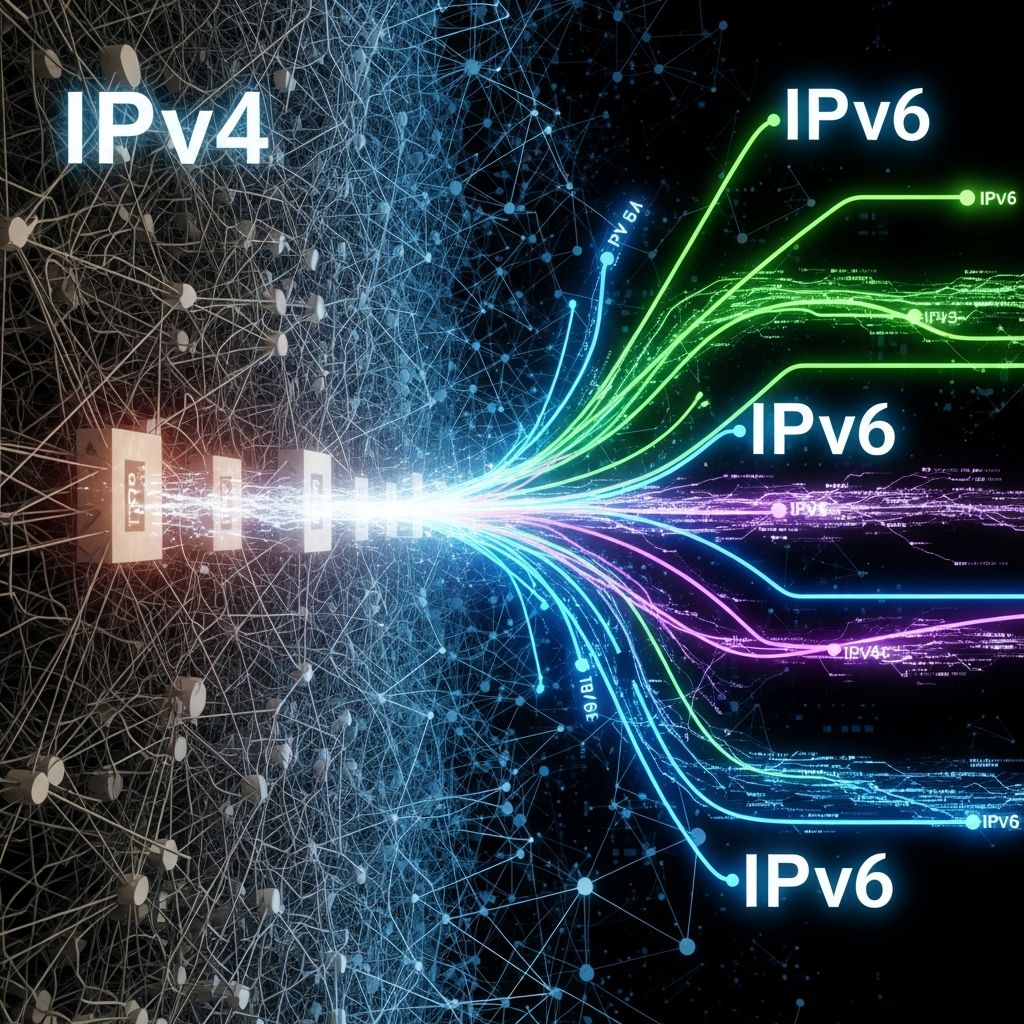
Navigating the Security Landscape: IPv6 Integration with Established IPv4 Infrastructure
The transition from Internet Protocol version 4 (IPv4) to Internet Protocol version 6 (IPv6) represents one of the most significant infrastructure changes in modern networking. While IPv6 was engineered to address critical limitations in IPv4—particularly the exhaustion of available address space—the coexistence of both protocols during the transition period creates a complex security environment that many organizations have not fully addressed. This complexity stems from the fundamental architectural differences between the two protocols and the varied ways they can be deployed together.
As enterprises and service providers navigate this transition, they often operate in a dual-stack environment where both IPv4 and IPv6 traffic traverse the same physical infrastructure. This hybrid approach, while pragmatic for maintaining backward compatibility and service continuity, introduces a distinct set of security challenges that extend beyond traditional IPv4-centric security measures. Understanding these implications is critical for organizations seeking to maintain robust security postures during the protocol transition.
The Fundamental Challenge: Protocol Coexistence and Security Complexity
Organizations that have invested heavily in IPv4 infrastructure often operate under the misconception that their networks remain secure simply because they have not deliberately deployed IPv6. This assumption represents a critical vulnerability in modern security thinking. In reality, IPv6 traffic may already be present on networks through automatic mechanisms, default configurations, or user-initiated tunneling applications, creating pathways that traditional IPv4-focused security tools cannot adequately monitor or control.
The core problem lies in the independence of IPv4 and IPv6 at the network layer. Despite sharing the same physical transmission media and switching infrastructure, these protocols operate through distinct logical pathways. This separation means that security mechanisms designed for IPv4—such as firewalls, intrusion detection systems, and monitoring infrastructure—must be paralleled by equivalent capabilities for IPv6. Organizations cannot simply rely on existing security investments to protect against IPv6-based threats.
The lack of coordinated security controls between these protocol stacks creates gaps in visibility and control. When security administrators focus exclusively on IPv4 traffic analysis, they may remain entirely unaware of the volume, source, destination, or content of IPv6 communications traversing their networks. This blind spot becomes particularly problematic when IPv6 is used, whether deliberately or accidentally, to circumvent established security policies and usage controls.
Tunneling Technologies: Convenient Transitions with Hidden Risks
IPv6 transition mechanisms have been developed to facilitate gradual migration while maintaining connectivity between IPv4-only and IPv6-only systems. These technologies—including automatic tunneling, configured tunneling, and hybrid translation mechanisms—enable IPv6 packets to be encapsulated within IPv4 datagrams for transport across predominantly IPv4 infrastructure. While these mechanisms serve legitimate operational purposes, they also create significant security vulnerabilities that attackers can exploit.
The most concerning aspect of tunneling technologies is their ability to bypass conventional network security controls. Threat actors can embed unauthorized IPv6 traffic within IPv4 tunnels, effectively hiding malicious communications from security monitoring tools that examine IPv4 traffic. Because these tools typically do not inspect the encapsulated payload, the IPv6 traffic remains invisible to security infrastructure designed to enforce network policies.
Additionally, attackers can exploit tunnel injection techniques where they forge encapsulated packets based on partial knowledge of tunnel endpoints and encapsulation protocols. This allows malicious actors to inject packets into legitimate tunnels or create unauthorized tunnels that traverse firewall and security appliance boundaries. Organizations that have not explicitly disabled automatic tunneling mechanisms on edge devices and end-user systems face particularly acute risks.
Automatic Tunneling Vulnerabilities
Automatic tunneling protocols attempt to create IPv6 connectivity without explicit configuration, detecting tunnel endpoints and establishing connections dynamically. While this automation reduces administrative overhead, it also means that attackers can leverage these same automatic mechanisms to establish covert communication channels. End-user devices may be configured with automatic tunneling capabilities by default, creating potential bridges between corporate networks and external IPv6 infrastructure that administrators cannot easily identify or control.
Configured and Manual Tunneling Risks
Even deliberately configured tunnels present security challenges if not properly managed. Organizations implementing manual or configured tunneling must ensure that tunnel endpoints are restricted to authorized systems, that tunnel traffic is monitored and logged, and that tunnels are disabled when not actively needed. Failure to maintain rigorous tunnel governance can result in persistent covert communication channels that bypass traditional security monitoring.
The ICMP Protocol Dilemma: A Critical Shift in Security Philosophy
One of the most significant philosophical differences between IPv4 and IPv6 relates to the role of the Internet Control Message Protocol (ICMP) and its IPv6 variant, ICMPv6. In IPv4 environments, security practitioners have traditionally advocated for blocking ICMP traffic as a security measure, reasoning that ICMP information disclosure could facilitate reconnaissance activities. This practice, while debatable even in IPv4 contexts, becomes fundamentally incompatible with IPv6 operations.
IPv6 has a hard dependency on ICMPv6 for critical operational functions that IPv4 either handles differently or does not require. Path Maximum Transmission Unit (MTU) discovery, a mechanism for determining the largest packet size that can traverse a network path without fragmentation, relies entirely on ICMPv6 messages. When routers encounter packets too large to forward, they do not fragment the packets as in IPv4; instead, they discard them and send ICMPv6 messages to the originating host indicating the appropriate MTU size. Without this functionality, connections may fail or operate at severely degraded performance levels.
Multicast group management for IPv6 also depends on ICMPv6, as does Neighbor Discovery—the protocol mechanism by which IPv6 hosts learn about routers, resolve addresses to hardware identifiers, and perform duplicate address detection. Blocking ICMPv6 or misconfiguring access control lists to prevent ICMPv6 traffic will cause widespread connectivity problems that are often difficult to diagnose, as the symptoms appear as intermittent connection failures or severely reduced throughput.
Organizations transitioning to IPv6 must fundamentally reconsider their approach to ICMP blocking. Rather than blocking ICMPv6 indiscriminately, security teams should implement granular filtering that allows essential ICMPv6 message types while restricting those that pose security risks. This represents a paradigm shift from the simple “block all ICMP” mentality prevalent in many IPv4 environments.
Multicast Dependencies and Firewall Complexity
Unlike IPv4, where multicast is optional and often disabled entirely, IPv6 incorporates multicast as a fundamental architectural component. Neighbor Discovery and link-local communications rely on multicast addressing and group membership management. This architectural choice means that firewalls and access control policies must be redesigned to accommodate IPv6 multicast traffic, which operates differently from IPv4 multicast.
The challenge for security teams lies in implementing firewall rules that permit necessary IPv6 multicast communication for network functionality while preventing attackers from abusing multicast mechanisms for network reconnaissance or launching address resolution attacks. Traditional IPv4 firewall logic, which often simply blocks multicast at network boundaries, cannot be applied to IPv6 without breaking fundamental network functionality.
Application and Service Compatibility Challenges
Many enterprise applications were developed when IPv4was the dominant protocol and carry hardcoded IPv4 address assumptions in their implementation. When organizations enable IPv6 on network segments, these legacy applications may behave unpredictably or fail entirely. Applications that parse IP addresses as strings, validate IP address formats, or make routing decisions based on IPv4-specific logic may not gracefully handle IPv6 addresses.
The situation becomes more complex in dual-stack environments where both IPv4 and IPv6 are available. Applications using standard socket libraries may establish connections via IPv6 when both address families are available, potentially connecting through different network paths with different security controls. Some applications might establish IPv4 connections to certain destinations and IPv6 connections to others, creating inconsistent security policy application.
Critical business applications lacking native IPv6 support require careful planning during transition phases. Organizations cannot simply disable IPv6 globally while maintaining compliance with emerging standards and preparing for eventual full IPv6 deployment. Instead, they must identify which applications require IPv6 support, validate compatibility, and implement translation mechanisms such as NAT64 (Network Address Translation 64) or DNS64 (Domain Name System 64) that allow IPv6-only endpoints to communicate with IPv4-only services.
Address Translation and Translation Service Risks
Network Address Translation technologies designed for IPv6-to-IPv4 communication, including NAT64, DNS64, and their combinations (such as 464XLAT), provide mechanisms for interconnecting IPv6-only systems with IPv4-only services. However, these translation services introduce their own security considerations that must be carefully managed.
Translation devices represent potential single points of failure in network architecture, as all traffic between IPv6 and IPv4 domains must pass through them. Organizations implementing these services must design for high availability and redundancy to prevent service interruption. More significantly, translation processes can interfere with security mechanisms that rely on end-to-end cryptographic properties. IPsec and DNS Security Extensions (DNSSEC) may not function correctly when packets traverse translation boundaries, as translation modifies packet headers and potentially payload content in ways that break cryptographic signatures and tunnel integrity.
Additionally, translation devices must maintain state information about ongoing communication flows, creating memory and processing requirements that scale with network utilization. Misconfigured translation services can exhaust system resources or fail to properly handle edge cases, potentially causing performance degradation or security vulnerabilities.
The Endpoint Security Problem: Dual-Stack Complexity at the Host Level
Endpoint protection becomes significantly more complex in dual-stack environments. Security controls that were engineered for IPv4-only systems must now be extended to manage both address families. Host-based firewalls must evaluate firewall rules for both IPv4 and IPv6 connections, requiring administrators to maintain parallel sets of access control rules.
The challenge extends beyond firewall rules to network monitoring, threat detection, and compliance enforcement. Applications running on dual-stack hosts may establish connections via either IPv4 or IPv6, and security administrators must ensure that policy enforcement applies consistently regardless of which protocol is used. The increased complexity creates opportunities for misconfiguration, where administrators accidentally leave open access control rules for one protocol while believing they have properly restricted network access.
Many organizations are considering restricting individual endpoints to single-stack deployments—either IPv4-only or IPv6-only—to reduce this complexity. Where dual-stack is necessary, limiting it to specific network infrastructure devices such as routers, gateways, and load balancers rather than general-purpose endpoints reduces the overall attack surface. This approach requires careful network design and planning but significantly simplifies security policy enforcement.
Monitoring and Visibility Gaps
Traditional network monitoring and logging infrastructure was designed with IPv4 address formats and traffic patterns in mind. When IPv6 traffic appears on networks previously considered IPv4-only, existing monitoring tools may not capture or analyze this traffic effectively. Security analysts relying on IPv4-centric dashboards and alerting systems may remain unaware of significant IPv6 communications.
Organizations implementing IPv6 must audit their monitoring infrastructure to ensure that tools can properly capture, parse, and analyze IPv6 traffic. This includes examining flow data collection, packet capture systems, intrusion detection platforms, and data loss prevention tools. Many organizations discover that their monitoring infrastructure requires significant upgrades or replacement to effectively handle IPv6.
The lack of visibility creates a critical security gap. Organizations cannot defend against threats in traffic they cannot see, and they cannot ensure policy compliance without visibility into all communications. This makes monitoring infrastructure upgrade a prerequisite for secure IPv6 deployment rather than an optional enhancement.
Strategic Recommendations for Secure Transition
Organizations undertaking IPv6 deployment should adopt a proactive approach to security that goes beyond simple protocol translation:
- Comprehensive inventory: Identify all systems, applications, and services that support IPv6 or could support it through translation mechanisms
- Policy alignment: Develop IPv6-specific security policies that reflect differences in protocol architecture while maintaining security objectives achieved through IPv4 policies
- Firewall modernization: Deploy next-generation firewalls capable of inspecting and enforcing policy on both IPv4 and IPv6 traffic, including tunnel-aware security
- Disable automatic tunnels: Explicitly disable default and automatic tunneling mechanisms on edge devices and end-user systems unless specifically required
- Implement tunnel control: Where tunneling is necessary, use tunnel-aware security solutions to monitor and control tunnel traffic
- Update monitoring: Ensure network monitoring, logging, and analysis tools support IPv6 traffic analysis with equivalent capabilities to IPv4 monitoring
- ICMPv6 strategy: Develop granular ICMPv6 filtering rules that permit necessary message types while blocking those that pose security risks
- Application testing: Validate application behavior in dual-stack environments and identify compatibility issues before production deployment
- Staff training: Ensure security and operations staff understand IPv6 architecture, threat vectors, and security controls specific to the protocol
- Gradual deployment: Implement IPv6 in controlled phases with clear security testing at each stage rather than attempting rapid large-scale deployment
Looking Forward: IPv6 as Security Foundation
While IPv6 introduces security challenges during transition periods, the protocol itself provides architectural improvements over IPv4. The integration of IPsec as a fundamental component rather than an optional addition creates opportunities for stronger end-to-end security. The larger address space and improved address allocation practices reduce the need for address translation and its associated security complications.
Organizations that successfully navigate the transition period and establish comprehensive IPv6 security controls may ultimately achieve more robust security postures than those that remain dependent on IPv4 addressing and translation mechanisms. However, this long-term benefit requires significant near-term investment in infrastructure modernization, security control implementation, and staff expertise development.
The security implications of IPv6 coexisting with IPv4 infrastructure represent neither an insurmountable obstacle nor a problem that resolves itself through inaction. Rather, they represent a complex technical and organizational challenge that requires deliberate planning, appropriate investment, and ongoing management attention. Organizations that treat IPv6 transition as a security initiative rather than merely an infrastructure upgrade are most likely to successfully implement the protocol while maintaining or improving their security posture.
References
- Security Considerations for Internet Protocol Version 6 (ITSM.80.003) — Canadian Centre for Cyber Security. 2023. https://www.cyber.gc.ca/en/guidance/security-considerations-internet-protocol-version-6-itsm80003
- IPv6 Security Guidance — U.S. Department of Defense Cybersecurity & Infrastructure Security Agency. 2023. https://media.defense.gov/2023/Jan/18/2003145994/-1/-1/0/CSI_IPV6_SECURITY_GUIDANCE.PDF
- IPv6 Security Issues — IPv6 Now Educational Resources. https://ipv6now.com.au/primers/IPv6SecurityIssues.php
- RFC 4302: IP Authentication Header — Internet Engineering Task Force. 2005. https://tools.ietf.org/html/rfc4302
- IPv6 Security: An In-Depth Tutorial — Catchpoint Systems. https://www.catchpoint.com/benefits-of-ipv6/ipv6-security
Similar Articles







Read full bio of medha deb