IPv6 Adoption Surges Past 50%
From 10% in 2016 to over 50% in 2026: How IPv6 became the internet's dominant protocol amid explosive growth.

In a landmark achievement for modern networking, IPv6 has surpassed 50% of global internet traffic, a dramatic evolution from its modest beginnings a decade ago. This protocol, designed to overcome the limitations of IPv4’s 4.3 billion address pool, now powers the majority of connections worldwide. As networks scale to accommodate billions of devices, IPv6’s vast address space and enhanced features are proving indispensable.
The Road to Majority: A Decade of Progress
The transition to IPv6 began as a response to the impending exhaustion of IPv4 addresses, predicted as early as the 1990s. Early adoption was sluggish, hovering below 10% until around 2016. Fast-forward to 2026, and metrics from leading observatories paint a picture of acceleration. Google’s IPv6 adoption dashboard, a key benchmark, recorded native IPv6 traffic at 46.49% as of April 30, 2026, with peaks hitting 50.1% on March 28th. Other sources like Facebook and Cisco report even higher figures in regions such as the US, exceeding 60%.
Globally, averages stand at 48.8% IPv6 versus 51.2% IPv4, with projections indicating a full crossover by mid-2026. This surge reflects not just technical necessity but strategic implementations by major players. From 2020’s 30% baseline, the protocol has gained 60% in relative share, underscoring a tipping point where IPv6 is no longer optional.
Telecom Giants Leading the Charge
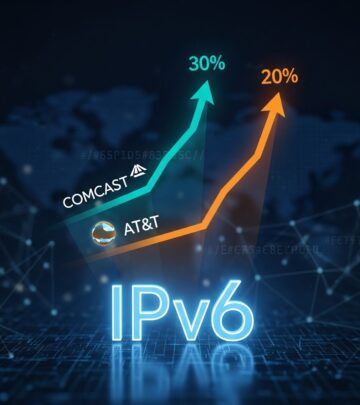
Major telecommunications providers have been instrumental in pushing IPv6 to the forefront, particularly in mobile networks where device density demands efficient addressing. T-Mobile boasts 88.4% IPv6 deployment, followed closely by AT&T and Verizon at 74-74.8%. These carriers enable seamless IPv6 for end-users, often without their knowledge, embedding the protocol into everyday connectivity.
This leadership extends beyond the US. Providers worldwide are adopting IPv6-only or IPv6-preferred models, reducing reliance on carrier-grade NAT (CGNAT) that complicates traffic management and security. The result is simpler routing, better performance, and lower operational costs, incentivizing broader rollout.
Cloud Computing’s Embrace of IPv6
Cloud services represent another powerhouse in IPv6 adoption. Amazon Web Services (AWS) has ramped up native IPv6 offerings, setting a standard for competitors. In 2026, expectations are high for accelerated provisioning of IPv6 resources across major platforms, simplifying end-to-end connectivity and minimizing NAT layers that inflate expenses.
IPv6-mostly networks are emerging as the norm, where IPv6 handles primary operations and IPv4 serves as a fallback via mechanisms like CLAT (Customer-side IPv4 to IPv6 translation). This model streamlines hybrid environments, making IPv6 the default for distributed systems critical to business and public sectors.
Key Benefits in Cloud Environments
- Scalability: Virtually unlimited addresses support massive IoT and edge deployments.
- Cost Efficiency: Eliminates complex NAT, reducing latency and management overhead.
- Security Enhancements: Built-in IPsec support and simpler state tracking bolster defenses.
- Global Reach: Native support aligns with international peering without translation hurdles.
Client-Side Maturity: OS and Device Support
Operating systems are catching up decisively. Microsoft’s announcement of default CLAT in Windows enables devices to prioritize IPv6, translating to IPv4 only when needed. This shift is pivotal for enterprise and consumer endpoints alike.
On the Linux front, distributions like Ubuntu, Debian, RHEL, and Rocky Linux are standardizing features such as DHCP Option 108 for route advertisements and robust CLAT implementations. These enhancements ensure consistent, plug-and-play IPv6 across desktops, servers, and embedded systems, maturing the client ecosystem.
| Provider | IPv6 Percentage | Region/Notes |
|---|---|---|
| 46.49% (Native) | Global, Apr 30 | |
| 60.73% | US | |
| Cisco | 67.86% | US |
| T-Mobile | 88.4% | Mobile Network |
| Average Global | 48.8% | All Traffic |
Regional Variations and Global Trends
Adoption isn’t uniform. The US leads with over 56% via Google metrics, fueled by aggressive carrier strategies. Europe and parts of Asia follow, while some developing regions lag due to legacy infrastructure. However, the trajectory is upward everywhere, with fixed broadband and mobile sectors converging on 50%+.
APNIC notes that IPv6 is now integral to daily operations across economies, from personal devices to data centers. This maturity dispels notions of it as experimental, affirming its role in a multi-trillion device future.
Overcoming Legacy Challenges
IPv4’s persistence stems from its entrenchment, but tools like 464XLAT and dual-stack lite bridge the gap. IPv6-only networks with IPv4 compatibility layers are gaining traction, particularly where address scarcity bites hardest, such as cellular IoT.
Challenges remain: inconsistent application support and middlebox interference. Yet, as ecosystems standardize, these fade. The protocol’s auto-configuration (SLAAC) and neighbor discovery streamline deployment, outpacing IPv4’s manual configurations.
Future Outlook: IPv6-Dominant Internet
By late 2026, IPv6 is poised to claim majority status outright. LACNIC predicts consolidation of IPv6-mostly paradigms, with clouds and enterprises designing natively. Non-commercial sites may opt for IPv6 primary with CGNAT IPv4, mirroring current practices in IPv4-scarce areas.
Long-term, IPv4 deactivation is unlikely soon, but its role diminishes to legacy. IPv6 unlocks innovations like seamless IoT meshes, micro-segmented security, and efficient content delivery networks.
Strategic Recommendations for Organizations
- Audit current dual-stack setups for IPv6 prioritization.
- Test applications in IPv6-only environments using translation tools.
- Partner with IPv6-forward providers for cloud and connectivity.
- Train teams on IPv6 troubleshooting and best practices.
Frequently Asked Questions
What is driving IPv6 adoption in 2026?
Key drivers include telecom deployments, cloud native support, OS enhancements like Windows CLAT, and IPv4 exhaustion pressures.
Is IPv6 faster than IPv4?
Often yes, due to no NAT overhead, larger packets, and optimized routing, though results vary by network.
Will IPv4 disappear?
Not imminently; it will coexist via translations, but IPv6 will dominate new deployments.
How do I check my IPv6 connectivity?
Use tools like Google’s IPv6 test or test-ipv6.com.
What are the security implications of IPv6?
Stronger with mandatory IPsec, but requires proper firewalling of extension headers.
References
- IPv6 Adoption — Google. 2026-04-30. https://www.google.com/intl/en/ipv6/
- What to Expect From IPv6 in 2026 — LACNIC Blog. 2026. https://blog.lacnic.net/en/ipv6-2026/
- Google hits 50% IPv6 — APNIC Blog. 2026-04-28. https://blog.apnic.net/2026/04/28/google-hits-50-ipv6/
- The Switch To Six, Part II: The IPv6 Tipping Point Is Here — SixMap Blog. 2026. https://www.sixmap.io/blog/ipv6-tipping-point-is-here-part-two/
- Google: IPv6 carried half of internet traffic for one day — The Register. 2026-04-17. https://www.theregister.com/2026/04/17/ipv6_50_percent_google/
Similar Articles






Read full bio of medha deb