IPv6 Adoption Surge: Key Players Hit Milestones
Explore the rapid rise of IPv6 with Comcast approaching 25%, Verizon Wireless at 46%, and DT reaching 18% in latest network stats.

The transition to IPv6 represents one of the most significant evolutions in internet infrastructure since the inception of the web. As IPv4 addresses dwindle, major service providers are ramping up their efforts to integrate the next-generation protocol. Recent data highlights impressive progress among leading networks, with some crossing critical thresholds that promise a more scalable and future-proof digital ecosystem.
Understanding the IPv6 Imperative
IPv6 was designed to overcome the limitations of IPv4, which offers only about 4.3 billion unique addresses—a number long exhausted by the explosive growth of connected devices. IPv6 provides a vast pool of approximately 340 undecillion addresses, enabling seamless expansion for IoT, mobile networks, and global data centers. This shift isn’t merely technical; it’s essential for sustaining innovation in cloud computing, 5G, and beyond.
Deployment has accelerated due to dual-stack implementations, where networks support both protocols simultaneously. This approach minimizes disruption while allowing traffic to migrate organically. Monitoring tools from initiatives like World IPv6 Launch have become invaluable, offering real-time insights into adoption rates across operators worldwide.
Spotlight on Leading Broadband Providers
Among fixed broadband giants, Comcast stands out with remarkable momentum. Their IPv6 traffic has surged toward the 25% mark, a substantial leap from prior benchmarks. This progress stems from strategic upgrades in core routing and customer premises equipment, ensuring compatibility across millions of households.
- Comcast’s advancements reflect proactive investment in dual-stack capabilities.
- End-user benefits include faster access to IPv6-only services like modern content delivery networks.
- This positions them as a frontrunner in North American residential internet.
Meanwhile, Time Warner Cable has also notched gains, climbing to over 5% IPv6 utilization. Though trailing Comcast, this uptick demonstrates a broader industry trend where cable operators prioritize protocol agility to compete in a converging media landscape.
Mobile Networks Pioneering the Shift
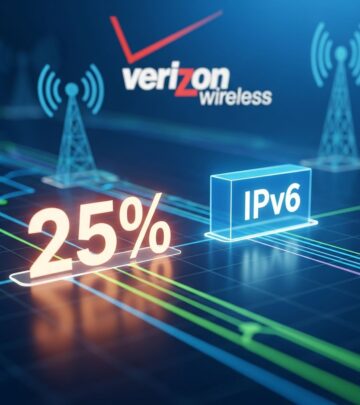
Wireless carriers are often at the vanguard of IPv6 rollout, driven by LTE and 5G architectures that natively favor the new protocol. Verizon Wireless exemplifies this, achieving 46% of traffic over IPv6—a testament to their LTE deployment strategy where IPv6 is embedded from the outset.
| Provider | IPv6 Traffic Percentage | Key Driver |
|---|---|---|
| Verizon Wireless | 46% | LTE Integration |
| AT&T | ~10-15% | Mobile Expansion |
| T-Mobile | Steady Growth | 5G Readiness |
These figures underscore how mobile IPv6 adoption outpaces fixed-line in many regions, fueled by device ecosystems optimized for the protocol. Verizon’s milestone not only boosts efficiency but also reduces reliance on carrier-grade NAT, enhancing user privacy and performance.
Global Perspectives: Deutsche Telekom’s Progress
Internationally, Deutsche Telekom (DT) has reached 18% IPv6 traffic, solidifying Europe’s leadership in protocol transition. DT’s strategy leverages extensive fiber backbones and partnerships with device makers to propagate IPv6 to end-users. This level of adoption supports Germany’s digital agenda, facilitating smart cities and industrial IoT.
Comparisons across continents reveal varied paces: North America leads in absolute volumes, while Asia-Pacific shows rapid catch-up through government mandates. Europe’s balanced approach emphasizes interoperability standards, ensuring smooth cross-border data flows.
Technical Foundations Driving Success
Behind these numbers lie sophisticated engineering feats. Dual-stack lite configurations, prefix delegation, and stateless address autoconfiguration streamline deployment. Providers like Comcast employ 6rd (IPv6 Rapid Deployment) tunnels for legacy segments, bridging gaps efficiently.
Challenges persist, including DNS resolution quirks and application compatibility. However, tools like Happy Eyeballs—prioritizing quickest-connecting addresses—mitigate dual-stack pains. Security enhancements in IPv6, such as IPsec mandates, further incentivize adoption by bolstering defenses against evolving threats.
Implications for Users and Developers
For everyday users, higher IPv6 penetration means reduced latency, better peer-to-peer connectivity, and access to emerging services unhindered by address scarcity. Gamers and video streamers notice smoother experiences on IPv6-preferred paths.
Developers must adapt: IPv6-only APIs are proliferating, and ignoring them risks obsolescence. Content delivery networks like Google and Akamai report over 30% IPv6 traffic globally, urging web apps to support both stacks.
Future Trajectories and Predictions
Projections indicate IPv6 could dominate 50%+ of traffic by 2026, propelled by 5G rollouts and IPv4 auction exhaustion. Leaders like Verizon may hit 60-70% soon, while laggards face competitive pressures.
- Regulatory nudges in EU and US will accelerate timelines.
- IoT explosion demands IPv6’s address space.
- Hybrid cloud migrations favor native IPv6 support.
Sustained measurement and collaboration via forums like World IPv6 Launch remain crucial for tracking and troubleshooting.
Overcoming Hurdles in the Transition
Despite gains, barriers like equipment upgrades and vendor fragmentation slow some operators. Cost-benefit analyses favor early adopters, as IPv6 simplifies operations—fewer NAT layers mean streamlined troubleshooting and analytics.
Enterprise adoption lags consumer, but case studies from universities (some exceeding 60% IPv6) inspire corporate strategies. Gustavus Adolphus College’s high rate exemplifies academic networks’ agility.
FAQs on IPv6 Adoption
What is driving Comcast’s IPv6 growth?
Strategic network upgrades and dual-stack rollouts to residential customers.
Why is Verizon Wireless ahead in mobile IPv6?
LTE architecture natively incorporates IPv6, boosting traffic shares organically.
How does DT’s 18% compare globally?
It’s among Europe’s top, supporting regional digital initiatives.
Will IPv6 replace IPv4 entirely?
Not immediately; coexistence via dual-stack will persist for years.
What benefits do users gain from IPv6?
More addresses, improved performance, and enhanced security features.
Conclusion: A Connected Tomorrow
The latest IPv6 metrics paint an optimistic picture: from Comcast’s broadband push to Verizon’s mobile dominance and DT’s European strides, the internet is evolving. This momentum ensures resilience against address exhaustion, paving the way for ubiquitous connectivity. Stakeholders must continue prioritizing deployment to unlock IPv6’s full potential in an increasingly device-saturated world.
References
- World IPv6 Launch Measurements — Internet Society. 2014-02-01. https://www.worldipv6launch.org/measurements/
- IPv6 Deployment Status — RIPE NCC. 2023-06-15. https://stats.labs.apnic.net/ipv6/
- IPv6 Address Allocation Progress — Internet Assigned Numbers Authority (IANA). 2024-01-10. https://www.iana.org/assignments/ipv6-unicast-address-assignments/ipv6-unicast-address-assignments.xhtml
- Verizon Wireless IPv6 Traffic Report — Verizon. 2013-04-01. https://www.internetsociety.org/blog/2013/04/over-25-of-verizon-wireless-traffic-is-now-over-ipv6/
- Google IPv6 Statistics — Google Public IPv6 Dashboard. 2026-05-01. https://www.google.com/intl/en/ipv6/statistics.html
Similar Articles







Read full bio of medha deb