IPv6 Adoption: Critical Considerations for Modern Broadcasters
Understanding the transition from IPv4 to IPv6 and its impact on broadcasting infrastructure
Introduction: The Inevitable Transition
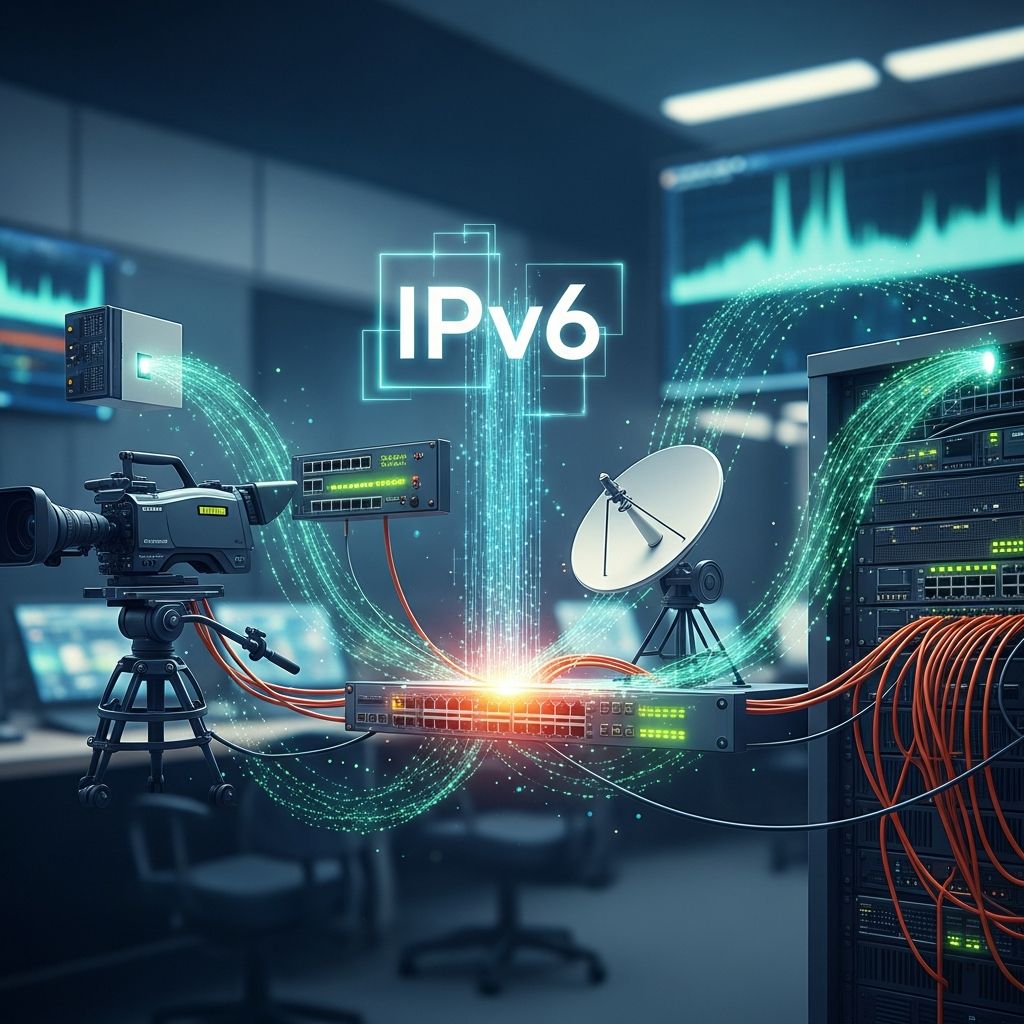
The landscape of digital broadcasting has undergone significant transformation over the past two decades, driven primarily by technological advancement and exponential internet growth. As broadcasting infrastructure becomes increasingly dependent on Internet Protocol (IP) technologies, media organizations face a critical juncture: adapting their networks to support IPv6, the next-generation internet protocol that promises to address fundamental limitations of its predecessor, IPv4.
While many broadcasters continue operating successfully with established IPv4 networks, the impending exhaustion of available IPv4 addresses creates urgent pressure to understand and plan for IPv6 integration. This transition represents more than a simple technical upgrade; it fundamentally reshapes how broadcasters approach network architecture, content distribution, device connectivity, and audience reach.
Understanding the Address Space Crisis
To comprehend why IPv6 matters to broadcasting organizations, one must first grasp the limitations of IPv4 addressing. IPv4 utilizes a 32-bit address scheme, theoretically providing approximately 4.3 billion unique addresses. When the internet protocol was standardized in the 1980s, this seemed like an virtually inexhaustible supply. However, the explosive growth of connected devices—from smartphones to Internet of Things sensors—has depleted this resource far more rapidly than early architects anticipated.
Regional Internet Registries across the globe have begun exhausting their IPv4allocation pools. Once these repositories are completely depleted, no new IPv4 addresses will become available through normal assignment channels. Organizations seeking additional addresses will be forced to purchase them from existing holders, transforming IP addresses into a tradeable commodity with associated costs and market volatility.
IPv6 addresses, by contrast, employ a 128-bit addressing scheme, generating approximately 340 undecillion unique addresses—a number so large it exceeds practical comprehension. This dramatic expansion ensures that address scarcity will never constrain network expansion for any foreseeable future application or use case.
Architectural Advantages Beyond Address Capacity
Elimination of Network Address Translation
Perhaps the most significant operational benefit IPv6 provides to broadcasters involves the elimination of Network Address Translation (NAT). Traditional IPv4 networks rely heavily on NAT to manage communication between private internal networks and public internet resources. This translation layer, while functional, introduces complexity and administrative overhead.
IPv6 architecture enables all devices to possess genuinely unique, publicly routable addresses. This fundamental design change restores the original end-to-end connectivity model that Internet Protocol was designed to support. For broadcasters, this means:
- Direct device-to-device communication without intermediate translation layers
- Significant reduction in IT administration burden related to NAT configuration and troubleshooting
- Simplified remote equipment management and monitoring across geographic boundaries
- More straightforward integration of mobile broadcast equipment and roaming devices
Integrated Quality of Service Capabilities
Broadcasting depends fundamentally on reliable, consistent data delivery. IPv4 networks implement a “best effort” delivery model, where all packets receive equal treatment regardless of their importance or content type. This approach works adequately for many applications but presents challenges for real-time media distribution where interruption or degradation directly impacts audience experience.
IPv6 incorporates Quality of Service (QoS) provisions directly into its protocol specification. The traffic-class field embedded within IPv6 packet headers allows network administrators to assign priority levels to different data streams. Broadcasters can designate audio and video packets with higher priority than routine data transfer, ensuring critical content maintains consistent quality even during network congestion.
This built-in QoS functionality eliminates the need for complex external QoS implementations and reduces the technical expertise required to maintain broadcast network performance standards.
Enhanced Mobility and Device Roaming
Modern broadcasting increasingly involves remote operations and mobile equipment. Satellite trucks, portable encoder units, and distributed news gathering systems require seamless connectivity regardless of location. IPv6 includes native mobility provisions that fundamentally improve how roaming devices operate.
Under IPv6, a mobile broadcast device retains the same global IP address as it moves between different network locations. This contrasts sharply with IPv4 environments where devices typically receive new addresses when connecting to different networks. The ability to maintain consistent addressing eliminates complicated workarounds and reduces connection establishment time, critical factors for time-sensitive broadcast operations.
Multicast Efficiency and Content Distribution
Multicasting represents a crucial technology for bandwidth-efficient content distribution, yet IPv4’s multicast implementation requires specialized routers and complex configuration. IPv6 fundamentally redesigns multicasting by embedding multicast routing intelligence directly into the addressing scheme itself.
IPv6 multicast addresses inherently support hierarchical distribution from local through global scope levels. This architectural improvement enables broadcasters to implement sophisticated, scalable content distribution networks without specialized equipment or complex manual configuration. Local multicast within facility networks becomes simpler, while multi-region distribution scales more efficiently than traditional IPv4 approaches.
For streaming audio operations, this means broadcasters can distribute content to listeners across different geographic regions and network segments using a single transmission path, maximizing bandwidth utilization and reducing redundant data transmission.
Security Implications and Device-Level Authentication
Security considerations extend beyond traditional firewall-based perimeter protection. IPv6’s unique addressing model enables more granular security implementation at the individual device level. Because every device possesses a genuine public address, security policies can be applied with greater precision and specificity than IPv4’s NAT-dependent model typically allows.
End-to-end authentication becomes simpler in IPv6 environments, as the network can definitively identify the true originating device rather than dealing with translated addresses. This capability supports stronger security practices for remote broadcast equipment, telemetry systems, and distributed studio operations. Network administrators can implement device-level security controls that provide enhanced protection compared to traditional network-perimeter approaches.
Protocol Efficiency and Performance Improvements
IPv6 header structure incorporates fixed-length fields and larger payload capacity compared to IPv4. These design improvements reduce the computational overhead required for packet processing within network routers and switching equipment. Research examining network performance has demonstrated measurable throughput improvements with IPv6 implementations, with some studies indicating IPv6 content delivery reaches end users approximately 15% faster than equivalent IPv4 delivery paths.
For broadcasters distributing time-sensitive live content, these performance gains translate directly into improved audience experience and more competitive positioning against alternative content sources.
Migration Strategy: Dual-Stack Implementation
Despite IPv6’s substantial advantages, immediate complete migration from IPv4 remains impractical for most broadcast organizations. IPv4 will persist as legacy infrastructure for many years, with countless devices, networks, and services continuing to operate exclusively under the older protocol.
The industry standard approach involves implementing dual-stack networks that simultaneously support both IPv4 and IPv6 protocols. This strategy allows gradual migration while maintaining compatibility with existing systems and audience access patterns. Broadcasters can incrementally upgrade network components, equipment, and services to IPv6 support without disrupting ongoing operations.
Major Internet Service Providers and network equipment manufacturers have already implemented IPv6 support in their core infrastructures and products. Operating systems across all major platforms provide native IPv6 support, eliminating technical barriers to adoption. This ecosystem maturity means broadcasters need not await technological breakthroughs before beginning migration planning.
Audience Reach and IPv6-Only Connectivity
An increasingly important consideration involves audience accessibility. As IPv4 address depletion progresses, regions and providers are deploying IPv6-only networks due to economic and practical constraints. These IPv6-exclusive environments cannot access content served exclusively over IPv4 infrastructure.
Broadcasters providing content exclusively in IPv4 format gradually restrict their addressable audience as IPv6-only populations grow. Content providers already implementing IPv6 deliver superior quality of experience to these audiences compared to those accessing via translation mechanisms, which introduces latency and potential degradation particularly affecting real-time audio and video streams.
Strategic broadcasters view IPv6 adoption as essential for maintaining and expanding audience reach in emerging markets and regions where infrastructure deployment directly implements IPv6 rather than IPv4.
Key Considerations for Implementation
Planning Framework
- Audit existing broadcast infrastructure to identify IPv4-dependent systems and equipment
- Prioritize equipment upgrades based on operational criticality and manufacturer support timelines
- Implement IPv6 alongside existing IPv4 networks rather than attempting simultaneous replacement
- Evaluate equipment suppliers’ IPv6 support roadmaps and implementation timelines
- Establish internal expertise through training and professional development
- Test IPv6 implementations thoroughly before deploying to production broadcast systems
Equipment Considerations
Audio codecs, streaming servers, routing equipment, and monitoring systems should support IPv6 connectivity. While most modern equipment incorporates this capability, legacy systems may require replacement. Broadcasters should incorporate IPv6 compatibility as a standard requirement in equipment procurement specifications.
Conclusion: The Strategic Imperative
IPv6 adoption represents not merely a technical inevitability but a strategic opportunity for broadcasters to modernize infrastructure, expand addressable audiences, and improve operational efficiency. The transition from IPv4 to IPv6 offers immediate benefits through enhanced security, improved quality of service, eliminated translation complexity, and simplified device mobility.
Rather than viewing IPv6 migration as a future concern, forward-thinking broadcast organizations should incorporate IPv6 planning into current network design initiatives. Dual-stack implementations allow gradual transition while maintaining operational continuity. As regional address pools exhaust and IPv6-only networks proliferate, broadcasters who have already completed migration will retain competitive advantages in content delivery quality, operational simplicity, and audience accessibility.
The broadcasting industry’s dependence on reliable, efficient network infrastructure makes IPv6 adoption not simply advantageous but essential for long-term operational sustainability and audience service excellence.
References
- Why IPv6 Matters to Your Station — TVTechnology. Accessed May 2026. https://www.tvtechnology.com/news/why-ipv6-matters-to-your-station
- Internet Protocol Version 6 (IPv6) Specification — Internet Engineering Task Force (IETF) RFC 2460. December 1998. https://tools.ietf.org/html/rfc2460
- Do I Really Need IPv6? — Radio World. Accessed May 2026. https://www.radioworld.com/tech-and-gear/radio-it-management/do-i-really-need-ipv6
- IPv6 for Broadcasters — Society of Broadcast Engineers. Accessed May 2026. https://sbe.org/webinars_on_demand/ipv6-broadcasters/
- What Does IPv6 Mean to Broadcasters? — Radio World. Accessed May 2026. https://www.radioworld.com/news-and-business/what-does-ipv6-mean-to-broadcasters
Similar Articles








Read full bio of Sneha Tete