IPv6 Adoption Milestone: US Carriers Lead
Explore how Verizon, T-Mobile, and AT&T pioneered IPv6 deployment, setting the stage for today's global internet evolution.

The transition from IPv4 to IPv6 represents one of the most critical evolutions in internet infrastructure. As early as 2014, major US mobile carriers demonstrated remarkable progress in this shift, with Verizon Wireless achieving 56% of its traffic over IPv6, T-Mobile USA at 40%, and AT&T at 24%. These figures, captured through World IPv6 Launch measurements, highlighted a pivotal moment when North American networks began outpacing global averages, laying groundwork for the expansive, future-proof addressing we rely on today.
Understanding the IPv6 Imperative
IPv4, with its 4.3 billion unique addresses, powered the internet’s explosive growth from the 1980s through the 2000s. However, by the early 2010s, address exhaustion became inevitable. IPv6, offering approximately 340 undecillion addresses, resolves this by expanding the address space to 128 bits. Beyond capacity, IPv6 enhances security through built-in IPsec support, simplifies routing, and enables efficient peer-to-peer communications without NAT complexities.
The urgency peaked around 2011 when regional internet registries began rationing IPv4 allocations. Organizations like the Internet Society championed World IPv6 Launch initiatives to accelerate adoption. US carriers responded aggressively, driven by LTE rollouts that demanded native dual-stack implementations—running both protocols simultaneously.
Verizon Wireless: Pioneering at 56%
Verizon Wireless emerged as the frontrunner, hitting 56% IPv6 traffic by September 2014. This wasn’t accidental; starting in 2010, Verizon integrated IPv6 into its LTE core network. Devices connecting via LTE received native IPv6 addresses, bypassing IPv4 tunneling. By mid-2011, over 50% of new activations were IPv6-capable, fueled by partnerships with device makers like Apple and Samsung.
Key strategies included:
- Dual-stack LTE deployment: Every LTE subscriber got a /56 IPv6 prefix, enabling end-to-end connectivity.
- Content partnerships: Collaborations with Google, Facebook, and Akamai ensured popular sites were IPv6-ready, boosting measurable traffic.
- Monitoring and optimization: Real-time analytics tracked IPv6 hit rates, allowing rapid fixes for dual-stack issues.
These efforts yielded rapid growth: from under 1% in early 2011 to double digits by year’s end, culminating in the 2014 milestone. Verizon’s approach influenced global mobile IPv6 strategies.
T-Mobile USA’s Aggressive Push to 40%
T-Mobile USA followed closely at 40%, leveraging innovative transition technologies. Launching IPv6 in 2012, T-Mobile adopted 464XLAT—a mechanism translating IPv4 to IPv6 and back seamlessly. This allowed full IPv6 deployment even with legacy IPv4 apps dominant.
T-Mobile’s timeline featured:
- 2012 rollout: Native IPv6 for all LTE users, achieving 20% within months.
- Device ecosystem focus: Prioritizing firmware updates for Android and iOS compatibility.
- Network slicing: IPv6 prioritized for high-bandwidth services like video streaming.
By 2014, T-Mobile’s metrics reflected content provider readiness, with YouTube and Netflix contributing significantly to IPv6 traffic shares.
AT&T’s Steady Climb to 24%
AT&T reached 24%, trailing but substantial for a carrier serving diverse fixed and mobile segments. AT&T’s strategy emphasized gradual integration, starting with enterprise customers before expanding to consumers. Dual-stack on LTE began in 2012, with public metrics showing steady 5-10% quarterly gains.
AT&T differentiated through:
- Hybrid models: Combining native IPv6 with 6rd (IPv6 Rapid Deployment) for broadband.
- Enterprise leadership: IPv6 for business VPNs drove internal adoption.
- Global alignment: Syncing with international subsidiaries for consistent policies.
Though behind Verizon and T-Mobile, AT&T’s scale amplified its impact on US IPv6 averages.
Global Context and Comparative Insights
In 2014, US carriers led worldwide. Europe’s averages hovered below 5%, Asia varied widely, and fixed broadband lagged mobile. A table illustrates top performers:
| Provider | Country | IPv6 Traffic (%) |
|---|---|---|
| Verizon Wireless | USA | 56 |
| T-Mobile USA | USA | 40 |
| AT&T | USA | 24 |
| Deutsche Telekom | Germany | 15 |
| Free (Iliad) | France | 12 |
These US figures contrasted sharply with global 2-3% averages, per World IPv6 Launch data.
Technical Enablers of Success
Carriers overcame hurdles via:
- DNS64 and NAT64: For IPv6-only clients accessing IPv4 content.
- Happy Eyeballs algorithm: Clients preferring fastest-connecting protocol.
- Prefix delegation: Assigning large IPv6 blocks to routers for subnetting.
Device support was crucial; by 2014, 90%+ of smartphones handled IPv6 natively.
From 2014 to 2026: Explosive Growth
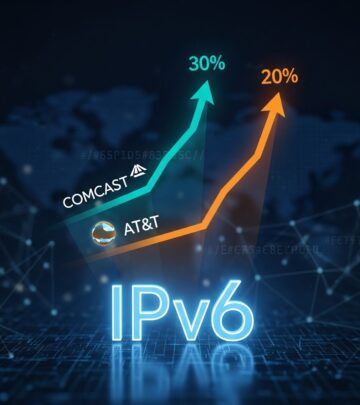
Building on 2014 foundations, adoption surged. Google’s IPv6 stats show US mobile exceeding 70% by 2023, global at 45-50% as of 2026. Verizon maintains leadership at ~75%, per APNIC labs. Fixed broadband caught up, with Comcast at 45%.
Drivers include 5G mandates for IPv6, IoT proliferation, and cloud-native services assuming IPv6.
Challenges Persisting Today
Despite progress:
- Legacy systems: Enterprise IT lags residential.
- Middle-mile gaps: Some ISPs still IPv4-dominant.
- Security tooling: IPv6 requires updated firewalls and monitoring.
Yet, benefits like reduced NAT overhead and direct IoT connectivity outweigh hurdles.
Future Horizons for IPv6
IPv6 enables 5G slicing, edge computing, and satellite internet like Starlink. Projections: 80% global by 2030. Carriers must prioritize IPv6-only pilots to phase out IPv4.
Frequently Asked Questions
What triggered the 2014 IPv6 surge in US carriers?
LTE deployments necessitated native addressing, combined with World IPv6 Launch pressure and content provider readiness.
Is IPv6 faster than IPv4?
Often yes, due to no NAT translation and larger headers optimized for modern routing.
Will IPv4 disappear soon?
Not immediately; dual-stack persists, but IPv6 will dominate new allocations.
How do I check my IPv6 connectivity?
Use sites like test-ipv6.com or Google’s statistics dashboard.
Why did mobile lead fixed broadband in IPv6?
New LTE networks started fresh, unlike brownfield fixed infrastructures.
References
- IPv6 Statistics — Google. 2026-05-09 (live). https://www.google.com/intl/en/ipv6/statistics.html
- IPv6 Deployment Update — APNIC Labs. 2016-05-13. https://stats.labs.apnic.net/ipv6/
- World IPv6 Launch Measurements — World IPv6 Launch. 2014-06-01. https://www.worldipv6launch.org/measurements/
- IPv6 at Verizon Wireless — APNIC. 2013-01-01. https://www.apnic.net/wp-content/uploads/2017/01/vzw_apnic_13462152832-2.pdf
- IPv6 Adoption by ISP — NetBeez. 2023-01-01 (updated). https://netbeez.net/blog/ipv6-adoption/
Similar Articles








Read full bio of Sneha Tete