IPv4 Exhaustion: Why IPv6 Transition is Essential Now
ARIN's IPv4 free pool depleted years ago—discover why organizations must prioritize IPv6 adoption for future-proof networking in 2026.
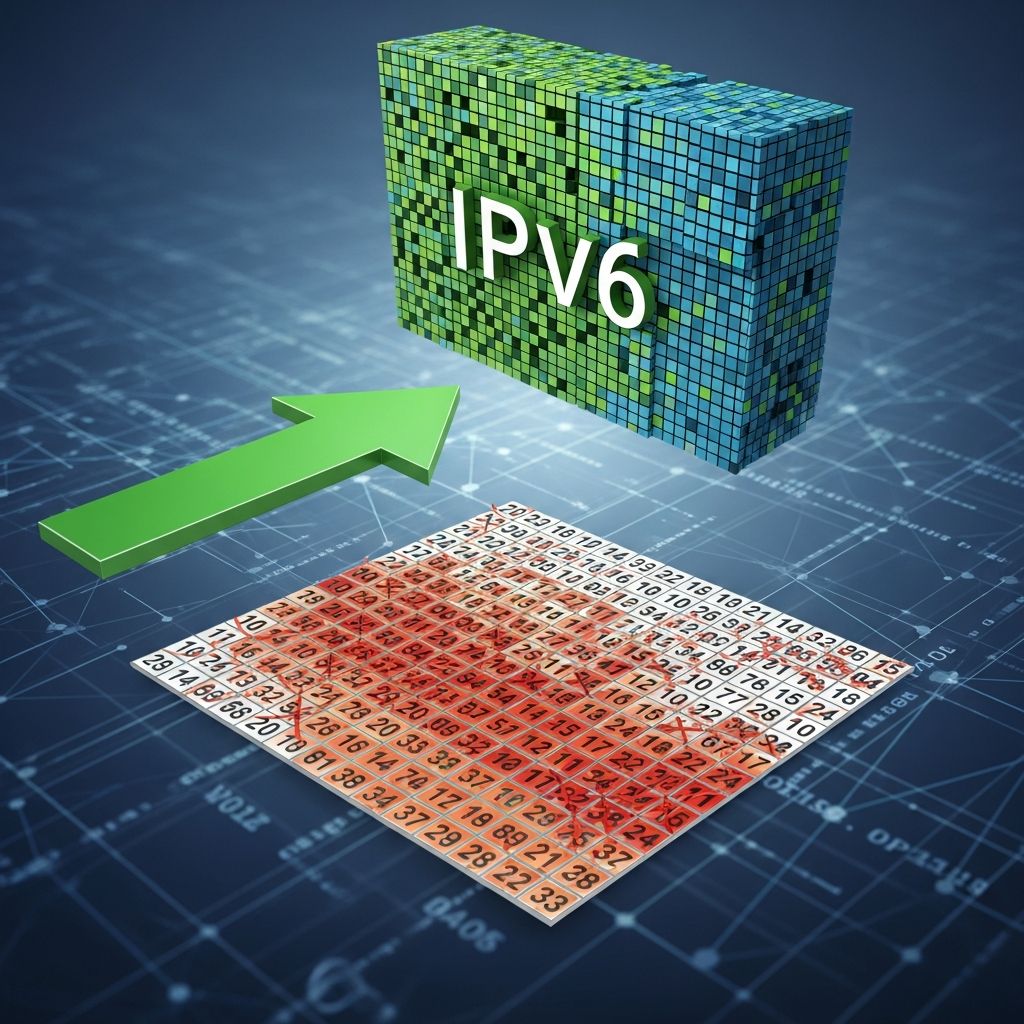
The Internet’s foundational addressing system, IPv4, is running on fumes. With only about 4.3 billion unique addresses available, the explosive growth of connected devices—from smartphones and IoT sensors to cloud servers—has pushed this resource to its limits. Regional Internet Registries (RIRs) like ARIN, responsible for North America, have long depleted their free pools, forcing a pivotal shift to IPv6. This article delves into the historical context of IPv4 scarcity, the mechanics of IPv6, current adoption landscapes, policy frameworks, and actionable strategies for organizations to navigate this transition effectively.
The Roots of the IPv4 Crisis
IPv4 addresses, structured as 32-bit numbers (e.g., 192.168.1.1), were sufficient for the early Internet era. However, by the early 2010s, demand outstripped supply. In 2011, the Internet Assigned Numbers Authority (IANA) distributed its final /8 blocks of IPv4 to the five RIRs, marking a global turning point. ARIN received its last major allocation around this time, initiating a countdown to exhaustion.
By September 24, 2015, ARIN officially depleted its IPv4 free pool.1 This wasn’t an abrupt halt; policies were enacted to manage the remainder. Organizations could no longer receive large blocks freely, shifting to waiting lists for returned or revoked addresses. This scarcity has persisted into 2026, with IPv4 now primarily sourced via transfers or limited reserves.
- Key Milestones: IANA’s final distribution (2011), ARIN’s last /8 integration (2014), free pool exhaustion (2015).
- Impact: Surging prices in the IPv4 transfer market, averaging $40–$50 per address in recent years.
Understanding IPv6: A Vast Address Universe
IPv6 employs 128-bit addresses (e.g., 2001:0db8:85a3:0000:0000:8a2e:0370:7334), offering approximately 340 undecillion unique identifiers—enough for every device on Earth, multiple times over. Beyond capacity, IPv6 simplifies networking with features like stateless autoconfiguration, eliminating NAT complexities, and built-in IPsec for security.
| Feature | IPv4 | IPv6 |
|---|---|---|
| Address Size | 32 bits (4.3B addresses) | 128 bits (3.4×1038 addresses) |
| NAT Requirement | Often needed | Not required |
| Configuration | DHCP/manual | Stateless autoconfig |
| Security | Optional IPsec | Mandatory IPsec-ready |
| Mobility Support | Limited | Native |
This table highlights why IPv6 isn’t just a patch—it’s a redesign for modern demands like 5G, edge computing, and hyper-scale data centers.
ARIN’s Post-Depletion Policies and IPv4 Reserves
Anticipating exhaustion, ARIN’s community developed the IPv4 Countdown Plan, retired in 2016 after Phase Four.2 Today, IPv4 requests fall under specific policies:
- NRPM 4.10: A reserved /10 block for IPv6 deployment facilitation. Eligible organizations receive a /24 (256 addresses) for dual-stack DNS or NAT translators, provided no prior allocation in six months and demonstrated need.1
- Waiting List: Unmet requests queue for recovered space from returns, revocations, or IANA distributions.
- Micro-Allocations (NRPM 4.4): For critical infrastructure like IXPs and DNS providers.
These measures extend IPv4’s utility as a bridge, but they underscore IPv6’s necessity. Everyone qualifies for IPv6 allocations, often /48 for end-sites, with no free pool limits.3
Global IPv6 Adoption Trends in 2026
From under 10% in 2015, global IPv6 usage has surged to around 40–45% by late 2023, continuing upward.6 Native adoption—devices connecting directly via IPv6—drives this, led by mobile networks (e.g., T-Mobile at 95%+), Google (over 40%), and Facebook.
ARIN reports steady IPv6 allocations since 1999, with campaigns like ‘IPv6: Let’s Grow!’ boosting uptake.3 In 2021, RIRs issued equivalent of 29,000 /32s, a 30% YoY increase, though ARIN saw some decline in large blocks.6 APNIC notes peak IPv4 allocations in 2010 at 250M addresses, now dwarfed by IPv6 volumes.
IPv6 adoption grows year-over-year, but full transition requires proactive planning amid fragmented progress.
Challenges and Myths Hindering IPv6 Rollout
Despite advantages, barriers persist:
- Compatibility Concerns: Myth that IPv6 breaks legacy apps—most modern OSes (Windows 10+, Linux, iOS) support dual-stack seamlessly.
- Cost Fears: Initial hardware upgrades, but long-term savings from no NAT and efficient routing.
- Inertia: ‘If IPv4 works, why change?’ Yet, NAT-induced complexities and address shortages inflate costs.
- Skill Gaps: Teams need training; tools like Hurricane Electric’s tunnelbroker.net aid testing.
Reality: Dual-stack (running both protocols) minimizes disruption, with IPv6 preferred for new connections.
Step-by-Step Guide to IPv6 Migration
- Assess Inventory: Audit devices, apps, and services for IPv6 readiness using tools like test-ipv6.com.
- Request Space: Apply to ARIN for IPv6 (/48 for sites, larger for ISPs). Justify via NRPM 6.3
- Enable Dual-Stack: Configure routers (e.g., Cisco IOS:
ipv6 unicast-routing), DNS (A+AAAA records), and firewalls. - Leverage Transitions: 6to4, Teredo, or NAT64 for islands; request /24 IPv4 aid via NRPM 4.10.
- Test & Monitor: Use Wireshark for traffic analysis; track with Google IPv6 stats.
- Go Native: Phase out IPv4 dependencies over 12–24 months.
Case Study: Comcast achieved 70%+ IPv6 penetration via dual-stack, reducing operational costs significantly.
Future Outlook: IPv6 as the New Standard
By 2026, IPv6 is no longer ‘next-gen’—it’s operational reality. With IoT projected at 75B devices by 2030, IPv4’s scarcity will intensify transfer market pressures. RIRs like ARIN emphasize: Request IPv6 now for growth.3 Governments (e.g., US Federal mandates) and enterprises lead, but SMEs lag.
Benefits extend to performance: IPv6’s header efficiency boosts speeds, and end-to-end connectivity enables innovations like seamless VR/AR streaming.
Frequently Asked Questions (FAQs)
Is IPv4 completely gone?
No, but free allocations ended in 2015. Use waiting lists, transfers, or reserves.2
Can I get IPv4 for IPv6 transition?
Yes, /24 via NRPM 4.10 every six months if justifying IPv6 needs.1
How much IPv6 space do I need?
ARIN assigns /48 (65K /64 subnets) to most orgs—ample for expansion.3
What’s dual-stack?
Running IPv4 and IPv6 concurrently, allowing gradual migration.
Is IPv6 secure?
Yes, with IPsec integration and no NAT obfuscation vulnerabilities.
In summary, the IPv4 era’s end compels IPv6 embrace. Delaying risks stagnation; acting now ensures scalability and innovation.
References
- Request IPv4 Addresses — American Registry for Internet Numbers (ARIN). 2023 (ongoing). https://www.arin.net/resources/guide/ipv4/request/
- IPv4 Addressing Options — ARIN. 2023 (ongoing). https://www.arin.net/resources/guide/ipv4/
- Let’s Grow with IPv6 — ARIN. 2023-01-30. https://www.arin.net/blog/2023/01/30/lets-grow-ipv6/
- IPv4 Depletion – FAQ — ARIN. 2023 (ongoing). https://www.arin.net/vault/resources/guide/request/ipv4_depletion/
- The History of IPv6 @ ARIN — ARIN. 2023 (ongoing). https://www.arin.net/resources/guide/ipv6/history/
- Another year of the transition to IPv6 — APNIC Blog. 2022-02-21. https://blog.apnic.net/2022/02/21/another-year-of-the-transition-to-ipv6/
Similar Articles







Read full bio of medha deb