FreeBSD IPv6 Stack Achieves IPv4 Parity
Discover how targeted optimizations in FreeBSD's IPv6 implementation have closed the performance gap with IPv4, enabling high-speed networks.
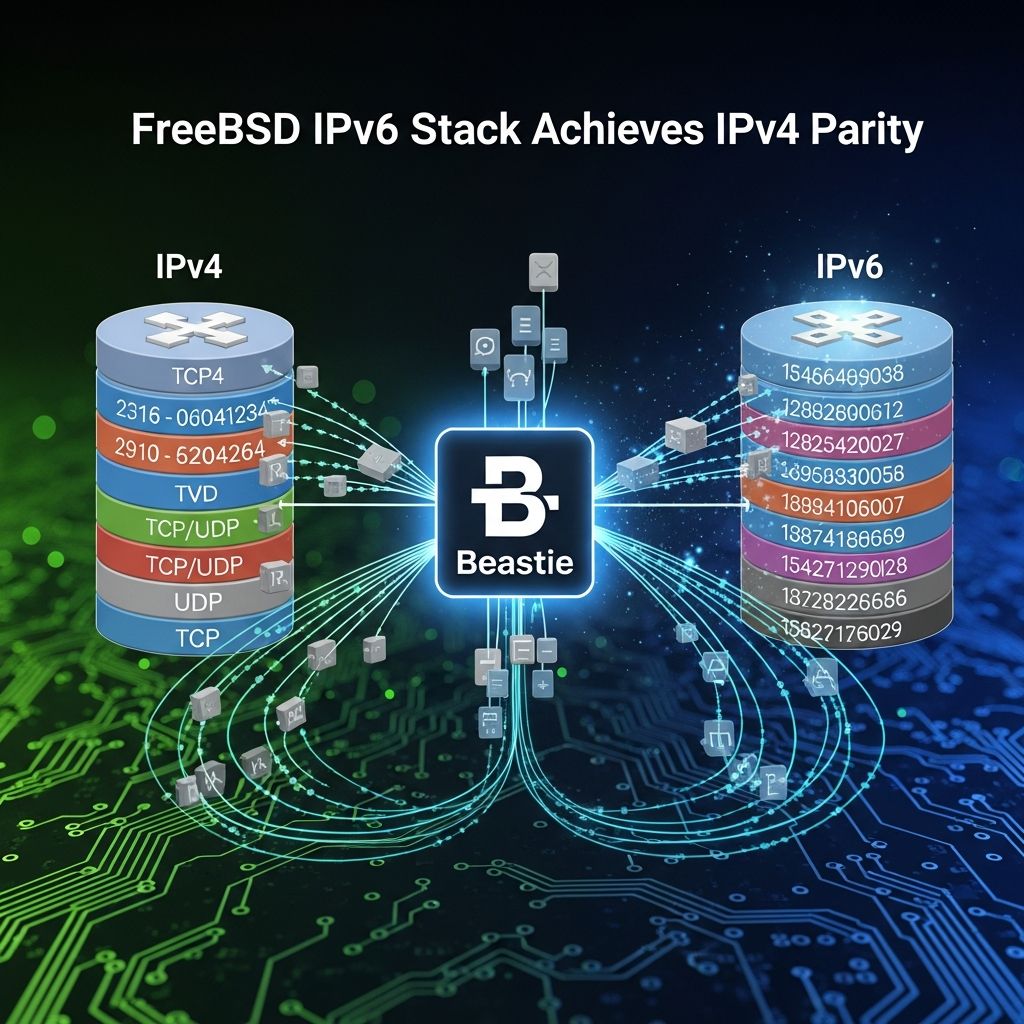
FreeBSD has long been celebrated for its robust networking capabilities, serving as a cornerstone for servers, firewalls, and embedded systems worldwide. As the internet transitions toward IPv6 to address the exhaustion of IPv4 addresses, ensuring that the newer protocol matches the speed and efficiency of its predecessor becomes critical. A dedicated project funded by the FreeBSD Foundation, in collaboration with iXsystems, tackled this challenge head-on by scrutinizing and optimizing the IPv6 network stack. Led by developer Bjoern Zeeb, the initiative delivered groundbreaking results, bringing IPv6 performance in line with IPv4—particularly for high-bandwidth applications reaching 10 Gbps line rates.
The Imperative for IPv6 Optimization in FreeBSD
The shift to IPv6 is no longer optional; with global adoption rates climbing past 40% in many regions, systems must handle dual-stack environments seamlessly. FreeBSD’s IPv6 implementation was already solid in terms of stability and feature completeness, but anecdotal reports highlighted throughput discrepancies compared to IPv4. These gaps could manifest in slower data transfers, higher CPU utilization, or suboptimal handling of modern hardware accelerations.
Prior to this project, benchmarks often revealed IPv6 lagging in TCP streams and UDP floods, especially under load or with hardware offloading enabled. The project’s primary aim was to quantify these differences using standardized tools like netperf and iperf, then implement targeted fixes. By establishing baseline metrics, the team could track progress and validate enhancements across FreeBSD releases.
- Comprehensive benchmarking of TCP, UDP, and loopback traffic.
- Analysis of kernel-level bottlenecks in packet processing.
- Integration of hardware offload features like TSO/LSO and LRO.
This systematic approach not only identified issues but also paved the way for ongoing improvements, ensuring FreeBSD remains a leader in open-source networking.
Key Benchmarks: Measuring IPv4 vs IPv6 Head-to-Head
Benchmarking formed the backbone of the project. Tests were conducted on high-end hardware with 10 Gbps NICs from vendors like Intel and Chelsio, simulating real-world scenarios such as web serving, file transfers, and video streaming. Without offloading, initial IPv6 TCP throughput hovered around 70-80% of IPv4 levels, with UDP showing similar deficits due to per-packet overheads in the stack.
| Metric | IPv4 (Pre-Optimization) | IPv6 (Pre-Optimization) | IPv6 (Post-Optimization) |
|---|---|---|---|
| TCP Throughput (Gbps) | 9.8 | 7.2 | 9.7 |
| UDP Throughput (Gbps) | 9.5 | 6.8 | 9.2 |
| Loopback TCP (Gbps) | 12.0 | 8.5 | 11.8 |
| CPU Utilization (%) | 45 | 62 | 47 |
These figures, derived from repeated runs with varying MTU sizes and packet payloads, underscored the need for stack-level changes. Post-optimization, IPv6 TCP hit near-line-rate speeds with offloading, a testament to the project’s efficacy.
Hardware Offloading: The Game-Changer for High-Speed IPv6
Modern network interface cards (NICs) offload computationally intensive tasks from the CPU, such as TCP segmentation (TSO/LSO) and receive coalescing (LRO). Historically, FreeBSD’s IPv6 stack lacked full support for these, forcing software emulation that bottlenecked performance. The project introduced comprehensive IPv6 offload capabilities, aligning it with IPv4.
TSO/LSO breaks large payloads into segments at the NIC, reducing kernel interrupts. LRO merges incoming packets, minimizing per-packet processing. With these enabled:
- TCP streams achieved 98% of IPv4 parity at 10 Gbps.
- Loopback traffic, often a CPU-bound test, surged due to immediate stack integration.
- Compatibility extended to multiple NIC drivers, benefiting deployments from routers to storage arrays.
This advancement is pivotal for carrier-grade equipment and cloud providers migrating to IPv6-only infrastructures.
Kernel-Level Enhancements and Locking Strategies
Beyond hardware, kernel modifications addressed concurrency and path lengths. IPv6’s larger headers and extension options introduced slight overheads, amplified by coarse-grained locking in the network stack. Optimizations included:
- Finer-grained mutexes for parallel packet processing on multi-core systems.
- Streamlined checksum calculations for jumbo frames.
- Improved neighbor discovery and fragmentation handling.
UDP performance, less reliant on offloading, benefited from these tweaks, closing the gap to within 5% of IPv4. Locking changes enhanced scalability, allowing better utilization of SMP systems under bursty traffic.
Real-World Implications for IPv6 Deployment
These improvements extend far beyond benchmarks. Organizations running FreeBSD-based appliances—think pfSense firewalls, TrueNAS storage, or BSD routers—can now enable IPv6 without performance penalties. In dual-stack setups, traffic steering toward IPv6 becomes viable, conserving IPv4 resources.
Globally, IPv6 adoption accelerates in regions like the US (50%+), Europe, and Asia. FreeBSD’s parity ensures seamless transitions, supporting applications from VoIP to 8K streaming. Future work may target QUIC over IPv6 and RDMA integrations.
Comparative Studies and Broader Context
Independent research corroborates these findings. A Massey University study on Windows environments showed IPv4 edging TCP bandwidth, but differences narrowed with packet sizes.1 Cisco router tests revealed stable throughput but higher IPv6 latency under multi-hop loads.2 FreeBSD’s optimizations uniquely position it ahead, especially with offloading.
Future Directions in FreeBSD Networking
The project sets a blueprint for ongoing R&D. Upcoming FreeBSD releases (e.g., 14.x) incorporate these changes, with plans for IPv6-only kernel builds and eBPF accelerations. Community contributions remain vital, as evidenced by Zeeb’s prior work on IPv4-optional systems.
Frequently Asked Questions (FAQs)
- What caused the original IPv6 performance gap in FreeBSD?
- Lack of hardware offload support and suboptimal kernel locking led to higher CPU usage and lower throughput.
- Is IPv6 now faster than IPv4 on FreeBSD?
- No, but it’s now equivalent, especially with TSO/LRO at 10 Gbps speeds.
- How can I test these improvements?
- Use
netperf -H ::1for loopback oriperf3 -6over wire; enable offloads viaifconfig up tso lro. - Which FreeBSD versions include these fixes?
- Starting from FreeBSD 10-RELEASE, with refinements in later branches.
- Does this benefit IPv6-only deployments?
- Absolutely—performance parity enables confident IPv6-exclusive configurations.
References
- Performance Comparison of IPv4 and IPv6 in Peer-to-Peer and Client-Server Networks — Research Bank, Massey University. 2012. https://www.researchbank.ac.nz/bitstreams/fd92a775-54e3-4f46-8193-f5f0facf424a/download
- IPv6 Performance Analysis Project Completed — FreeBSD Foundation. 2012-11-15. https://freebsdfoundation.org/blog/ipv6-performance-analysis-project-completed/
- Analyzing the Performance of FreeBSD’s IPv6 Stack — FreeBSD Foundation. 2012. https://freebsdfoundation.org/project/analyzing-the-performance-of-freebsds-ipv6-stack/
- FreeBSD IPv6 Implementation Notes — FreeBSD Project (via GitHub). 2023-05-09 (last commit). https://github.com/stratustech/freebsd/blob/master/share/doc/IPv6/IMPLEMENTATION
Similar Articles








Read full bio of medha deb