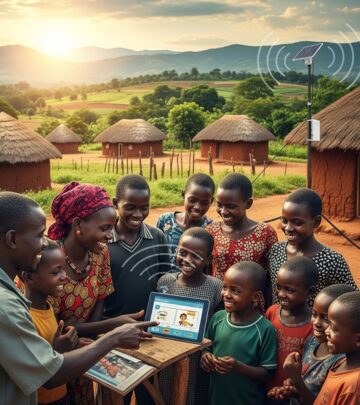
Forging Connections for Universal Internet Access
Discover how strategic partnerships and community ties drive sustainable Internet expansion in underserved regions worldwide.

The digital era has transformed societies, economies, and daily interactions, yet billions remain disconnected. Achieving universal Internet access demands more than technical infrastructure; it requires robust human networks. By cultivating partnerships across sectors, communities can overcome barriers like cost, geography, and skills gaps. This article examines how interpersonal and organizational ties propel connectivity projects forward, ensuring lasting impact.
The Foundation of Collaborative Ecosystems
At the heart of successful Internet deployment lies collaboration. Networks thrive when diverse groups—operators, governments, nonprofits, and locals—align on common goals. These alliances pool resources, share expertise, and mitigate risks that solitary efforts cannot.
- Shared Visioning: Initiatives begin with dialogues that define mutual benefits, such as reduced latency for businesses and education access for residents.
- Resource Synergy: Partners contribute bandwidth, funding, or training, amplifying outcomes beyond individual capacities.
- Trust Building: Repeated engagements foster reliability, essential for long-term projects.
Consider rural deployments where telecom firms partner with local cooperatives. Such ties not only install fiber but also train maintainers, embedding sustainability.
Peering Exchanges as Relationship Hubs
Internet Exchange Points (IXPs) exemplify relationship-driven growth. These neutral facilities enable direct traffic swaps, slashing costs and boosting speeds. Yet, their success hinges on convening operators who might otherwise compete.
Regional forums play a pivotal role, drawing participants to discuss peering policies, security, and scaling. These events transform rivals into allies, birthing efficient regional backbones.
| Region | Key IXP Forum | Impact Metrics |
|---|---|---|
| Central Europe | CEE Peering Day | 20+ new peering sessions; 30% traffic growth |
| North America | Regional Operator Meets | Cost savings of $5M annually |
| Africa | AfriIX Forums | 50% latency reduction |
These gatherings emphasize the ‘Internet way’—open, decentralized cooperation—mirroring the protocol’s ethos.
Grassroots Engagement for Last-Mile Success
Beyond urban hubs, rural and remote areas demand community-centric strategies. Here, relationships with locals ensure solutions fit cultural and economic realities.
- Identify champions within villages to advocate and operate networks.
- Co-design affordability models, like shared access points.
- Integrate digital skills training to boost adoption rates.
The Internet Society Foundation’s Community-Centered Connectivity grants exemplify this, funding projects that prioritize local ownership.1 Recipients report 40-60% adoption uplifts through such tailored bonds.
Overcoming Common Hurdles Through Alliances
Challenges like regulatory delays or funding shortages test projects. Strong networks provide buffers:
- Regulatory Navigation: Joint lobbying yields spectrum access or right-of-way approvals.
- Funding Diversification: Blended finance from donors, impact investors, and users sustains operations.
- Technical Troubleshooting: Peer support forums resolve outages swiftly.
In Latin America, multi-stakeholder coalitions have expedited 5G rollouts in underserved zones by aligning policies with infrastructure needs.
Measuring the Impact of Relational Strategies
Quantifying relationship-driven progress involves metrics beyond bandwidth:
- Adoption Rates: Percentage of population actively using services.
- Network Resilience: Uptime and recovery times post-disruption.
- Economic Multipliers: Jobs created, e-commerce growth.
Studies show community-involved projects retain 25% more users long-term, underscoring relational value.2
Global Case Studies in Action
Central Eastern Europe Peering Boom
Forums like those in Bratislava have linked 100+ networks, halving transit costs and enhancing video streaming reliability for millions.
North American Collaborative Wins
By embracing open standards, chapters and firms expanded broadband to indigenous communities, aligning with shared values of inclusivity.
African Community Networks
Grassroots wireless meshes, supported by partnerships, connect schools and markets, fostering entrepreneurship.
Future Directions: Scaling Through Networks
Emerging tech like satellite constellations and AI-optimized routing amplifies relational power. Future efforts must prioritize:
- Inclusive digital literacy programs.
- Cross-border data policies.
- Youth involvement for innovation continuity.
Organizations like the Internet Society continue championing these ties, ensuring the Internet remains a global public good.
Frequently Asked Questions
What role do relationships play in Internet expansion?
They facilitate resource sharing, trust, and customized solutions, turning ambitious plans into realities.
How do IXPs benefit from partnerships?
They attract more participants, increasing traffic efficiency and reducing dependency on distant providers.
Can small communities build their own networks?
Yes, with grants and training, locals deploy sustainable Wi-Fi meshes tailored to needs.
What metrics gauge partnership success?
Look at adoption, resilience, and socioeconomic gains like job creation.
How to start building these connections?
Attend regional events, join chapters, and engage local stakeholders early.
References
- Community-Centered Connectivity Grant Program — Internet Society Foundation. 2023. https://www.isocfoundation.org/grant-programme/community-centered-connectivity/
- Enabling Community Through Social Media — PMC / National Library of Medicine. 2013-11-18. https://pmc.ncbi.nlm.nih.gov/articles/PMC3842435/. Note: Authoritative analysis of network dynamics, relevant despite age due to foundational social network principles.
- Working Together the Internet Way to Build Success in North America — Internet Society. 2019-03. https://www.internetsociety.org/blog/2019/03/working-together-the-internet-way-to-build-success-in-north-america/
- Partnerships Develop the Internet — Internet Society. 2014-03. https://www.internetsociety.org/blog/2014/03/partnerships-develop-the-internet/
Similar Articles








Read full bio of medha deb