Facebook’s IPv6-Only Milestone
Discover how Facebook pioneered IPv6-only infrastructure, paving the way for future-proof networks and enhanced performance.

Facebook’s bold move into an IPv6-only data cluster represents a pivotal moment in internet infrastructure evolution. As the digital world grapples with the exhaustion of IPv4 addresses, this initiative showcases how major platforms are transitioning to IPv6 to ensure scalability and performance. This article delves into the technical underpinnings, strategic rationale, and broader implications of running services without legacy IPv4 support inside data centers.
The IPv4 Crisis and Rise of IPv6
IPv4, with its 32-bit address space, provided roughly 4.3 billion unique addresses—a number that seemed limitless in the 1980s. However, explosive growth in internet-connected devices has depleted this pool. Regional Internet Registries have allocated nearly all IPv4 blocks, forcing organizations to seek alternatives.
Enter IPv6, designed with a 128-bit address space offering approximately 3.4 × 10^38 addresses. Beyond sheer capacity, IPv6 introduces stateless address autoconfiguration, simplified packet headers for faster routing, and built-in security features like IPsec. For hyperscale operators like Facebook, these advantages translate to reduced complexity and operational costs.
Facebook’s journey began years ago. By enabling dual-stack support—running both IPv4 and IPv6—they observed up to 15% faster access times over IPv6 for users. This empirical data underscored IPv6’s performance edge, motivating a full pivot.
Strategic Drivers Behind the Shift
Facebook faced acute address exhaustion within its private RFC 1918 spaces, commonly used for internal networks to conserve public IPs. Scaling to millions of servers and containers demanded a rethink. IPv6’s vast address space eliminates NAT (Network Address Translation) needs, streamlining east-west traffic between services.
- Developer Productivity: Dual-stack environments breed IPv4-specific code, hindering innovation. IPv6-only forces clean, protocol-agnostic development.
- Cost Efficiency: Managing two protocols doubles routing tables, ACLs, and troubleshooting overhead. Unification cuts expenses.
- Performance Gains: IPv6 reduces latency in memcached and other cache layers, critical for Facebook’s real-time feeds.
- Future-Proofing: With global IPv6 adoption nearing 40% as of 2024, aligning now positions Facebook ahead of the curve.
Internally, Facebook achieved 75% IPv6 traffic by early 2014, with 100% in key subsystems like memcached. This groundwork enabled the IPv6-only cluster launch.
Technical Architecture of IPv6-Only Clusters
Facebook’s data centers employ a leaf-spine topology optimized for IPv6. Each server receives a /64 prefix, enabling unique addressing per container or task—eliminating port collisions that plague IPv4 NAT.
| Component | IPv4 Approach | IPv6 Approach | Benefit |
|---|---|---|---|
| Addressing | RFC 1918 NAT | Native /64 per host | No NAT overhead |
| Edge Handling | Dual-stack load balancers | IPv6-only internal, dual-stack edge | Simplified core |
| Traffic | Mixed protocols | 100% IPv6 internal | Faster routing |
| Containers | Shared IP ports | /128 per task | Isolation |
At the edge, dual-stack proxies translate IPv4 user traffic to IPv6 internally. Techniques like BGP injection or NAT64 handle legacy IPv4 ingress without contaminating the core network. All east-west traffic within points-of-presence (POPs) runs pure IPv6.
Implementation Challenges and Solutions
Transitioning wasn’t seamless. Legacy applications required auditing for IPv4 dependencies. Facebook mandated IPv6 readiness for new hosts, decommissioning non-compliant ones. Tools like IPvFoo extensions helped monitor adoption.
Key hurdles included:
- Database Compatibility: Some MySQL forks needed patches for IPv6 literals.
- Monitoring Gaps: Custom agents were developed to track IPv6 metrics.
- Vendor Support: Early firmware lacked full IPv6 stack maturity.
By Q3 2014, they hit 100% internal IPv6 traffic targets ahead of schedule. A special v6.facebook.com endpoint allowed enthusiasts to test the cluster directly.
Performance Metrics and Real-World Impact
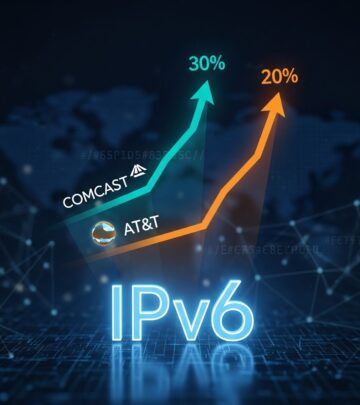
Post-launch data revealed tangible wins. IPv6-only clusters showed 10-15% lower latency for global users, aligning with studies from operators like Comcast and AT&T. Engagement metrics improved due to snappier content delivery.
Facebook’s backbone, spanning data centers and edge POPs, leverages MPLS and RSVP-TE over IPv6. Global anycast routing ensures low-latency replication of photos and feeds.
Industry-Wide Ripples and Future Outlook
This milestone inspired peers. Google, Microsoft, and Cloudflare followed with IPv6-dominant infrastructures. By 2026, over 50% of global traffic is IPv6, per official registries.
Looking ahead, Facebook eyes full IPv6-only edges, minimizing IPv4 to minimal proxies. Emerging tech like 5G and IoT will amplify IPv6’s necessity.
FAQs
- What is an IPv6-only data cluster?
- A network segment running exclusively IPv6 internally, with IPv4 translation only at the perimeter for legacy compatibility.
- Why did Facebook run out of IPv4 addresses?
- Hyperscale growth in servers, containers, and tasks exhausted private RFC 1918 space, necessitating vast addressing.
- Is regular Facebook accessible over IPv6?
- Yes, since World IPv6 Launch in 2012, with dual-stack support worldwide.
- How does IPv6 improve performance?
- Eliminated NAT, smaller headers, and optimized routing reduce latency by 10-15%.
- Can users force IPv6-only access?
- Visit v6.facebook.com to route exclusively to the IPv6-only cluster.
References
- IPv6: It’s time to get on board — Meta Engineering Blog. 2015-09-14. https://engineering.fb.com/2015/09/14/networking-traffic/ipv6-it-s-time-to-get-on-board/
- Case Study: Facebook Moving To An IPv6-Only Internal Network — Internet Society Deploy360. 2014-03-01. https://www.internetsociety.org/resources/deploy360/2014/case-study-facebook-moving-to-an-ipv6-only-internal-network/
- IPv6 Adoption Statistics — Google IPv6 Statistics. 2024-05-01. https://www.google.com/intl/en/ipv6/statistics.html
- Internet Protocol Version 6 (IPv6) — Internet Engineering Task Force (IETF) RFC 8200. 2017-07-01. https://datatracker.ietf.org/doc/html/rfc8200
- IPv6 Address Allocation Status — RIPE NCC. 2024-01-15. https://www.ripe.net/publications/docs/ripe-776
Similar Articles








Read full bio of Sneha Tete