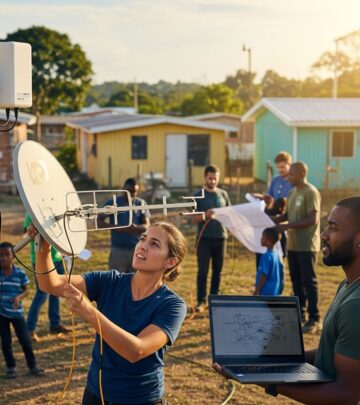
Empowering Communities to Create Their Own Internet
Discover how grassroots initiatives and community-driven efforts are bridging the digital divide by building local networks with accessible tools and supportive policies.

In an increasingly connected world, billions still lack basic internet access. Traditional providers often overlook remote or low-income areas due to high costs and low returns. However, a transformative approach is gaining momentum: community-led networks. These initiatives allow residents to take charge of their digital future, using affordable technology and collaborative spirit to establish reliable connections. This article delves into the mechanics, benefits, and pathways forward for such networks, highlighting their potential to close the global digital gap.
The Global Challenge of Internet Inequality
Access to the internet is no longer a luxury but a necessity for education, healthcare, economic opportunity, and social inclusion. Yet, vast populations remain excluded. Rural villages, isolated islands, and urban slums face persistent barriers including expensive infrastructure deployment, regulatory hurdles, and insufficient commercial interest from telecom giants.
Market-driven models prioritize profitable urban centers, leaving peripheral regions in the dark. This creates a vicious cycle where lack of connectivity stifles development, making it even less attractive for investment. Community networks disrupt this pattern by flipping the script: locals pool resources, knowledge, and labor to create tailored solutions that serve their unique needs.
What Are Community Networks?
At their core, community networks are grassroots-built telecommunications systems owned and operated by the very people they serve. Unlike corporate ISPs, these networks emphasize sustainability, affordability, and local control. Participants contribute equipment, skills, or funding, fostering a sense of ownership that ensures long-term maintenance.
These setups often leverage wireless technologies like Wi-Fi mesh systems, where devices relay signals across nodes, forming a resilient web. A single high-speed link to the broader internet—known as an upstream connection—feeds the entire mesh, distributing bandwidth efficiently to homes, schools, and businesses.
- Key Features: Decentralized architecture, open-source software, cost-recovery pricing.
- Scalability: From small villages with dozens of users to expansive regional meshes spanning thousands.
- Customization: Adapted to local terrain, culture, and demands, such as prioritizing agricultural data apps in farming communities.
Technical Foundations for DIY Connectivity
Building a community network starts with accessible hardware. Low-cost routers, directional antennas, and solar-powered repeaters make entry barriers low. Open-source platforms like LibreMesh or Commotion simplify configuration, allowing non-experts to deploy secure, interference-resistant networks.
Consider a typical setup: Install a gateway router connected to fiber or satellite backhaul at a central location, perhaps a school or cooperative. From there, mesh nodes on rooftops extend coverage up to several kilometers. Software handles routing dynamically, optimizing paths around obstacles like hills or buildings.
| Component | Purpose | Cost Range (USD) |
|---|---|---|
| Mesh Router | Signal relaying | 20-50 |
| Antenna | Long-range extension | 10-30 |
| Solar Kit | Off-grid power | 50-100 |
| Backhaul Modem | Internet uplink | 100-300 |
Training is crucial. Workshops teach spectrum management to avoid interference and cybersecurity basics to protect against threats. With these tools, a group of 50 households can go online for under $5,000 initial investment, recovering costs through minimal fees.
Real-World Success Stories
Around the globe, communities are proving the model works. In rural India, Guifi.net-inspired projects connect thousands of farmers to market prices via mobile apps, boosting incomes by 20-30%. Latin American cooperatives in Mexico and Brazil link indigenous groups, preserving languages through digital archives.
In Africa, initiatives like those supported by the Internet Society have lit up Kenyan villages, enabling telemedicine that reduced travel for checkups by 70%. Europe’s Freiburg mesh network powers over 800 nodes, providing free public Wi-Fi while experimenting with blockchain for billing.
These examples demonstrate not just connectivity but empowerment: locals gain skills in IT, entrepreneurship, and governance, creating jobs in network operation and content creation.
Overcoming Regulatory and Economic Hurdles
Despite promise, challenges persist. Licensing fees, spectrum allocation restrictions, and taxes treat communities like corporations, pricing them out. Innovative policies can help: spectrum reservations for non-commercial use, streamlined permits, and subsidies for backhaul.
Governments play a pivotal role by fostering public-private partnerships. For instance, sharing tower infrastructure or offering tax credits encourages collaboration. International bodies like the ITU advocate for these reforms, emphasizing multistakeholder dialogues.
Community networks thrive where policies prioritize inclusion over profit, turning users into builders.
The Role of Support Organizations
Entities like the Internet Society provide blueprints, training, and advocacy. Their chapters worldwide offer toolkits, from hardware guides to policy templates. Partnerships with tech firms supply discounted gear, while academic collaborations refine protocols for harsh environments.
Funding streams—crowdfunding, grants from development banks, or impact investors—bridge startup gaps. Success hinges on blending local initiative with external expertise, ensuring networks evolve sustainably.
Future Prospects and Scaling Up
As 5G and low-Earth orbit satellites mature, community networks can hybridize: using satellite for backhaul and meshes for last-mile distribution. AI-driven optimization will enhance efficiency, predicting traffic and self-healing faults.
To connect the next billion, we need bold action. Governments must enact supportive laws, philanthropists fund pilots, and tech leaders open-source innovations. Imagine a world where every village decides its digital destiny.
Frequently Asked Questions
Can anyone start a community network?
Yes, with basic tech savvy and community buy-in. Start small, scale with experience.
How much does it cost to build one?
Initial setups range from $1,000 for micro-networks to $50,000 for larger ones, often self-funding via fees.
Are they secure and reliable?
Modern open-source tools match commercial standards, with redundancy built into mesh designs.
What policies are needed?
License exemptions, spectrum access, and infrastructure sharing are key enablers.
How do they impact local economies?
They create jobs, enable e-commerce, and support remote work, lifting GDP in underserved areas.
References
- Measuring digital development: Facts and figures 2023 — International Telecommunication Union. 2023-12-07. https://www.itu.int/itu-d/reports/statistics/2023/10/10/ff23-internet/
- Community Networks: Regulatory issues and gaps – Experiences from India — Internet Society. 2017-06-01. https://www.internetsociety.org/resources/doc/2017/community-networks-regulatory-issues-gaps-experiences-india/
- Comment of the Internet Society on Developing a Sustainable Spectrum Strategy for the 21st Century — NTIA / Internet Society. 2018-07-17. https://www.ntia.gov/sites/default/files/publications/isoc_comment-ntia-noi-2018-07-17_0.pdf
- Internet Infrastructure Security Guidelines for Africa — Internet Society and African Union Commission. 2017-05-01. https://www.internetsociety.org/blog/2017/05/internet-society-and-african-union-commission-launch-internet-infrastructure-security-guidelines-for-africa/
Similar Articles








Read full bio of Sneha Tete