Edge Router Essentials
Discover the vital role of edge routers in securing and connecting networks to the wider internet and beyond.
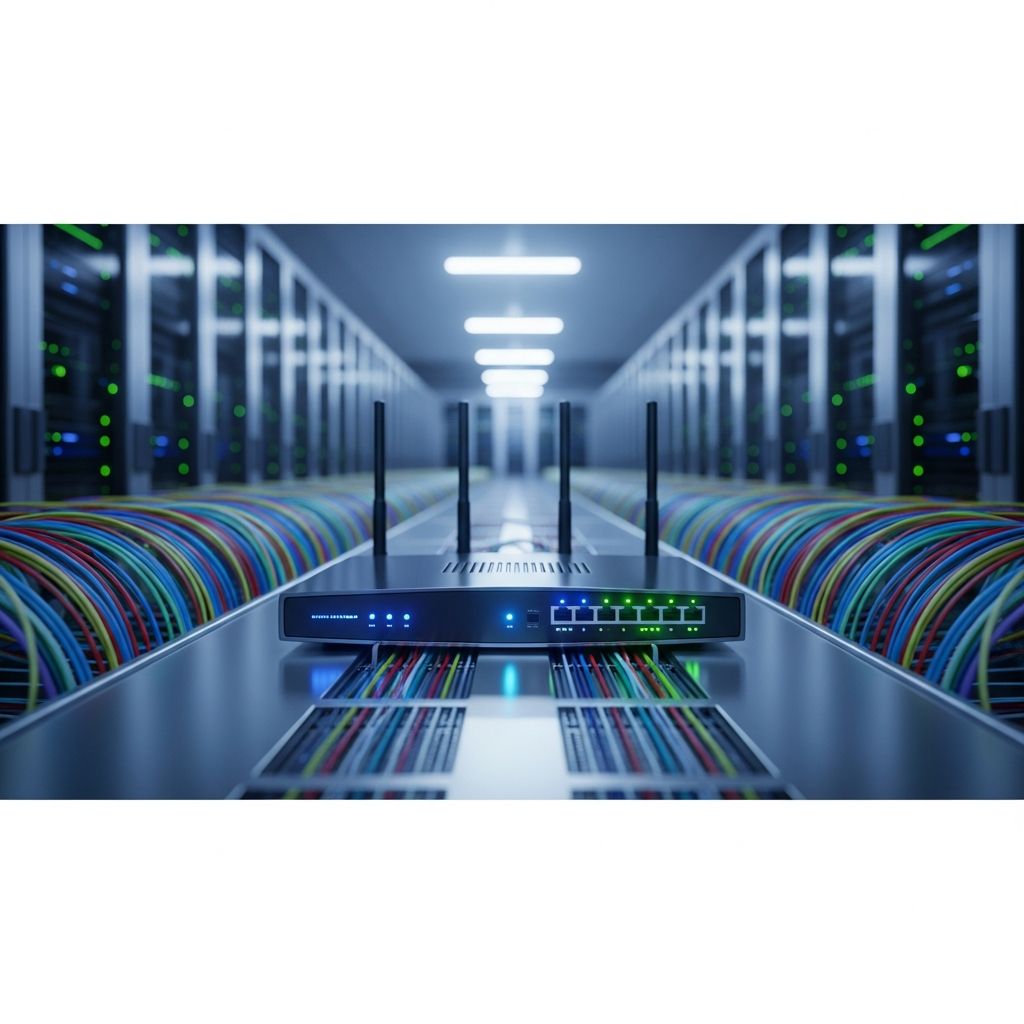
In the complex world of modern networking, edge routers stand as the vigilant sentinels at the perimeter of organizational networks. These specialized devices manage the crucial handoff between private local area networks (LANs) and expansive external systems, such as the public internet or wide area networks (WANs). By filtering traffic, enforcing security policies, and optimizing data flows, edge routers ensure reliable and protected communication in an era of escalating cyber threats.
Understanding the Core Mission of Edge Routers
At their heart, edge routers are engineered to operate precisely where networks meet the outside world. Positioned at strategic boundary points, they handle incoming and outgoing traffic with a focus on defense and efficiency. Unlike devices buried deep within a network’s interior, edge routers confront diverse and potentially hostile data streams daily, making them indispensable for businesses, data centers, and service providers alike.
Key responsibilities include authenticating connections, blocking unauthorized access, and prioritizing critical transmissions. For instance, in a corporate setting, an edge router might inspect packets from remote employees while throttling non-essential downloads to maintain bandwidth for VoIP calls. This dual role of gateway and guardian underscores their importance in upholding network integrity.
- Traffic inspection and filtering to detect anomalies.
- Protocol translation for compatibility across diverse systems.
- Quality of service (QoS) enforcement to favor business-critical data.
Distinguishing Edge from Core: A Comparative Analysis
While core routers power the high-speed backbone of large-scale networks, edge routers specialize in perimeter defense. Core routers excel in rapid packet forwarding within a controlled environment, often using massive throughput capacities measured in terabits per second. Edge routers, conversely, emphasize threat mitigation, supporting fewer connections but with deeper scrutiny.
| Feature | Edge Router | Core Router |
|---|---|---|
| Primary Location | Network boundary | Network interior |
| Main Focus | Security and external connectivity | High-volume internal routing |
| Typical Protocols | BGP, OSPF, MPLS | OSPF, IS-IS |
| Throughput Priority | Balanced with inspection | Maximum speed |
This table highlights fundamental divergences: edge routers buffer against external risks, whereas core routers optimize internal efficiency. In ISP infrastructures, core routers form the high-capacity spine, while edge routers interface with customer premises.
Primary Categories of Edge Routing Devices
Edge routers fall into distinct categories tailored to specific deployment scenarios. Subscriber edge routers primarily serve end-users, bridging home offices, small businesses, or enterprises to ISP backbones. They manage broadband handoffs, often via Ethernet links at gigabit speeds over fiber or copper mediums.
Label edge routers, integral to MPLS architectures, add intelligent labeling to packets for expedited transit across WANs. These devices ingress and egress MPLS domains, stripping or applying labels to streamline routing in service provider clouds.
- Subscriber Edge: Connects SMBs or consumers to ISP edges; handles NAT, basic firewalls.
- Label Edge: Gateways in MPLS setups; supports label switching for VPNs.
Hybrid models are emerging, blending these functions with software-defined capabilities for cloud-era flexibility.
Critical Protocols Powering Edge Operations
Edge routers rely on robust protocols to navigate inter-network communications. Border Gateway Protocol (BGP) dominates for exchanging routing info between autonomous systems, enabling policy-based path selection. Open Shortest Path First (OSPF) aids internal optimization but extends to edge for efficient packet paths.
Multiprotocol Label Switching (MPLS) enhances performance by pre-labeling packets, reducing header processing at each hop. IPv6 support is increasingly standard, accommodating the shift from IPv4 exhaustion.
- BGP for AS peering and internet-scale routing.
- OSPF for dynamic, link-state path computation.
- MPLS for traffic engineering and QoS.
- IPsec for encrypted tunnels over public links.
Hardware and Software Implementations
Traditionally hardware-centric, modern edge routers leverage modular chassis with line cards for scalability. High-end models from vendors like Cisco or Juniper boast redundant power supplies, advanced ASICs for wire-speed processing, and deep packet inspection engines.
Software alternatives run on x86 servers via virtualized platforms like NFV (Network Functions Virtualization), offering cost savings and rapid updates. Containerized deployments on Kubernetes clusters further decentralize edge functions, ideal for distributed enterprises.
Deployment considerations include physical durability for harsh environments, such as industrial IoT sites requiring ruggedized housings resistant to dust and vibration.
Security Imperatives at the Network Edge
Exposed to the full spectrum of internet threats, edge routers deploy multilayered defenses. Stateful firewalls track connection states, intrusion prevention systems (IPS) scan for exploits, and DDoS mitigation absorbs volumetric attacks. VPN terminations secure remote access, while zero-trust models verify every packet regardless of origin.
Regular firmware patches address vulnerabilities, and anomaly detection leverages AI to flag unusual patterns, such as sudden traffic spikes indicative of botnets.
Performance Optimization Strategies
To maximize efficacy, edge routers implement QoS policies classifying traffic into queues—voice gets low latency, bulk transfers high bandwidth. Load balancing distributes sessions across multiple links, ensuring failover without disruption.
Monitoring tools like SNMP provide visibility into metrics such as latency, jitter, and packet loss, enabling proactive tuning.
Edge Routers in Contemporary Architectures
SD-WAN revolutionizes edge routing by overlaying intelligent software on commodity hardware, dynamically selecting optimal paths over MPLS, LTE, or broadband. Edge computing pushes processing closer to data sources, with routers hosting microservices for real-time analytics in 5G and IoT ecosystems.
In hybrid clouds, edge routers federate on-premises with AWS Direct Connect or Azure ExpressRoute, maintaining consistent policies across realms.
Deployment Best Practices
Successful implementations begin with capacity planning—oversize for growth while avoiding underutilization. Redundancy via VRRP or HSRP ensures high availability. Segmentation isolates guest Wi-Fi from corporate VLANs, minimizing breach vectors.
- Conduct regular security audits and penetration testing.
- Integrate with SIEM for centralized logging.
- Test failover scenarios quarterly.
Future Horizons for Edge Technology
Quantum-safe cryptography looms as post-quantum threats emerge, with routers adapting lattice-based algorithms. Intent-based networking automates configurations via AI, reducing human error. 5G slicing demands granular edge control for URLLC applications in autonomous vehicles and smart grids.
Frequently Asked Questions
What distinguishes an edge router from a standard router?
Standard routers handle internal subnet traffic; edge routers specialize in external interfacing with advanced security.
Can edge functions run on virtual machines?
Yes, NFV enables software edge routing on commodity servers for agile deployments.
Why prioritize BGP on edge devices?
BGP facilitates multi-homed internet connectivity and robust path selection across providers.
Are edge routers essential for small businesses?
Absolutely—they provide foundational security and WAN access beyond basic consumer gateways.
How do MPLS label edge routers function?
They impose labels on ingress packets and remove them at egress for efficient core transit.
References
- What Is an Edge Router? — Cisco Systems. 2024-05-01. https://www.cisco.com/site/us/en/learn/topics/networking/what-is-an-edge-router.html
- RFC 4271: A Border Gateway Protocol 4 (BGP-4) — IETF. 2006-01-01 (authoritative standard). https://datatracker.ietf.org/doc/html/rfc4271
- What is an Edge Router? — EMnify. 2023-11-15. https://www.emnify.com/blog/what-is-an-edge-router
- RFC 3031: Multiprotocol Label Switching Architecture — IETF. 2001-01-01 (foundational spec). https://datatracker.ietf.org/doc/html/rfc3031
- Edge Router vs. Core Router Explained — Robustel. 2024-02-20. https://www.robustel.store/blogs/industrial-iot-blog/what-is-an-edge-router-and-how-is-it-different-from-a-core-router
Similar Articles







Read full bio of medha deb