Drones Revolutionizing Disaster Response in Philippines
How unmanned aerial vehicles are transforming emergency communications and rescue operations in typhoon-prone regions.
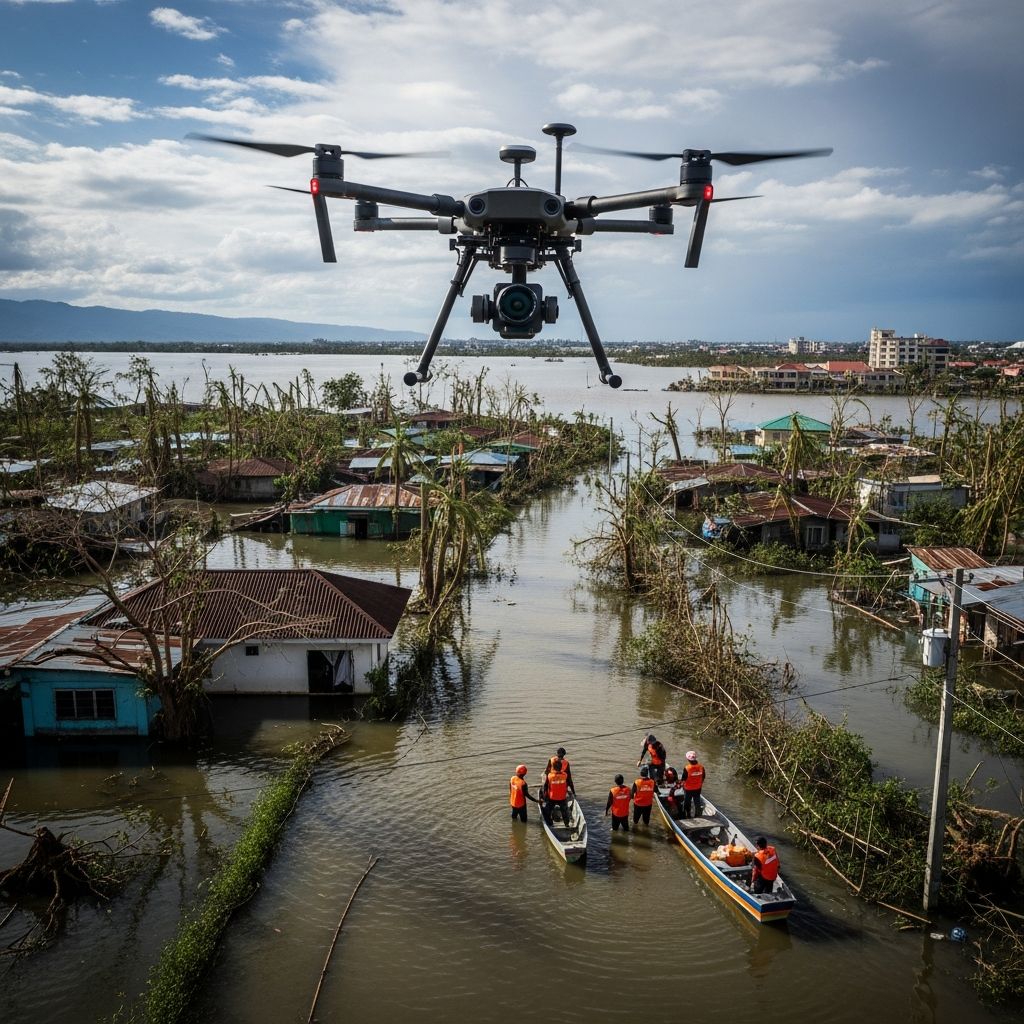
In a nation frequently battered by typhoons, earthquakes, and volcanic eruptions, the Philippines faces unique challenges in delivering timely humanitarian aid. Traditional communication infrastructures often crumble under the weight of such catastrophes, leaving responders disconnected and survivors isolated. Enter unmanned aerial vehicles (UAVs), commonly known as drones, which are emerging as game-changers in disaster management. These flying marvels provide aerial surveillance, instant connectivity, and data aggregation, bridging critical gaps when ground-based systems fail.
The Urgent Need for Resilient Tech in Typhoon Alleys
The Philippine archipelago, with over 7,600 islands, is one of the most disaster-prone countries globally. According to the World Risk Index, it consistently ranks among the top for vulnerability to natural hazards. Typhoon Haiyan in 2013 alone claimed over 6,000 lives and displaced millions, exposing the fragility of existing response mechanisms. When cell towers topple and roads become impassable, information flow grinds to a halt, delaying rescues and aid distribution.
Drones address these pain points by soaring above debris, delivering real-time imagery, and establishing ad-hoc networks. Initiatives led by local tech innovators and international partners are testing these capabilities, proving that aerial tech can restore communications within hours rather than days.
Building Mesh Networks from the Sky
One of the most promising applications is the deployment of drones as airborne wireless relays. These UAVs create mesh networks—self-healing systems where devices communicate directly, bypassing damaged infrastructure. Equipped with transceivers operating on frequencies like 915 MHz and 760 MHz, drones hover strategically to connect ground teams, survivors, and command centers.
- Survivor Connectivity: Drones relay distress signals from LoRa-enabled beacons, transmitting GPS coordinates, names, and vital stats over long distances.
- Team Coordination: Push-to-talk radios integrated with Android protocols ensure rescuers stay linked, even in remote areas.
- Data Forwarding: Using delay-tolerant standards (like RFC 5050), drones store and forward messages when direct links are unavailable.
This approach was piloted in simulations around Batangas province, demonstrating reliable coverage over 140 kilometers from Manila. Initial tests showed drones maintaining links for hours, aggregating data from multiple sources for centralized analysis.
Integrating Air and Ground for Comprehensive Coverage
To maximize impact, projects are pairing UAVs with unmanned ground vehicles (UGVs). While drones offer bird’s-eye views, UGVs navigate terrain to collect granular data. Together, they form hybrid systems capable of environmental monitoring, victim location, and supply delivery.
| UAV Capabilities | UGV Capabilities | Combined Benefits |
|---|---|---|
| Aerial imaging and wide-area surveillance | Ground-level sensor data and navigation | Multi-layered situational awareness |
| High-altitude relay networks | Obstacle detection and pathfinding | End-to-end resilient communications |
| Rapid deployment over large areas | Precise material transport | Efficient search-and-rescue operations |
Such integrations enable facial recognition for identifying vulnerable groups like the elderly and persons with disabilities, cross-referenced against pre-stored social networks for targeted aid.
Real-World Pilots and Partnerships Driving Innovation
Philippine chapters of global organizations have spearheaded field tests. In San Juan, Batangas, teams launched UAVs for connectivity experiments, capturing survivor data and road conditions. Collaborations with entities like the Ateneo de Manila University Innovation Center have refined use cases for mission-critical scenarios.
Broader efforts include:
- High-resolution imaging in flood-prone areas like Pateros and Navotas, identifying evacuation routes.
- Partnerships with the International Organization for Migration for community mapping.
- Red Cross initiatives deploying LTE-connected drones with analytics for situational awareness.
These pilots underscore the value of low-cost hardware like Raspberry Pi hubs, making scalable solutions feasible for resource-limited regions.
Advanced Features: From Imaging to Analytics
Beyond connectivity, drones excel in data collection. Equipped with cameras and sensors, they generate datasets for feature extraction—spotting damaged structures, flood extents, and survivor clusters. AI-driven analytics process this imagery in real-time, prioritizing response zones.
In post-Typhoon Haiyan recovery, drones assessed Carigara Hospital and Tacloban Bay, guiding NGO efforts. Nokia’s Saving Lives solution, adopted by the Philippine Red Cross, combines portable LTE networks with drone feeds, enabling commanders to visualize crises dynamically.
Challenges and Pathways Forward
Despite promise, hurdles remain. Regulatory approvals for airspace use, battery life limitations, and privacy concerns demand careful navigation. Weather in typhoon seasons can ground flights, necessitating robust designs.
Solutions include:
- Capacity building for 400+ responders across 15 countries, as per WFP programs.
- Prepositioned drone fleets in high-risk regions.
- Protocols emphasizing data protection and aviation safety.
Future iterations may incorporate autonomous swarms and 5G integration for even greater resilience.
Global Lessons from Philippine Innovations
The Philippines’ experiments offer blueprints for other disaster hotspots. WFP’s drone initiatives since 2017 have conducted over 50 activities worldwide, from mapping to emergency telecoms. By fostering public-private partnerships, these efforts amplify impact, proving tech can save lives when seconds count.
Frequently Asked Questions (FAQs)
- How do drones establish communications in disaster zones?
- They deploy mesh networks using radio transceivers to relay signals, creating ad-hoc Wi-Fi-like coverage independent of damaged infrastructure.
- What frequencies do these drone networks use?
- Commonly 915 MHz, 760 MHz, and LoRa at 433 MHz for long-range, low-power transmissions.
- Are drones safe for use near survivors?
- Yes, with privacy protocols, altitude controls, and no-fly zones ensuring safe operations while respecting data protection laws.
- How has Typhoon Haiyan influenced drone adoption?
- It highlighted comms failures, spurring projects like NetHope’s civil drone deployments for base camp scouting and damage assessment.
- What’s next for UAVs in humanitarian aid?
- AI autonomy, UGV swarms, and integration with satellite networks for global scalability.
References
- Philippine Red Cross to employ Nokia Drone Networks solution to aid disaster response — Nokia. 2018-11-27. https://www.nokia.com/newsroom/philippine-red-cross-to-employ-nokia-drone-networks-solution-to-aid-disaster-response/
- WFP Drones — World Food Programme. 2023-05-09 (last updated). https://www.wfp.org/wfp-drones
- Testing Drones for Post-Disaster Operations in the Philippines — Internet Society Foundation. 2017-04-01. https://www.isocfoundation.org/story/testing-drones-for-post-disaster-operations-in-the-philippines/
- Civil Drone Supports NetHope Haiyan Relief in PH — NetHope. 2013-11-20. https://nethope.org/articles/civil-drone-helps-nethope-haiyan-relief-efforts-in-the-philippines/
- Timeline of drone use — American Red Cross. 2022-01-15 (last updated). https://americanredcross.github.io/rcrc-drones/timeline.html
Similar Articles






Read full bio of medha deb