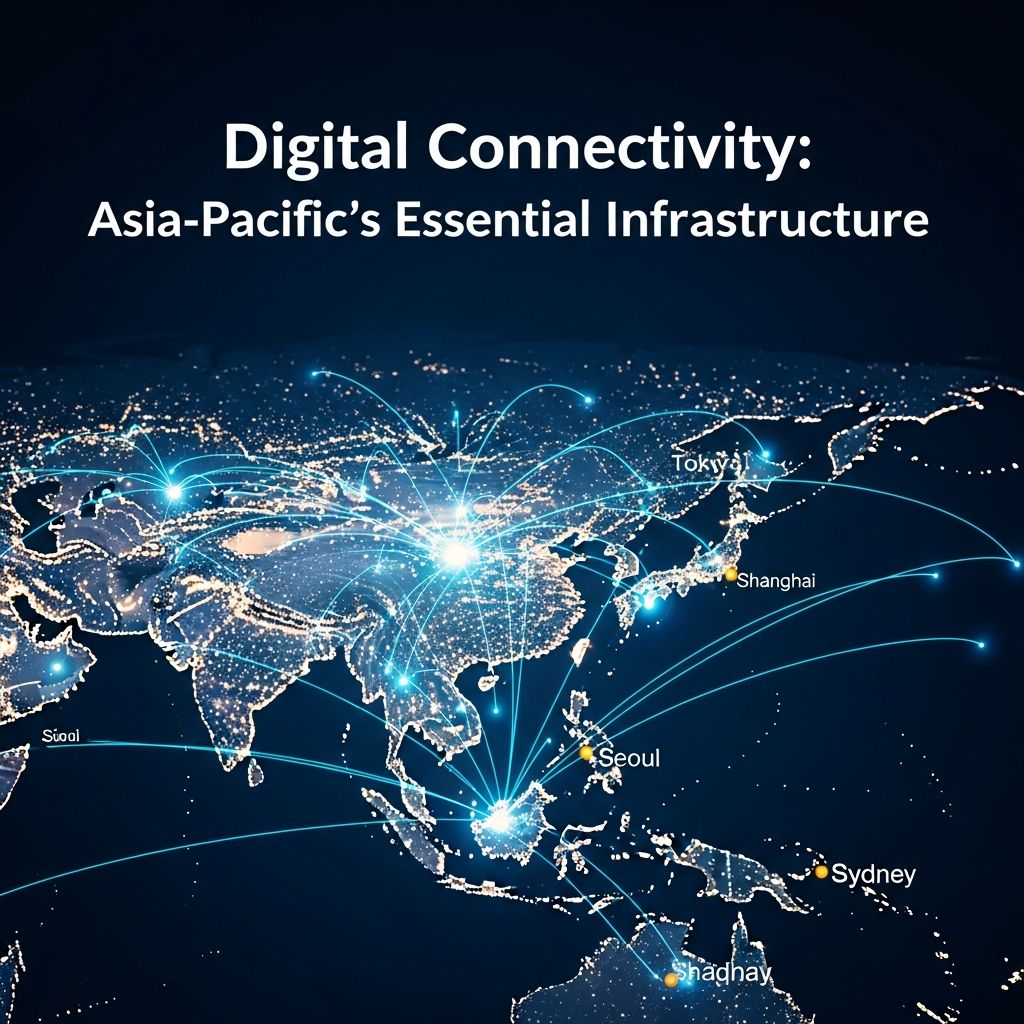
Digital Connectivity: Asia-Pacific’s Essential Infrastructure
How internet infrastructure serves as critical lifeline during emergencies and development
Understanding the Critical Role of Internet Networks in Regional Development
The Asia-Pacific region stands at a pivotal juncture in its digital transformation. While approximately 67% of the population has access to internet services, according to the International Telecommunication Union, vast disparities remain within and between countries. The digital infrastructure present across this diverse region serves purposes that extend far beyond entertainment or commerce. Rather, connectivity functions as a fundamental lifeline that enables communities to respond to emergencies, pursue economic opportunities, and strengthen social bonds during times of crisis.
Understanding the multifaceted role of internet infrastructure requires examining how networks operate during both routine conditions and extraordinary circumstances. The Asia-Pacific context is particularly instructive because the region encompasses countries at vastly different stages of technological development, geographic challenges ranging from island nations to mountainous terrain, and populations experiencing varying levels of digital literacy. This diversity creates both unique challenges and opportunities for leveraging connectivity as a tool for resilience and development.
Bridging Communication Gaps During Natural Disasters
When catastrophic events strike, traditional communication infrastructure often becomes overwhelmed or damaged entirely. The internet and related digital technologies have emerged as alternative pathways for information flow, enabling affected populations to reach out to loved ones, coordinate rescue operations, and access critical information about ongoing threats.
During major seismic events affecting the region, technology companies deployed specialized platforms that allowed individuals to broadcast their status and search for information about acquaintances. These tools proved invaluable when conventional telephone networks reached capacity. Simultaneously, telecommunications providers waived fees for voice communications, removing financial barriers to staying connected with support networks. E-commerce platforms and digital payment systems mobilized to facilitate the collection and distribution of charitable donations to affected communities.
The coordination between government bodies, private sector operators, and international organizations demonstrates how digital infrastructure enables rapid response mechanisms. When a powerful tropical cyclone threatened a Pacific island nation, authorities worked with mobile operators to establish text-based alert systems that reached citizens across the archipelago. These systems provided critical evacuation guidance and emergency information that undoubtedly saved lives by enabling organized responses rather than chaotic reactions.
Real-Time Information Mapping and Situational Awareness
Beyond direct communication, internet connectivity enables sophisticated data collection and visualization systems that provide emergency responders with comprehensive pictures of disaster situations. Volunteers distributed across the globe, including diaspora communities, have utilized social media feeds, news reports, and satellite imagery to create dynamic online maps showing real-time disaster impacts.
These crowdsourced mapping initiatives allow rescue coordinators to identify blocked transportation routes, locate stranded populations, and allocate resources more effectively. When communication becomes congested through traditional channels, internet-based platforms provide alternative means for survivors to report their conditions and locations. Specialized geo-tagging technologies continuously update maps with crisis information, enabling first responders to make informed decisions about deployment and resource allocation.
International humanitarian organizations have adapted their operations to leverage internet connectivity in disaster zones. Mobile data collection systems, including innovative inflatable antennas, restore connectivity in remote locations when conventional infrastructure fails. These systems enable aid workers to compile information about needs, verify conditions on the ground, and coordinate assistance efforts with greater precision than would otherwise be possible.
Early Warning Systems and Hazard Detection Networks
Beyond responding to disasters after they occur, internet-enabled technologies support prevention and early warning initiatives. Throughout the Asia-Pacific region, various pilot projects employ networks of sensors to monitor environmental conditions continuously. These systems track metrics including temperature fluctuations, precipitation levels, soil moisture content, wind speeds, and water levels.
The sensors employed in these systems are increasingly affordable and energy-efficient, often powered by solar panels and utilizing small single-board computing devices. This technological accessibility has democratized environmental monitoring, allowing communities with limited budgets to implement sophisticated early warning capabilities. Data collected by distributed sensor networks transmits wirelessly through mobile networks and satellite connections to central processing facilities. Analysis of this information enables detection of impending hazards such as landslides or flash floods before they strike populated areas.
Such early warning systems are particularly valuable in geographically vulnerable regions characterized by steep terrain, variable rainfall patterns, or proximity to water bodies. The ability to provide citizens with advance notice of natural hazards allows evacuation procedures to be implemented methodically, reducing casualties and giving communities time to secure property and prepare resources.
Resilience Through Decentralized Network Architecture
A fundamental challenge in disaster-prone regions involves maintaining connectivity when infrastructure damage is extensive. Traditional centralized network models prove vulnerable because damage to key nodes can disrupt service across entire areas. Innovative approaches employ decentralized, mesh-based network architectures that enhance system resilience.
Open-source software solutions enable devices to communicate directly with one another using unlicensed radio spectrum, creating redundant networks capable of automatically rerouting data around damaged components. Such networks can function even when connectivity to the broader internet is unavailable, allowing communities to maintain internal communication during the critical period immediately following a disaster.
Emerging technologies push resilience concepts further by creating networks that tolerate variable connectivity and intermittent service. Systems incorporating delay-tolerant networking store data locally on mobile devices and relay information incrementally through available connections. Mobile units equipped with near-cloud servers act as computing nodes, aggregating data and passing information between vehicles and eventually to the global internet. This approach accommodates the reality that in disaster situations, connectivity is often sporadic rather than continuous, yet communication remains essential.
Spectrum Policy and Infrastructure Deployment
The technical capabilities of networks depend significantly on spectrum allocation policies and regulatory frameworks. Lower frequency bands, particularly those in the 700-800 MHz range, possess superior propagation characteristics that enable coverage across wider areas and better penetration through physical obstacles. However, regulatory barriers often prevent innovators from accessing these frequencies for experimental or community-based deployments.
Television white space—spectrum previously reserved for broadcasting but unused in particular geographic locations—represents another potential resource for expanding network capacity and coverage. Policymakers in various jurisdictions are increasingly recognizing the value of enabling experimental use of such spectrum for disaster response and resilience building. Regulatory frameworks that permit controlled, temporary deployment of communication infrastructure during emergencies can significantly enhance response capabilities without compromising existing licensed operations.
Progressive policies supporting innovation in spectrum utilization, particularly for public safety applications, have enabled development of technologies that might otherwise remain theoretical exercises. By permitting limited deployment of experimental systems, governments and industry partners can validate technologies in real conditions and refine them based on practical experience.
Economic Opportunities Enabled by Digital Connectivity
Beyond emergency applications, internet connectivity functions as a foundation for economic development and income generation. Low-cost network infrastructure has catalyzed entrepreneurial activity in communities previously excluded from digital economy participation. Business ventures emerging from improved connectivity include service-based operations such as Wi-Fi rental services, printing facilities, and internet voucher distribution.
Communities leveraging online platforms have discovered tourism opportunities by sharing cultural content and heritage information through digital channels. Local entrepreneurs have accessed markets far beyond their geographic vicinity, expanding customer bases and revenue potential. Agricultural communities connected through internet services can acquire knowledge about advanced farming techniques, market prices, and supply chain opportunities, enabling more profitable production strategies.
The availability of affordable connectivity has fundamentally altered the calculus for small business development. Entrepreneurs previously constrained by limited access to information and distant markets can now participate in digital commerce, access training resources, and network with potential partners. As local telecommunication competitors respond to affordable connectivity offerings by lowering their own prices, the benefits ripple across broader populations.
Digital Literacy and Skills Development
Internet access alone proves insufficient if populations lack the knowledge and skills necessary to utilize available technologies effectively. The Asia-Pacific region exhibits considerable variation in digital literacy levels, creating barriers to full participation in the digital economy. While physical infrastructure deployment proceeds at an accelerating pace, complementary investments in digital education and skills training require equivalent prioritization.
Training initiatives must address multiple competency levels, from basic computer operation and internet navigation for first-time users through advanced technical skills for specialized applications. Vocational training programs can align skills development with actual market opportunities in specific communities, ensuring that educational investments produce tangible employment outcomes. Online platforms themselves can facilitate learning by offering affordable or free training courses that individuals access at times convenient to their schedules.
Infrastructure Affordability and Cost Barriers
Despite technological progress in network deployment, affordability remains a substantial barrier to universal access across Asia-Pacific. In many areas, the cost of internet service relative to median income levels remains prohibitively high, pricing substantial population segments out of meaningful participation. Additionally, the expense of computing devices required to access services exceeds what many households can allocate from limited budgets.
Innovative business models addressing affordability challenges include community-based networks operated on non-profit or cooperative bases. Such initiatives can reduce operational overhead compared to commercial operators and redistribute financial benefits to community participants rather than distant shareholders. Subsidized pricing structures funded through combination of user fees, government support, and philanthropic investment create access opportunities for lower-income households.
Regulatory Frameworks Supporting Innovation and Resilience
The development of internet-based emergency response and resilience systems depends on enabling regulatory environments. Policymakers must balance legitimate concerns about spectrum interference and security against the need to permit innovation and technology development. Regulatory sandboxes that allow limited deployment of experimental systems in defined geographic areas or timeframes enable testing and refinement without compromising licensed operations.
Policies that clarify liability protections for emergency communications, facilitate cooperation between government and private sector entities, and enable rapid deployment of infrastructure during crises accelerate response capabilities. Pre-established agreements specifying how equipment, personnel, and resources will be marshaled during emergencies reduce delays when disasters strike and critical minutes matter.
Regional Cooperation and Technology Sharing
The Asia-Pacific region encompasses countries at different stages of technological development and with varying resource levels. Mechanisms enabling technology transfer, knowledge sharing, and cooperative development accelerate progress toward universal access and resilience goals. Regional forums fostering collaboration between government agencies, academic institutions, private companies, and international organizations facilitate identification of emerging solutions and deployment strategies.
Countries that have successfully deployed particular technologies or implemented effective policies can share experiences and lessons learned, enabling others to avoid costly mistakes and accelerate adoption of proven approaches. International cooperation on spectrum policy, technical standards, and interoperability requirements ensures that networks developed in different jurisdictions can cooperate effectively during cross-border emergencies.
Future Directions and Ongoing Challenges
The trajectory of internet development across Asia-Pacific suggests continued expansion of coverage and capacity, yet substantial work remains to achieve universal access. Geographically challenging terrain, dispersed rural populations, and economic constraints will require continued innovation in technology design and deployment models. Emerging technologies including satellite internet constellations, high-altitude platforms, and advanced wireless systems offer potential solutions for areas where terrestrial infrastructure proves impractical or uneconomical.
Equally important as technological advancement is the sustained commitment to policies, regulatory frameworks, and funding mechanisms that prioritize universal access and resilience. Internet connectivity has evolved from a convenience amenity to essential infrastructure comparable in importance to roads, electricity, and water systems. This recognition should drive policy decisions toward ensuring that all communities, regardless of geographic location or economic status, can participate in the digital economy and access services that increasingly concentrate online.
The evidence from disaster response experiences and economic development outcomes demonstrates that internet connectivity generates value extending far beyond commercial applications. As a communication tool during emergencies, as a foundation for economic opportunity, and as a medium for social interaction and knowledge sharing, digital networks have become integral to regional development and human wellbeing across Asia-Pacific.
References
- Understanding community-centred connectivity initiatives in Asia — Asia-Pacific Community, APC. 2024. https://www.apc.org/sites/default/files/cccis-in-asia_final.pdf
- The Internet as a lifeline in Asia-Pacific — Internet Society. 2015-10. https://www.internetsociety.org/blog/2015/10/the-internet-as-a-lifeline-in-asia-pacific/
- Opening a New Chapter Together For Asia-Pacific Economic Development — Ministry of Foreign Affairs of the People’s Republic of China. 2024-05-30. https://www.fmprc.gov.cn/mfa_eng/xw/zyjh/202405/t20240530_11341582.html
- Internet revolution is mobile — APNIC (Asia-Pacific Network Information Centre) Blog. 2015-07-15. https://blog.apnic.net/2015/07/15/internet-revolution-is-mobile/
- Lockdowns and Shutdowns — Harvard Law School Human Rights Program. 2021-01. http://hrp.law.harvard.edu/wp-content/uploads/2021/01/Lockdowns-and-Shutdowns-1.pdf
Similar Articles







Read full bio of Sneha Tete