Cybersquatting Explained
Uncover the tactics of domain hijackers and learn how to shield your brand from cybersquatting threats in the digital age.
In the vast landscape of the internet, domain names serve as digital real estate, anchoring brands and individuals online. However, this valuable asset class has given rise to a predatory practice known as cybersquatting. This illicit activity undermines trust, diverts traffic, and erodes brand value. As online commerce expands, understanding cybersquatting becomes essential for businesses, celebrities, and everyday users alike. This comprehensive guide delves into the mechanics of cybersquatting, its variants, consequences, legal frameworks, and robust defense strategies.
The Fundamentals of Cybersquatting
Cybersquatting refers to the malicious registration of internet domain names that closely resemble established trademarks, company names, or prominent personal identities. The perpetrator’s goal is typically financial gain, achieved by reselling the domain at an inflated price, redirecting visitors to fraudulent sites, or monetizing through deceptive ads. Unlike legitimate domain investing, cybersquatting hinges on bad faith intent, exploiting the goodwill associated with the imitated name.
Originating in the internet’s nascent days, cybersquatting capitalized on brands’ slow adoption of online presence. Today, with over 350 million registered domains worldwide, squatters target high-value names across new top-level domains (TLDs) like .app, .shop, and country-code variants. The practice thrives on user errors, search engine algorithms, and the sheer volume of possible combinations.
Common Variants of Domain Exploitation
Cybersquatting manifests in several forms, each designed to capitalize on different vulnerabilities. Recognizing these helps in early detection and mitigation.
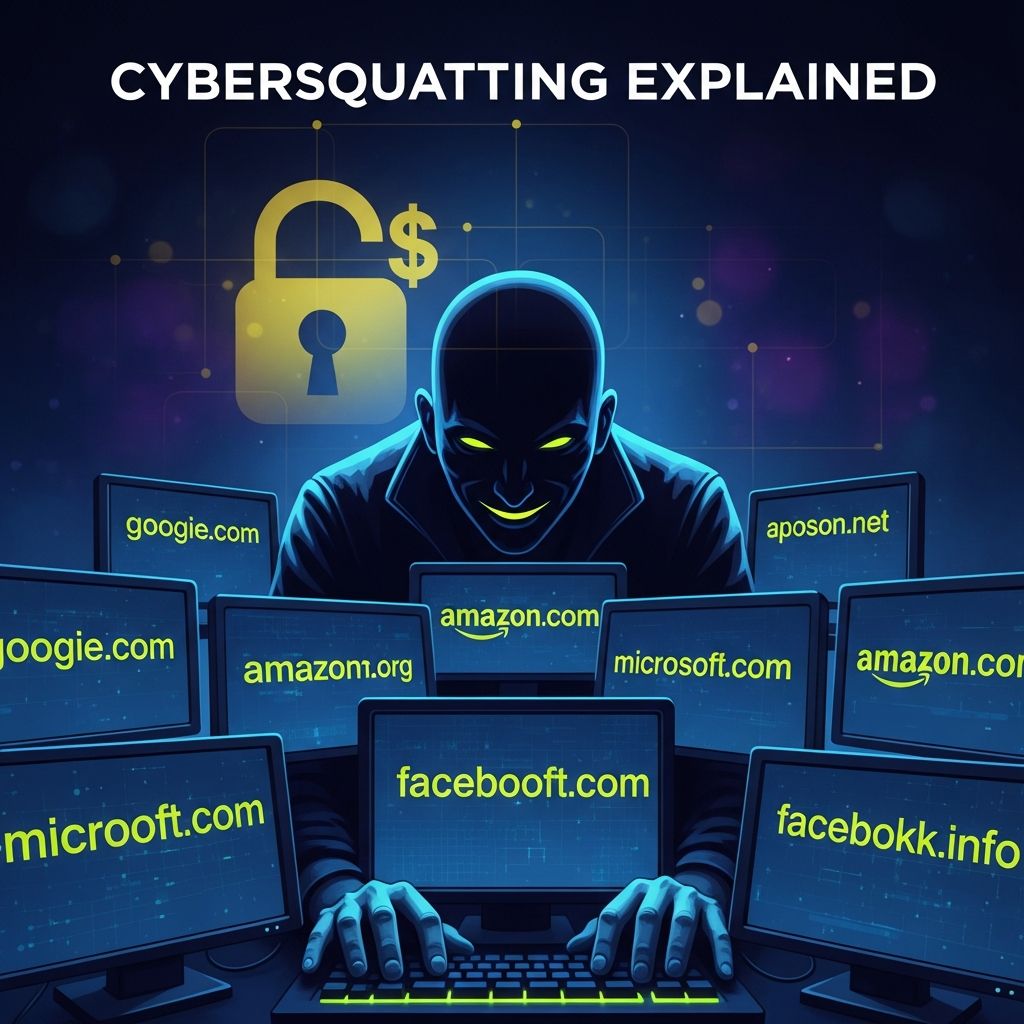
- Typosquatting: This involves registering domains with common misspellings of popular sites, such as ‘g00gle.com’ instead of ‘google.com’. Users who fat-finger their keyboard unwittingly visit these traps, exposing them to malware or phishing.
- Brandjacking: Squatters mimic exact or near-exact brand names, often appending hyphens or numbers, like ‘nike-shoes.com’. These sites peddle counterfeit goods or harvest credentials.
- Domain Tasting: Exploiters register domains briefly during a grace period, test for traffic profitability, then delete if unviable—repeating at scale to avoid costs.
- Subdomain Squatting: Targeting unused subdomains on legitimate sites, e.g., ‘blog.example.com’ controlled by a squatter if not properly secured.
- New TLD Abuse: With expansions like .xyz or .top, squatters flood lesser-known extensions with trademark variants.
These tactics evolve with technology, incorporating AI to predict typos or generate variations en masse.
Why Cybersquatters Target Specific Brands
Squatters prioritize names with high recognition and traffic potential. E-commerce giants, financial institutions, and celebrities are prime targets due to their search volume. For instance, a squatter might grab ‘barackobama.net’ anticipating political interest. Motivations include:
- Resale profits: Demanding thousands from the rightful owner.
- Ad revenue: Parking pages laden with pay-per-click links.
- Malicious redirection: Leading to scam sites or ransomware.
- Competitive sabotage: Diverting rivals’ customers.
Small businesses suffer disproportionately, lacking resources for swift reclamation. A 2022 report noted over 5,500 U.S. cybersquatting lawsuits, up 10% from prior years, signaling rising prevalence.
Real-World Impacts on Businesses and Users
The fallout from cybersquatting extends beyond financial loss. Brands face reputational damage as consumers encounter fake sites, eroding trust. Revenue dips from traffic theft, while legal battles drain resources. Users risk data theft, malware infection, or financial scams.
Consider a mid-sized retailer: A typosquatted domain siphons 5% of traffic, leading to $100,000 in lost sales annually, plus cleanup costs. High-profile cases, like disputes over celebrity domains, amplify media scrutiny, compounding harm.
| Impact Area | Business Effects | User Risks |
|---|---|---|
| Financial | Lost sales, legal fees | Fraud, identity theft |
| Reputational | Brand dilution | Misinformation exposure |
| Operational | Recovery efforts | Malware infection |
Legal Safeguards Against Domain Abuse
Robust laws deter cybersquatting. In the U.S., the Anticybersquatting Consumer Protection Act (ACPA) of 1999 targets bad-faith registrants, allowing trademark owners to sue for damages up to $100,000 per domain. Courts assess factors like intent, trademark similarity, and commercial use.
Globally, ICANN’s Uniform Domain-Name Dispute-Resolution Policy (UDRP) offers a faster, arbitration-based remedy. Complainants prove: (1) domain identical/confusingly similar to trademark, (2) no legitimate interest, (3) bad faith registration/use. Over 80% of UDRP cases favor complainants.
Additional protections include the Digital Millennium Copyright Act (DMCA) for IP overlaps and national laws like the EU’s Trademark Regulation.
Step-by-Step Prevention Blueprint
Proactive measures trump reaction. Implement these strategies:
- Secure Core Domains: Register exact matches, common misspellings, and variants across major TLDs (.com, .net, .org) and new gTLDs.
- Monitor Registrations: Use WHOIS tools and services like MarkMonitor to alert on similar domains.
- Trademark Defensively: Federally register marks for stronger legal standing.
- Leverage DNS Security: Enable DNSSEC to prevent subdomain hijacks; use registrars with anti-abuse policies.
- Educate Users: Promote official URLs via branding and bookmarks.
- Automate Detection: Deploy tools scanning for typosquatting risks.
Businesses should budget for a domain portfolio 5-10x their primary name.
Responding to a Cybersquatting Incident
If victimized, act swiftly:
- Document evidence: Screenshots, traffic data, WHOIS records.
- File UDRP: Typically resolves in 2-3 months, costs $1,500-$5,000.
- Pursue Litigation: For egregious cases under ACPA.
- Contact Registrar: Request voluntary transfer citing policies.
- Issue Cease-and-Desist: Often prompts surrender.
Engage specialized counsel familiar with ICANN proceedings.
Future Trends in Domain Squatting
As Web3 and decentralized domains (e.g., .eth on Ethereum) emerge, cybersquatting adapts. NFT domains face similar risks, with squatters minting trademark-like names on blockchains. AI-driven automation scales attacks, but blockchain transparency may aid recovery. Regulators eye stricter TLD oversight.
Frequently Asked Questions
What counts as bad faith in cybersquatting?
Bad faith includes intent to profit from a trademark without rights, evidenced by offers to sell, fake sites, or pattern of abuses.
Is typosquatting always illegal?
Not if legitimate use (e.g., criticism site), but profit-driven exploitation violates laws.
How much does UDRP cost?
$1,500 per domain for single panelist; scales with panels/complexity.
Can individuals file against squatters?
Yes, celebrities and public figures succeed via personal name trademarks.
What’s the success rate of domain disputes?
UDRP: ~85% transfer to complainant; ACPA varies by evidence.
References
- Anticybersquatting Consumer Protection Act — U.S. Congress. 1999-11-29. https://www.law.cornell.edu/wex/cybersquatting
- Policies & Procedures: Uniform Domain Name Dispute Resolution Policy — ICANN. 2015-12-01 (ongoing updates). https://www.icann.org/resources/pages/help/dndr/udrp-en
- What Is Cybersquatting? Definition & Real Examples — CrowdStrike. 2023-06-15. https://www.crowdstrike.com/en-us/cybersecurity-101/threat-intelligence/cybersquatting-domain-squatting/
- About Cybersquatting — ICANN. 2013-05-03 (authoritative policy reference). https://www.icann.org/resources/pages/cybersquatting-2013-05-03-en
- Cybersquatting — Legal Information Institute, Cornell Law School. Accessed 2026. https://www.law.cornell.edu/wex/cybersquatting
Similar Articles







Read full bio of Sneha Tete