Community Networks Empowering Rural Brazil
Discover how grassroots Internet initiatives are bridging the digital divide and safeguarding vulnerable communities in northern Brazil's remote regions.
In the vast, lush landscapes of northern Brazil, where dense rainforests meet sprawling rivers, countless communities have long been cut off from the digital world. Traditional telecom providers often overlook these remote areas due to high costs and challenging terrain. However, a grassroots revolution is underway: community networks built and managed by locals themselves. These initiatives are not just about providing Internet; they represent a lifeline for education, economic growth, safety, and cultural preservation. By harnessing affordable wireless technologies, these networks are closing the digital gap and fostering resilience in regions plagued by isolation and conflict.
The Digital Desert in Northern Brazil
Northern Brazil, encompassing states like Maranhão, Pará, and Piauí, is home to diverse populations including indigenous tribes and quilombo descendants—Afro-Brazilian communities formed by escaped slaves. According to Brazil’s telecommunications agency Anatel, over 25% of rural households lack reliable Internet, exacerbating inequalities. Without connectivity, residents miss out on online schooling, telemedicine, e-government services, and market access for their agricultural products.
Geographic barriers like the Amazon rainforest and flooding rivers make commercial expansion unviable. Moreover, socio-political issues, including land disputes with agribusiness and illegal logging, heighten vulnerabilities. Communities face threats that demand quick communication for alerts and coordination. Enter community networks: self-sustaining systems where locals install, maintain, and govern their own infrastructure, often using unlicensed spectrum and open-source tools.
Grassroots Tech: Building from the Ground Up
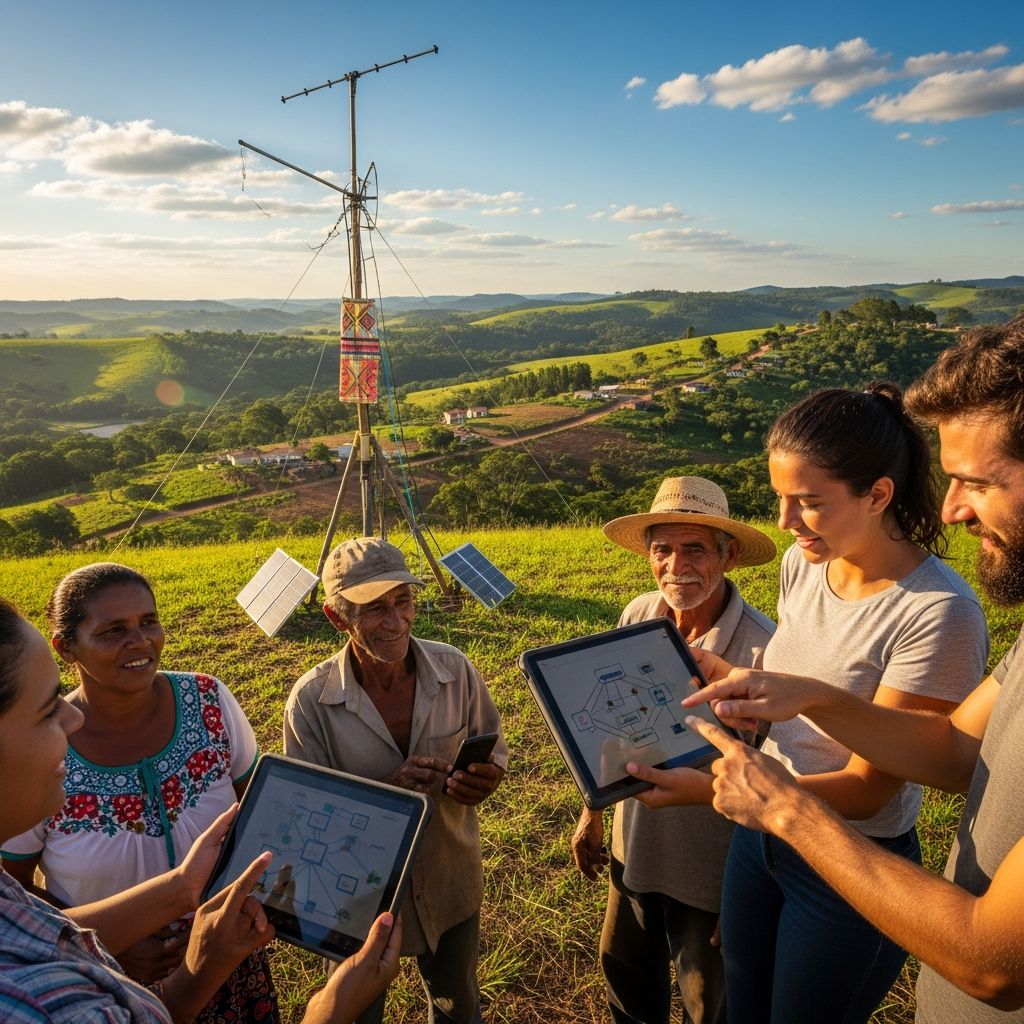
These networks typically start small—a solar-powered router on a hilltop linking a few homes—then scale with community input. Key technologies include long-range Wi-Fi (e.g., 5 GHz bands), mesh topologies for redundancy, and integration with satellite backhaul for broader reach. Training is pivotal; locals learn to troubleshoot via workshops, empowering youth as ‘network guardians.’
- Hardware Basics: Affordable routers like Ubiquiti or MikroTik, paired with directional antennas for 10-20 km links.
- Power Solutions: Solar panels and batteries ensure uptime in off-grid areas.
- Software: OpenWRT for customization, with monitoring dashboards for real-time health checks.
In Maranhão, for instance, projects have equipped six territories with fiber-ready kits, laptops, and servers, training 26 individuals—many youth—in maintenance skills. This hands-on approach builds autonomy, reducing reliance on distant providers.
Safety First: Networks as Shields Against Threats
Beyond connectivity, these networks serve as early-warning systems. In conflict-prone areas, real-time video feeds, group chats, and geofenced alerts notify residents of encroaching dangers. During a 2022 land invasion in Piauí, a community mesh network enabled rapid mobilization, alerting authorities and allies via integrated apps.
Data sovereignty is another boon. Local servers host critical info, shielding against censorship or outages. The ‘Tiwa’ autonomous system, for example, provides resilient hosting, ensuring communities control their digital narrative amid pressures from powerful landowners.
Unlocking Education and Skills Development
Internet access transforms learning. Children in remote quilombos now access Khan Academy, YouTube tutorials, and virtual classrooms, boosting literacy rates. Adults pursue online certifications in agriculture or crafts, enhancing employability.
| Pre-Network | Post-Network |
|---|---|
| Offline textbooks only; travel 50km for school | Daily online classes; 80% attendance rise |
| No digital skills training | 26 trainees certified in networking |
| Limited teacher resources | Cloud-based lesson plans shared regionally |
Youth programs, like those training 14 teens in Santa Joana, create job pipelines in tech support and even network expansion to neighboring villages.
Boosting Economies Through Digital Markets
Farmers once sold crops at exploitative local prices; now, platforms like Mercado Livre connect them directly to buyers, increasing incomes by 30-50%. Artisans market handicrafts globally via Etsy clones, while e-government portals streamline subsidies and licenses.
In Espírito Santinho, a fiber community network—Brazil’s first rural fiber optic setup—cut costs and enabled e-commerce. Partnerships with universities like IFF provided expertise, proving scalable models.
Policy Push: Creating an Enabling Environment
Sustainability hinges on supportive policies. Anatel’s recent spectrum allocations for community use mark progress, but challenges persist: regulatory hurdles, funding gaps, and gender disparities in tech roles. APC’s policy briefs urge inclusive licensing, subsidies for women’s training, and recognition of indigenous rights in telecom laws.
- Streamline registrations for non-profits.
- Subsidize backhaul in remote zones.
- Mandate digital literacy in rural programs.
International backers like Internet Society amplify efforts, funding pilots that influence national strategy.
Challenges and Pathways Forward
Hurdles include equipment vandalism, skill retention (youth migrate to cities), and climate impacts like floods. Solutions? Community cooperatives for shared costs, blockchain for transparent governance, and AI-driven predictive maintenance.
Future visions include 5G mesh hybrids and LEO satellite integration (e.g., Starlink APIs), potentially serving 1 million more rural users by 2030. Scaling requires multi-stakeholder alliances: governments, NGOs, and tech firms.
Real Stories of Transformation
Take Maria from a Maranhão quilombo: “Before, we were invisible. Now, our network shares videos of our struggles, garnering national support.” Or João, a trained technician: “I fix the links and dream of expanding to the next river.” These voices underscore the human impact.
Frequently Asked Questions (FAQs)
What is a community network?
A locally owned and operated Internet system, using wireless tech to connect underserved areas affordably.
How much does it cost to set up?
Initial kits start at $2,000 for 50 users, dropping with scale and solar reuse.
Are they legal in Brazil?
Yes, under Anatel’s community provisions, with simplified licensing.
Can they withstand disasters?
Mesh designs and solar power offer high resilience; Tiwa systems survived 2023 floods.
How to get involved?
Contact Nupef or Internet Society chapters for training and partnerships.
Community networks are more than wires—they weave social fabric, turning isolation into innovation. As Brazil’s rural heartlands connect, they herald a digitally inclusive future.
References
- From Isolation to Innovation: how Internet access is empowering indigenous and quilombo communities in northern Brazil — Internet Society Foundation. 2023. https://www.isocfoundation.org/story/from-isolation-to-innovation-how-internet-access-is-empowering-indigenous-and-quilombo-communities-northern-brazil/
- Policy brief and recommendations for an enabling environment for community networks in Brazil — Association for Progressive Communications (APC). 2022. https://www.apc.org/en/pubs/policy-brief-and-recommendations-enabling-environment-community-networks-brazil
- How the Espírito Santinho Community Created Brazil’s First Fiber Community Network — Internet Society. 2023-03-01. https://www.internetsociety.org/blog/2023/03/how-the-espirito-santinho-community-created-brazils-first-fiber-community-network/
- Community Networks as Enablers of Human Rights — FGV Direito Rio. 2023. https://direitorio.fgv.br/conhecimento/community-networks-enablers-human-rights
- Poverty profile: the rural North and Northeast regions of Brazil — Instituto de Pesquisa Econômica Aplicada (IPEA). 2019. https://repositorio.ipea.gov.br/bitstreams/4600893c-0591-46b7-9db5-eb2838af8e06/download
Similar Articles








Read full bio of medha deb