CDN vs Cloud Computing: Key Differences
Discover how Content Delivery Networks outperform cloud platforms in speed while clouds excel in scalable computing power.
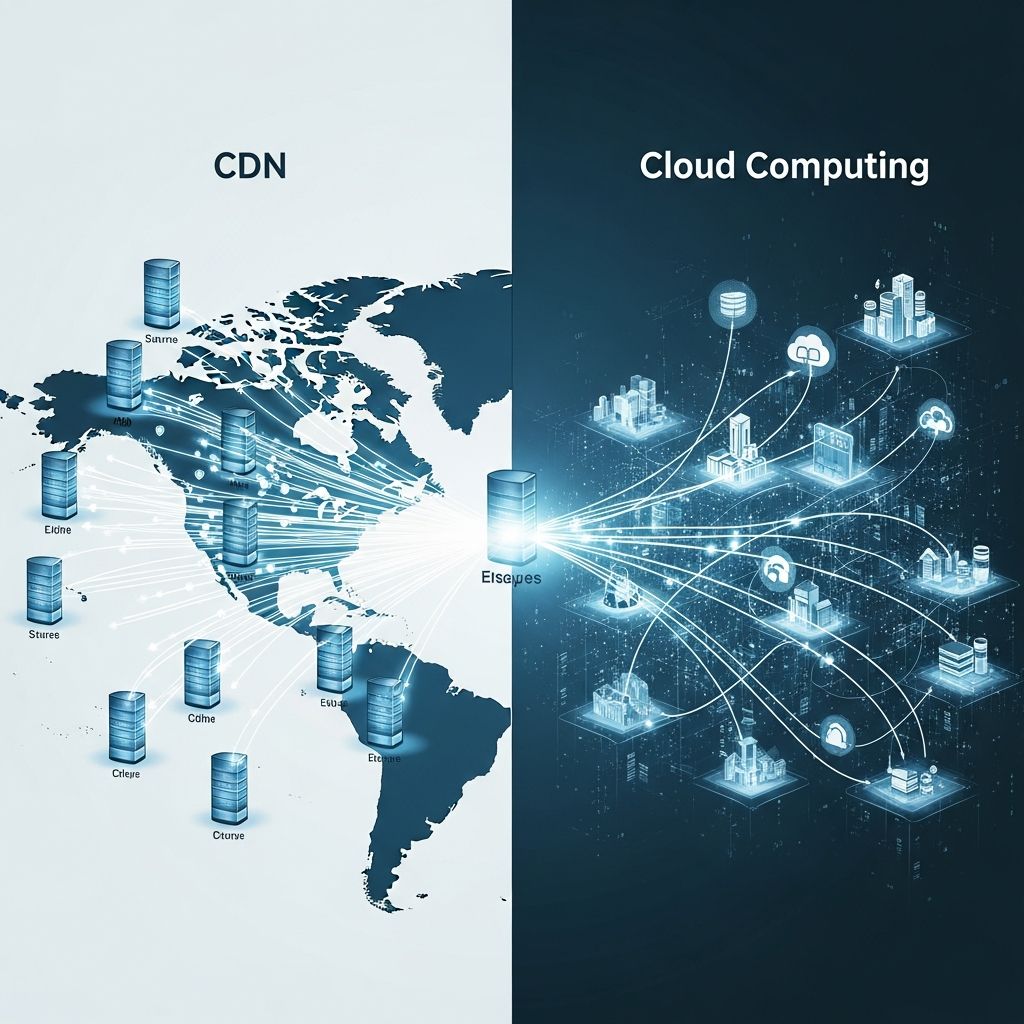
In the fast-paced digital landscape, businesses rely on robust technologies to deliver content and services efficiently. Two prominent solutions often stand out: Content Delivery Networks (CDNs) and cloud computing platforms. While both leverage distributed systems to enhance performance, they address fundamentally different needs. CDNs prioritize lightning-fast content distribution to global users, whereas cloud computing focuses on providing elastic, on-demand resources for running applications and storing data. This article delves deep into their functionalities, advantages, limitations, and synergistic potential, helping you decide which—or both—to deploy for your operations.
Understanding Content Delivery Networks
A Content Delivery Network is a geographically dispersed group of servers designed to deliver web content, such as images, videos, scripts, and HTML pages, to users with minimal delay. By caching copies of static assets at edge locations worldwide, CDNs ensure that data travels the shortest possible distance to the end-user.
The architecture of a CDN involves an origin server, where original content resides, and numerous edge servers or points of presence (PoPs). When a user requests content, the CDN’s intelligent routing—often powered by DNS resolution—directs the request to the nearest edge node. If the content is cached there, it’s served instantly; otherwise, it’s fetched from the origin and stored for future requests. This caching mechanism drastically cuts latency and bandwidth costs.
- Global Reach: With PoPs in hundreds of cities, CDNs serve users from locations closest to them.
- Traffic Offloading: Reduces load on primary servers, preventing bottlenecks during peaks.
- Security Features: Many CDNs include DDoS protection, WAF (Web Application Firewall), and SSL/TLS encryption.
CDNs shine in scenarios like streaming services, e-commerce sites, and news portals where static content dominates and user experience hinges on speed. For instance, video platforms use CDNs to buffer high-definition streams seamlessly across continents.
Demystifying Cloud Computing Platforms
Cloud computing represents a paradigm shift from traditional on-premises infrastructure to virtualized resources delivered over the internet. Providers like AWS, Google Cloud, and Azure offer Infrastructure as a Service (IaaS), Platform as a Service (PaaS), and Software as a Service (SaaS) models, enabling businesses to rent computing power, storage, and databases on a pay-as-you-go basis.
At its core, cloud computing emphasizes scalability, elasticity, and accessibility. Virtual machines (VMs), containers, and serverless functions can be spun up or down instantly to match demand. Data centers are clustered in regions, with replication across availability zones for high reliability. Unlike CDNs, clouds handle dynamic workloads, including compute-intensive tasks like machine learning training or database queries.
| Cloud Service Model | Description | Use Case |
|---|---|---|
| IaaS | Virtual servers, storage, networking | Custom app hosting |
| PaaS | Runtime environment, middleware | App development |
| SaaS | Ready-to-use applications | CRM, email services |
Clouds excel in flexibility, allowing developers to focus on code rather than hardware management. They support hybrid setups, integrating private and public clouds for compliance-sensitive industries.
Core Distinctions: CDN vs Cloud Computing
Though both technologies distribute resources geographically, their objectives diverge sharply. CDNs are laser-focused on delivery optimization, accelerating static content via proximity and caching. Cloud computing prioritizes compute and storage elasticity, powering full-stack applications with dynamic processing.
Consider latency: CDNs minimize it to milliseconds by serving from edges, ideal for real-time interactions. Clouds, while improving access through regional deployments, incur higher latency for global users due to centralized processing in fewer, larger data centers. Bandwidth efficiency also differs—CDNs compress and optimize files en route, conserving costs for high-volume traffic.
- Purpose: CDN for content speed; Cloud for app scalability.
- Content Type: CDN handles static (videos, images); Cloud manages dynamic (APIs, databases).
- Cost Structure: CDNs charge per GB delivered; Clouds bill for compute hours/storage.
Geographically, CDNs boast thousands of edge nodes versus clouds’ dozens of regions. This makes CDNs superior for worldwide audiences but less suited for heavy computation, where clouds dominate with GPU clusters and AI accelerators.
Performance and Scalability Compared
Performance metrics reveal stark contrasts. CDNs achieve sub-100ms response times globally through edge caching and protocols like HTTP/3 with QUIC. Clouds scale vertically (bigger instances) or horizontally (more instances) via auto-scaling groups, handling millions of requests per second but with variable latency based on region.
In benchmarks, a CDN can reduce page load times by 50-70% for static-heavy sites. Clouds shine in bursty workloads, auto-scaling during Black Friday sales without upfront provisioning. Reliability-wise, CDNs offer 99.99% uptime via anycast routing, while clouds provide SLAs backed by multi-zone redundancy.
Scalability challenges: CDNs effortlessly absorb traffic spikes via infinite edge capacity, but cache invalidation for dynamic updates requires careful TTL management. Clouds demand orchestration tools like Kubernetes for containerized apps, introducing complexity.
When to Choose CDN, Cloud, or Both
Selection depends on your stack. Opt for CDN if your site is content-rich—media sites, blogs, or SaaS frontends. Pure cloud suits compute-bound apps like analytics platforms or enterprise software. Most modern architectures blend them: Host dynamic logic in the cloud, front it with a CDN for static assets.
Hybrid benefits include cost savings (offload 80% traffic to CDN), enhanced security (CDN as first defense), and developer velocity (cloud for backends, CDN for delivery). Streaming giants like Netflix use cloud for encoding/transcoding and CDN for playback.
Real-World Implementations and Case Studies
E-commerce leader Shopify integrates Cloudflare CDN with Google Cloud, slashing load times by 40% and boosting conversions. Gaming firms leverage AWS with Akamai CDN for low-latency multiplayer experiences. These integrations demonstrate how CDNs extend cloud reach without replacing core infrastructure.
Challenges in integration: Ensure cache keys align with app logic, monitor purge latencies, and configure origin shielding to prevent origin overloads.
Future Trends: Convergence with Edge
CDNs evolve into edge computing platforms, running serverless functions at the edge (e.g., Cloudflare Workers). Clouds push ‘edge zones’ closer to users. This blurs lines, promising serverless at true edge latency—under 10ms worldwide.
5G and IoT amplify demand, with CDNs handling massive sensor data feeds and clouds processing analytics.
Frequently Asked Questions
What is the main advantage of a CDN over cloud computing?
CDNs provide superior global latency reduction through edge caching, ideal for content delivery.
Can I use a CDN without cloud hosting?
Yes, pair CDNs with traditional hosting for static acceleration.
Are CDNs more expensive than clouds?
Not always—CDNs save bandwidth costs; compare based on traffic volume.
How do CDNs improve SEO?
Faster load times boost Core Web Vitals, improving search rankings.
What’s the role of CDNs in security?
They mitigate DDoS, bot attacks, and enforce HTTPS globally.
References
- What is a content delivery network (CDN)? — Cloudflare. 2025-03-15. https://www.cloudflare.com/learning/cdn/what-is-a-cdn/
- Cloud Computing Definition — National Institute of Standards and Technology (NIST). 2011-09-01 (authoritative standard, remains foundational). https://nvlpubs.nist.gov/nistpubs/Legacy/SP/nistspecialpublication800-145.pdf
- State of the CDN Industry — Forrester Research. 2025-01-22. https://www.forrester.com/report/The-State-Of-The-CDN-Industry-2025/RES180123
- AWS Global Infrastructure — Amazon Web Services. 2026-04-10. https://aws.amazon.com/about-aws/global-infrastructure/
- Edge Computing vs. CDN — Akamai Technologies. 2025-06-05. https://www.akamai.com/blog/edge/edge-computing-vs-cdn
Similar Articles








Read full bio of Sneha Tete