Beyond Earth: Building Networks for Space Exploration
Discover how delay-tolerant networking enables communication across the solar system
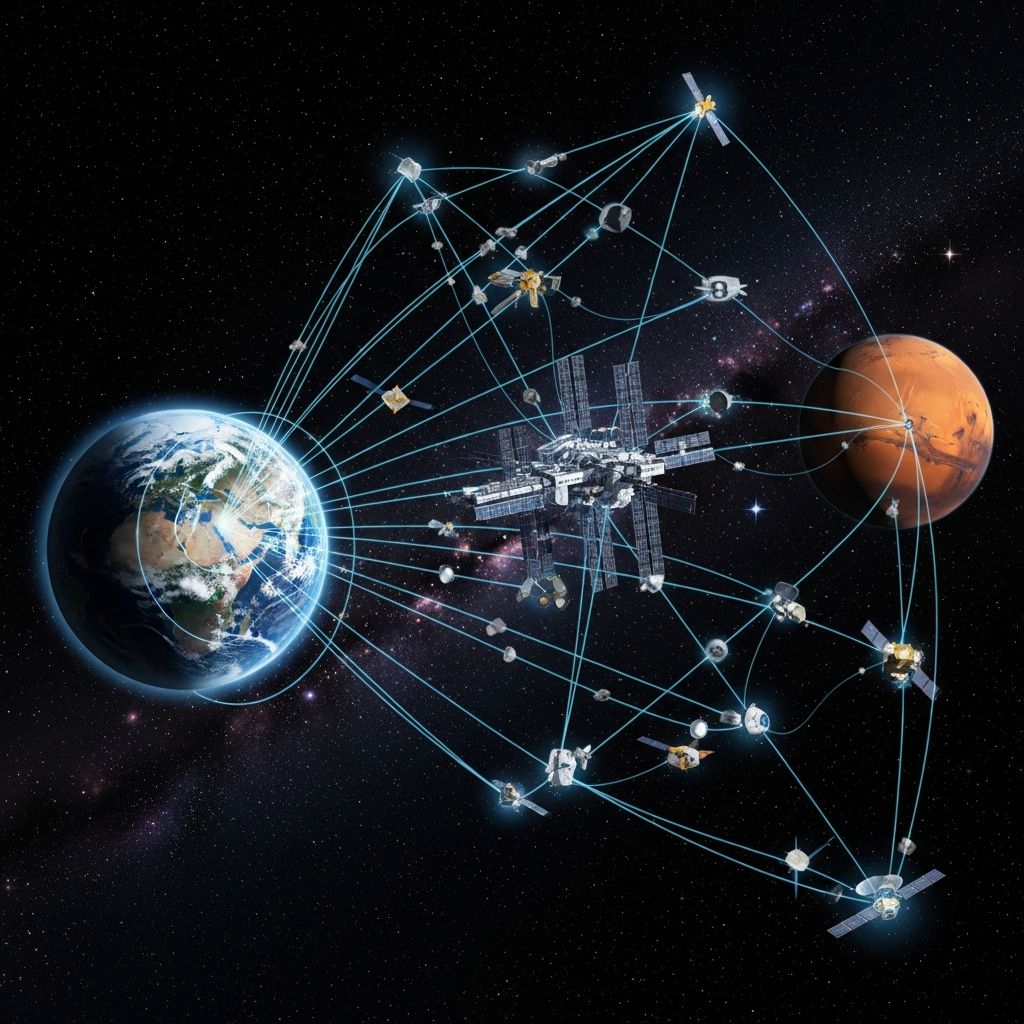
The exploration of space has long been constrained by communication limitations that traditional Earth-based networking protocols cannot overcome. As humanity expands its presence beyond our planet—establishing lunar bases, sending robotic explorers to distant worlds, and planning crewed missions to Mars—the need for reliable, scalable communication infrastructure becomes increasingly critical. Recent technological developments in network architecture are making what once seemed like science fiction a tangible reality, fundamentally transforming how we transmit data across the vast distances of our solar system.
The Challenge of Cosmic Communication
Traditional Internet protocols, designed for continuous connectivity across terrestrial networks, fail when applied to space environments. The fundamental obstacles facing interplanetary communications are multifaceted and severe. Light-time delays spanning from minutes to hours make real-time two-way conversations impossible. When a command is sent to a Mars rover, scientists must wait anywhere from three to twenty minutes for confirmation that the message arrived. Additionally, planetary orbits create periods of disconnection lasting weeks or months when celestial bodies move into positions that block direct signal transmission. Power constraints on spacecraft, limited bandwidth in deep space, and the unpredictability of space weather introduce further complications that Earth-bound networks rarely encounter.
These challenges necessitate a fundamentally different approach to network design. Rather than relying on continuous connections and immediate acknowledgment of data transmission, space networks must employ intelligent storage and forwarding mechanisms that can tolerate extended periods of disconnection and adapt to the unique constraints of the cosmic environment.
Pioneering a New Network Architecture
Recognizing these barriers, space agencies and technology researchers developed an innovative networking paradigm specifically engineered for conditions where traditional connectivity assumptions break down. This approach, known as Delay and Disruption Tolerant Networking (DTN), represents a fundamental reimagining of how data moves through a network. Unlike conventional systems that discard failed transmissions, DTN bundles data into discrete packages that can be stored at intermediate nodes, held in memory or on disk, until a viable transmission path becomes available to the next destination or the final recipient.
The architecture operates on a store-and-forward principle where each node in the network acts as both a receiver and a temporary custodian of information. When connectivity is disrupted or unavailable, data remains securely stored. As soon as communication channels reopen, accumulated bundles begin transmitting, ensuring no information is lost to disconnection. This approach dramatically increases reliability in environments where disruption is not an exception but rather an expected characteristic of normal operation.
Core Components of Interplanetary Network Systems
Building functional space networks requires several interdependent technological elements working in concert:
- Bundle Protocol Layer: This specialized protocol operates above the traditional transport layer, handling the creation, management, and routing of data bundles across heterogeneous network segments
- Custody Transfer Mechanisms: Systems that manage responsibility for data as it moves from one node to another, ensuring accountability and reliable delivery
- Deep Space Backbone Infrastructure: Long-haul wireless communication links forming the primary network arterial system connecting major space stations and command centers
- Regional Network Nodes: Distributed Internet-like systems at various locations throughout the solar system, each maintaining local connectivity while connecting to the broader backbone
- Data Relay Satellites: Space-based systems that extend communication reach and provide redundancy across vast interplanetary distances
Practical Implementation and Real-World Testing
The theoretical foundations of interplanetary networking have transitioned from concept to practical deployment through systematic testing and incremental implementation. Space agencies worldwide are actively experimenting with these technologies on current missions, refining protocols and identifying optimization opportunities. The protocols being developed follow established Internet standards where feasible, ensuring compatibility and leveraging decades of terrestrial networking expertise. However, they introduce specialized mechanisms specifically addressing the unique demands of space environments.
Early implementations utilize custodial file-delivery protocols based on established space communication standards, progressively scaling capabilities to support increasingly sophisticated user services. This measured approach allows researchers to validate technologies in operational environments before expanding their scope and complexity. As missions to Mars accumulate in coming years, each will contribute real-world data about network performance, enabling continuous improvement of the system architecture.
Applications Driving Network Development
Multiple compelling use cases motivate investment in reliable interplanetary communication infrastructure. Scientific missions benefit tremendously from systems capable of transmitting vast quantities of sensor data reliably across solar-system distances. Robotic exploration systems operating with degrees of autonomy require networks that can handle extended disconnection periods and variable connectivity. Future human missions to the Moon and Mars will demand communication systems supporting both scientific operations and crew safety systems. Commercial space ventures increasingly require dependable infrastructure for maintaining operations across multiple orbital and interplanetary locations.
Scientific Exploration
Research missions generate enormous volumes of data that must be reliably transmitted to Earth. Instruments studying planetary atmospheres, subsurface geology, astronomical phenomena, and countless other scientific questions produce information streams that often exceed available transmission bandwidth. Networks designed with store-and-forward capabilities can accumulate observations and transmit them during optimal communication windows, ensuring no valuable data is lost.
Human Spaceflight Operations
Astronauts living and working beyond Earth require communication systems that prioritize safety and mission-critical operations. A reliable network architecture can manage simultaneous transmission of voice communications, telemetry, environmental data, and multimedia content without requiring continuous high-bandwidth connections. During emergencies, systems can prioritize critical safety information while storing routine operational data for transmission when circumstances permit.
Commercial Space Infrastructure
As private companies establish space stations, operate lunar facilities, and develop Mars resources, they require communication systems that reduce operational costs while maintaining data integrity. Commercial operators benefit from standardized protocols that decrease dependence on custom equipment and enable interoperability with government agencies and international partners.
Network Architecture and Interconnection Strategy
The envisioned interplanetary Internet architecture departs significantly from traditional terrestrial models. Rather than a centralized network, it consists of distributed regional Internets, each maintaining autonomy while connecting through specialized high-capacity backbone links. Each region—whether centered on Earth, lunar orbit, Mars, or other locations—operates as a semi-independent network following local Internet protocols and standards. These regional systems then interconnect through long-haul wireless communication channels forming the backbone that unites the solar system network.
This hierarchical federation approach offers multiple advantages. Regional networks can optimize their operations for local conditions and user requirements. The backbone can evolve to incorporate additional relay satellites and communication nodes as infrastructure expands. The architecture accommodates international participation, enabling space agencies and commercial operators from different nations to contribute infrastructure while maintaining interoperability. Future expansion to accommodate new destinations, whether new planetary missions or asteroid mining operations, can proceed without requiring complete system redesign.
Technology Transfer and Terrestrial Applications
While developed specifically for space applications, interplanetary networking technologies demonstrate relevance for solving communication challenges in terrestrial environments lacking reliable connectivity. Mobile networks in areas with inconsistent coverage can benefit from store-and-forward approaches similar to those used in space. Emergency response systems operating in disaster zones where infrastructure is damaged require communication systems that function despite disconnections. Remote research stations in extreme environments can employ similar network designs to maintain operational connectivity despite environmental disruption.
This technology transfer creates opportunities for commercial development and expanded research investment. Companies and organizations developing solutions for space communications can apply their expertise to terrestrial markets, creating business opportunities while advancing overall network science. Educational institutions gain access to sophisticated networking problems and emerging technologies, attracting talented researchers and developing expertise that serves multiple sectors.
Future Development and Scaling Challenges
As interplanetary exploration expands, network infrastructure must scale to accommodate increasing traffic volumes and growing numbers of participants. Future challenges include managing increasingly complex routing decisions as more nodes join the network, developing security mechanisms appropriate for space environments, optimizing transmission schedules to maximize throughput given unpredictable connectivity windows, and establishing governance structures enabling international coordination without compromising operational efficiency.
The planned expansion of human presence in space will drive network development in coming decades. Lunar bases will require reliable communication with Earth and with spacecraft transiting between Earth and Moon. Mars missions will need infrastructure supporting communication across interplanetary distances while maintaining enough bandwidth for scientific operations and human safety systems. Potential expansion to asteroid mining, establishment of space tourism infrastructure, and other commercial activities will add further complexity and opportunities for network optimization.
Comparing Network Approaches
| Characteristic | Traditional Internet Protocols | Delay-Tolerant Networking |
|---|---|---|
| Connection Requirement | Continuous connectivity assumed | Tolerates extended disconnections |
| Data Handling on Failure | Data discarded if transmission fails | Data stored and retransmitted later |
| Latency Tolerance | Optimized for minimal delay | Designed to handle minutes-to-hours delays |
| Bandwidth Efficiency | Real-time streaming assumed | Batch transmission during optimal windows |
| Ideal Environment | Dense, well-connected networks | Sparse networks with intermittent connectivity |
Frequently Asked Questions
How does bundle protocol technology work?
Bundle protocol technology treats data as discrete packages or “bundles” rather than continuous streams. Each bundle can be independently routed and stored. Intermediate nodes examine bundle metadata to determine forwarding decisions, maintaining custody of bundles until successful delivery to the next node. If a complete file is split into multiple bundles, the receiving system reassembles them once all bundles arrive, recovering the original data even if bundles traverse different routes or arrive out of sequence.
What latency should be expected in interplanetary communications?
Latency depends on planetary positions and transmission distances. Earth-to-Moon communication involves roughly 1.3-second light-time delay. Mars communication ranges from 3 minutes to over 20 minutes one-way, depending on orbital positions. Beyond Mars, delays increase further. These delays are physical constraints determined by the speed of light and cannot be overcome through better technology, making real-time interaction impossible and requiring systems designed around asynchronous communication patterns.
How does interplanetary networking improve data reliability?
By storing data at intermediate nodes until transmission paths open, DTN systems eliminate data loss from disconnection events. Traditional systems discard failed transmissions, requiring retransmission requests across interplanetary distances, creating long delays. DTN systems maintain custody of data automatically, transparently handling retransmission without intervention, dramatically improving reliability in environments where disconnection is frequent and expected.
What role do commercial companies play in this technology?
Commercial companies are increasingly developing DTN-based platforms specifically designed for space operations. These commercial solutions leverage government space agency research while creating products optimized for commercial space ventures. By establishing commercial markets for interplanetary networking technology, these companies accelerate development and reduce costs through competition and innovation.
When will the interplanetary Internet be fully operational?
Interplanetary networks are already partially operational, with DTN technology being tested and deployed on current NASA missions. Full interoperability across diverse space missions and international partners will develop gradually through the 2020s and beyond as more systems adopt standardized protocols. Ambitious timelines aim to have functional networks supporting lunar operations within the next several years, with Mars-capable infrastructure following as human missions to the red planet accelerate.
Conclusion: Connecting Our Solar System
The development of delay-tolerant networking and interplanetary Internet infrastructure represents a fundamental advance in space technology, enabling reliable communication across vast cosmic distances. By moving beyond traditional Internet assumptions of continuous connectivity, these systems embrace the realities of space environments while leveraging proven networking principles. As humanity expands its presence throughout the solar system, these networks will form the digital backbone enabling scientific discovery, supporting human exploration, and facilitating commercial activities across multiple worlds. The convergence of government space agencies, international partners, and commercial enterprises working toward shared networking standards promises an unprecedented era of space exploration and utilization.
References
- The Interplanetary Internet — Communications of the ACM, Association for Computing Machinery. Accessed May 2026. https://cacm.acm.org/research/the-interplanetary-internet/
- Enabling the Interplanetary Internet — Johns Hopkins University Applied Physics Laboratory Technical Digest. Accessed May 2026. https://secwww.jhuapl.edu/techdigest/content/techdigest/pdf/V30-N02/30-02-Krupiarz.pdf
- Interplanetary Internet: Sending Data Across the Solar System — ISS National Lab. Accessed May 2026. https://issnationallab.org/upward/8-2-interplanetary-internet-cerf/
- Future-Proofing the Interplanetary Internet — NASA. YouTube. Accessed May 2026. https://www.youtube.com/watch?v=GM9v2RVuoGU
- Moving Forward to an Internet That’s Interplanetary in Scope and Function — Internet Society. January 2019. https://www.internetsociety.org/blog/2019/01/moving-forward-to-an-internet-thats-interplanetary-in-scope-and-function/
Similar Articles








Read full bio of medha deb