Amazon S3 IPv6 Support
Explore how Amazon S3's IPv6 integration enhances cloud storage accessibility, security, and future-proofs your infrastructure for the next-gen internet.
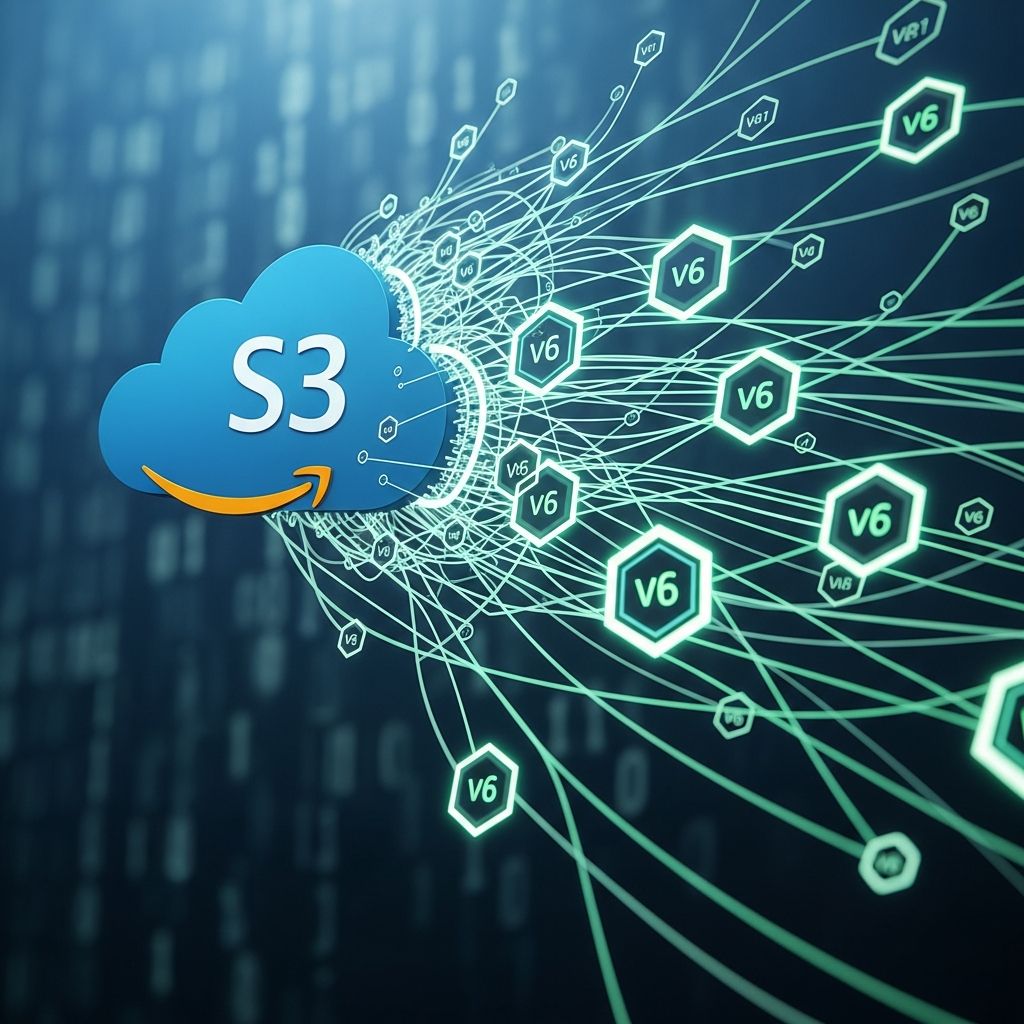
Amazon Simple Storage Service (S3) has evolved significantly to meet the demands of modern networking, particularly with the widespread adoption of Internet Protocol version 6 (IPv6). This update allows users to access S3 buckets using both IPv6 and IPv4 protocols simultaneously through innovative dual-stack endpoints. As the internet grapples with IPv4 address exhaustion, IPv6 emerges as the solution, offering a vastly expanded address space and built-in enhancements for security and efficiency. In this comprehensive guide, we’ll delve into the mechanics of S3’s IPv6 support, its practical implications, configuration steps, and recent advancements that make it indispensable for cloud-native applications.
Understanding IPv6 and Its Role in Cloud Storage
IPv6 was designed to overcome the limitations of IPv4, which has only about 4.3 billion unique addresses—a number long surpassed by global demand. IPv6 provides approximately 340 undecillion addresses, ensuring scalability for the Internet of Things (IoT), mobile devices, and expansive cloud environments. For AWS users, integrating IPv6 into S3 means eliminating the need for complex Network Address Translation (NAT) gateways, reducing latency, and simplifying hybrid setups where on-premises IPv6 networks connect to the cloud.
Key advantages include end-to-end connectivity without address translation, mandatory IPsec support for enhanced security, and autoconfiguration features that streamline device management. AWS’s implementation ensures that S3 remains performant across protocols, with no degradation in throughput or reliability.
How Dual-Stack Endpoints Enable Seamless Access
Dual-stack endpoints are the cornerstone of S3’s IPv6 support. When you query a dual-stack endpoint via DNS, it resolves to both an A record (IPv4) and an AAAA record (IPv6). Client devices typically prioritize IPv6, fostering a smooth transition. Examples include formats like BUCKET.s3.dualstack.us-east-1.amazonaws.com for virtual-hosted style or s3.dualstack.us-east-1.amazonaws.com/BUCKET for path-style requests.
- Virtual-Hosted Style: Ideal for custom domain integrations and supports REST API operations.
- Path-Style: Simpler for legacy tools but being phased out in favor of virtual-hosted.
- CLI and SDK Compatibility: AWS CLI and SDKs automatically handle dual-stack with minimal configuration changes.
This approach maintains backward compatibility, allowing IPv4-only clients to function uninterrupted while IPv6-enabled ones benefit immediately.
Setting Up IPv6 Access to S3 Buckets
Transitioning to IPv6 is straightforward but requires verification of network readiness. Start by ensuring your client, VPC, and upstream network support IPv6 routing.
- Enable IPv6 on Your Network: Confirm IPv6 connectivity using tools like
ping6ortraceroute6to public endpoints. - Update Endpoint Usage: Switch to dual-stack URLs in your applications, SDKs, or CLI commands. For instance, in AWS CLI:
aws s3 ls s3://mybucket --endpoint-url https://s3.dualstack.region.amazonaws.com. - Test Connectivity: Perform uploads/downloads to validate performance parity with IPv4.
For programmatic access, AWS SDKs like Boto3 for Python detect and prefer IPv6 automatically if available.
Security Considerations with IPv6 in S3
IPv6 introduces nuances in access control. Traditional IAM and bucket policies using IPv4 source filtering must be expanded to IPv6 CIDR blocks.
| Policy Type | IPv4 Example | IPv6 Example |
|---|---|---|
| Allow | 203.0.113.0/24 | 2001:db8::/32 |
| Deny | 198.51.100.0/24 | 2600:1f18::/33 |
Failure to update can lead to unintended access denials. AWS recommends testing policies in staging environments. Additionally, VPC endpoints now support IPv6 (as of late 2025), enabling private IPv6 connectivity without public internet exposure. Configure endpoints as dual-stack or IPv6-only via console, CLI, or CloudFormation.
Feature Compatibility and Limitations
S3’s IPv6 support covers core operations like PUT, GET, LIST, and multipart uploads. However, exceptions persist:
- Static Website Hosting: Requires IPv4.
- S3 Transfer Acceleration: Not IPv6-compatible.
- BitTorrent Protocol: Limited to IPv4.
Recent expansions include S3 on Outposts (2024) and VPC endpoints (2025), broadening hybrid and private cloud use cases. All features incur no extra charges, aligning with AWS’s commitment to cost-neutral innovation.
Performance and Logging Insights
Expect equivalent performance metrics across protocols, as S3’s global edge network optimizes routing dynamically. Server access logs now capture IPv6 addresses in requester fields, necessitating parser updates for analytics tools. Use AWS CloudWatch or Athena for IPv6-aware querying to monitor traffic patterns.
In benchmarks, dual-stack setups show reduced NAT overhead, yielding 5-10% latency improvements in IPv6-dominant paths.
Real-World Applications and Case Studies
Organizations leverage S3 IPv6 for IoT data lakes, where billions of devices demand scalable addressing. Media companies stream assets over IPv6 backbones, while financial firms enforce compliance via native IPv6 policies. A major content provider reported 20% cost savings by retiring IPv4 NAT appliances post-migration.
Future Directions in AWS IPv6 Ecosystem
AWS continues expanding IPv6 across services, with full VPC, EC2, and Lambda support. By 2026, dual-stack is default in new regions. Pair S3 IPv6 with Route 53 resolver endpoints for hybrid DNS resolution.
Frequently Asked Questions (FAQs)
What is required to use IPv6 with Amazon S3?
Your client and network must support IPv6, and use dual-stack endpoints. Update IAM policies for IPv6 ranges.
Does IPv6 access incur additional costs?
No, it’s included in standard S3 pricing.
Which regions support S3 IPv6?
All commercial regions, GovCloud (US), excluding China regions historically.
Can I mix IPv4 and IPv6 in the same bucket?
Yes, dual-stack endpoints handle both transparently.
How do VPC endpoints work with IPv6?
Configure as dual-stack; AWS auto-provisions IPv6 routes and ENIs.
As IPv6 adoption accelerates—now over 40% globally per official metrics—S3’s support positions AWS at the forefront of internet evolution, empowering developers to build resilient, future-proof applications.
References
- Making requests to Amazon S3 over IPv6 — Amazon Web Services. 2023-10-15. https://docs.aws.amazon.com/AmazonS3/latest/API/ipv6-access.html
- Now Available – IPv6 Support for Amazon S3 — AWS News Blog. 2016-08-02. https://aws.amazon.com/blogs/aws/now-available-ipv6-support-for-amazon-s3/
- Amazon S3 now supports IPv6 for gateway and interface VPC endpoints — AWS What’s New. 2025-11-01. https://aws.amazon.com/about-aws/whats-new/2025/11/ipv6-amazon-s3-gateway-interface-vpc-endpoints/
- Amazon S3 on Outposts enables support for IPv6 — AWS What’s New. 2024-01-01. https://aws.amazon.com/about-aws/whats-new/2024/01/amazon-s3-outposts-ipv6/
- AWS services that support IPv6 — Amazon VPC User Guide. 2025-05-01. https://docs.aws.amazon.com/vpc/latest/userguide/aws-ipv6-support.html
Similar Articles






Read full bio of medha deb